
Moonbeam

Moonbeam

Home Forums Sailing Models Moonbeam

  • This topic is empty.
Viewing 25 posts - 151 through 175 (of 440 total)
  • Author
    Posts
  • #67274
    Bob Abell 2
    Participant
      @bobabell2

      Hi Banjo

      You are doing a very well, no nonesense, well organised job!

      The veneer looks very stable……..ie…..Straight and true

      I suspect you've made a few violins in the past?

      The Purfling will be a challenge shortly

      Bob

      #67275
      Banjoman
      Participant
        @banjoman

        Hello Bob,

        Warmest thanks for your kind words! But no: I have never built any violins, nor any other musical instruments, with the exception of a rather hapless attempt when I was 15 of making a banjo from a tambourine and and old electric guitar neck. My skills at the time left quite a few things to be desired, though, and although I tried to reinforce the neck joint with an L-bracket of the type used to mount shelves, the thing was very wobbly indeed, and stayed in tune for a few seconds at the most … Oh dear. But I was young, penniless and desperate to play the banjo …

        As for the planking material, yes, it is absolutely first-rate stuff! Although I have found a few lengths in the bunch that had been ripped across a knot in the wood, and thus were not quite straight across the full length of the piece, the vast majority are straight as arrows, and ripped and sanded to very exact dimensions. I have made a few spot checks of variations in the width, and every strip thus tested was of an even width to within a tolerance of 0.05 mm or about two thousandths of an inch. Also, most strips have been completely free of blemishes, and the wood is both beautiful and very agreeable to work with. Of course it wasn't exactly given away, but it's been worth every penny, and based on this experience I can heartily recommend the company from which I bought it, The Wood Rack in Norfolk (http://www.thewoodrack.co.uk/ ).

        Mattias


        Edited By Banjoman on 23/08/2016 09:11:35

        Edited By Banjoman on 23/08/2016 09:12:14

        Edited By Banjoman on 23/08/2016 09:12:51

        #67292
        Banjoman
        Participant
          @banjoman

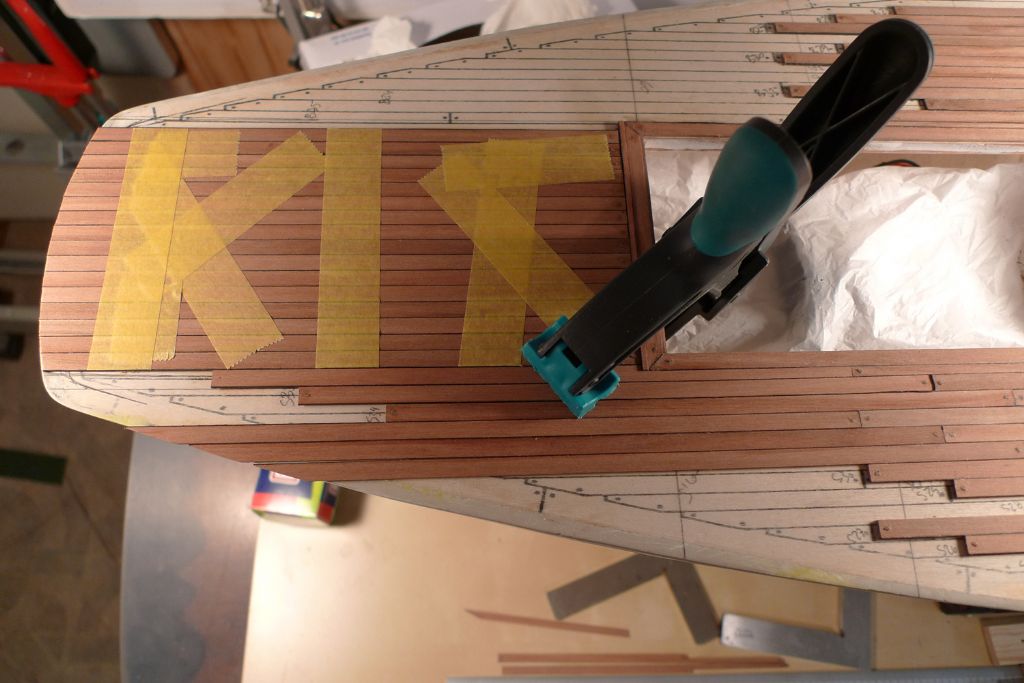
          So … second attempt at rebating the corner planks! And this time I managed to get the starboard one pretty much just so — it lays neatly along the desired pencile line on the underdeck.

          mbbygg448.jpg

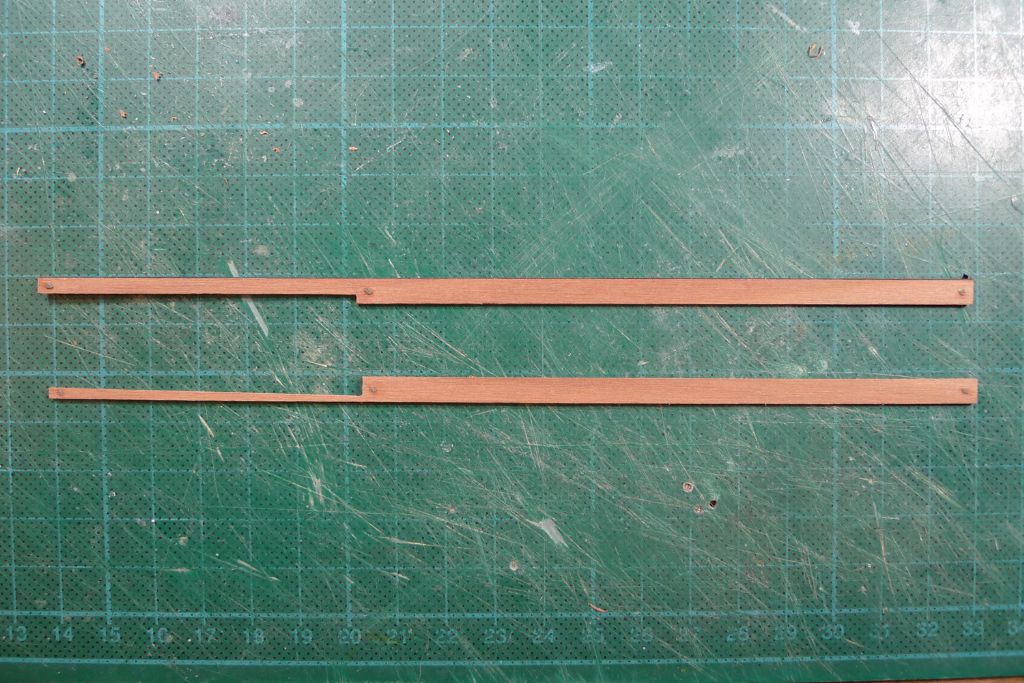
          The below photo of the two rebated planks, port (below) and starboard (above), shows the difference needed to subtly set the whole afterdeck planking off on a very mild tangent …

          mbbygg449.jpg

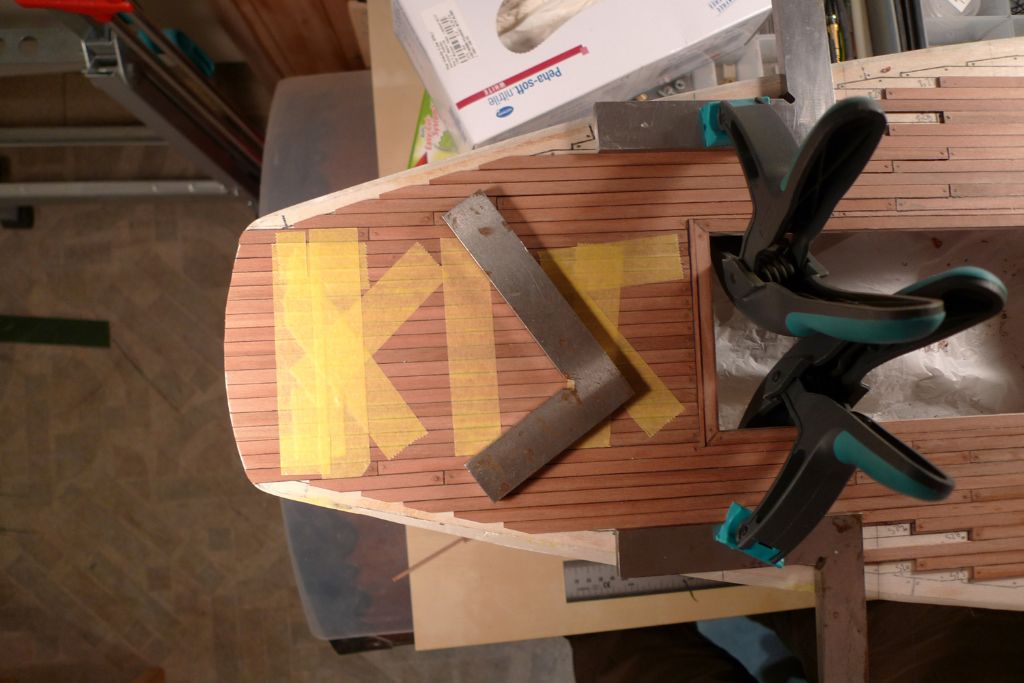
          … like so! As can be seen, the assymetry of the stern shape has been more or less completely disguised.

          Of course, the price to pay for this is another assymetry, around the after end of the cockpit hatch. However, this is to my mind a much lesser sin, and well worth the cheating. Around the hatch, the pattern discrepancies are already partially hidden amongst the many lines involved, and will, I think, be even less obvious once the cockpit structure is in place. The stern on the other hand is fully visible, and exactly the sort of shape where the eye is very, very good at picking up any irregularities.

          mbbygg450.jpg

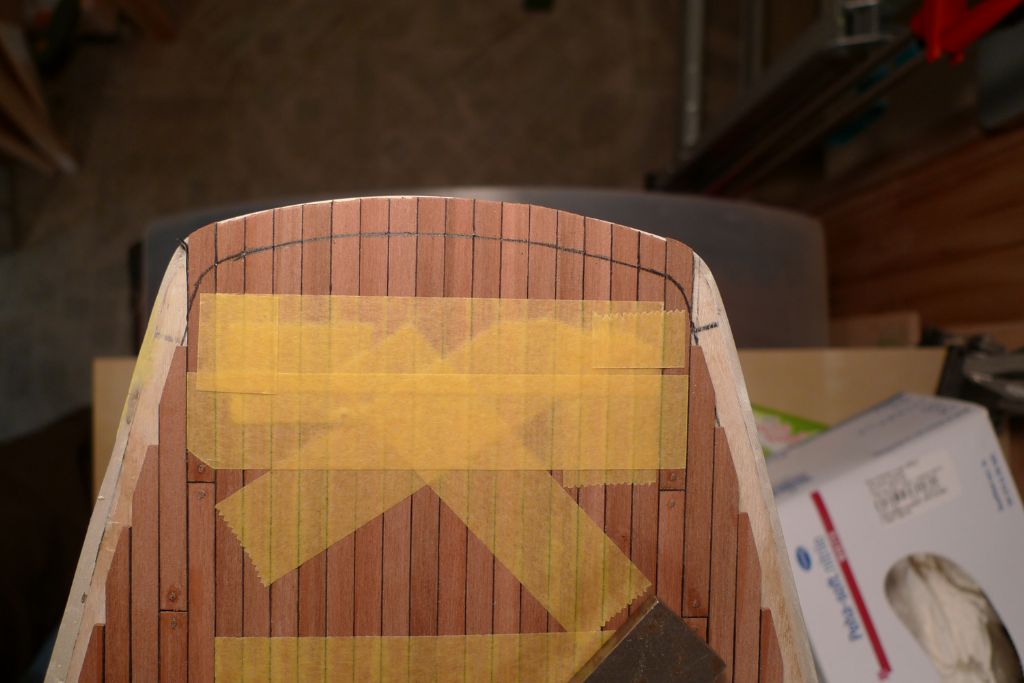
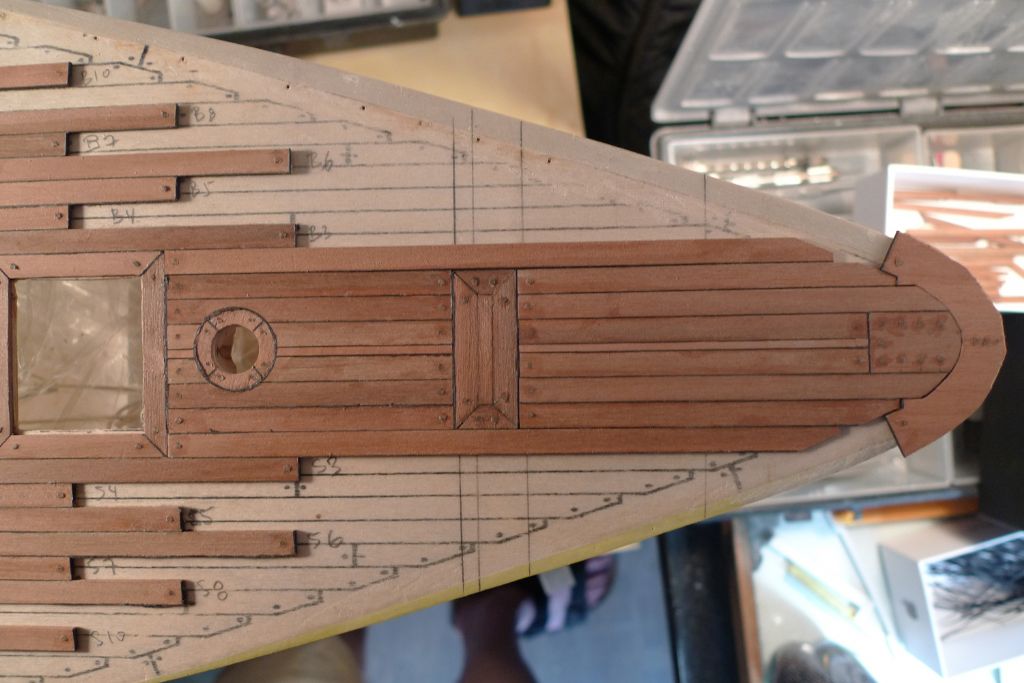
          I also made up endplanks S34–S36 and B34–B36, and then cut endplanks B31–B35 and S31–S35 to their joggled shapes, after which the shape of the stern counter was transferred in pencil to the afterdeck plank ends.

          mbbygg451.jpg

          The ends were then cut away on the bandsaw, and the whole thing carefully trimmed and sanded down to the right shape with a nice sweep to the curve.

          mbbygg452.jpg

          Over the next few days I shall make up the remaiing 56 endplanks, after which it will time for the fun and frolics that'll be cutting the waterway planks to shape … And of course I also still need to decide whether or not to try to improve the shape of the port bows!

          mbbygg453.jpg

          To be continued …

          Mattias

          #67322
          Banjoman
          Participant
            @banjoman

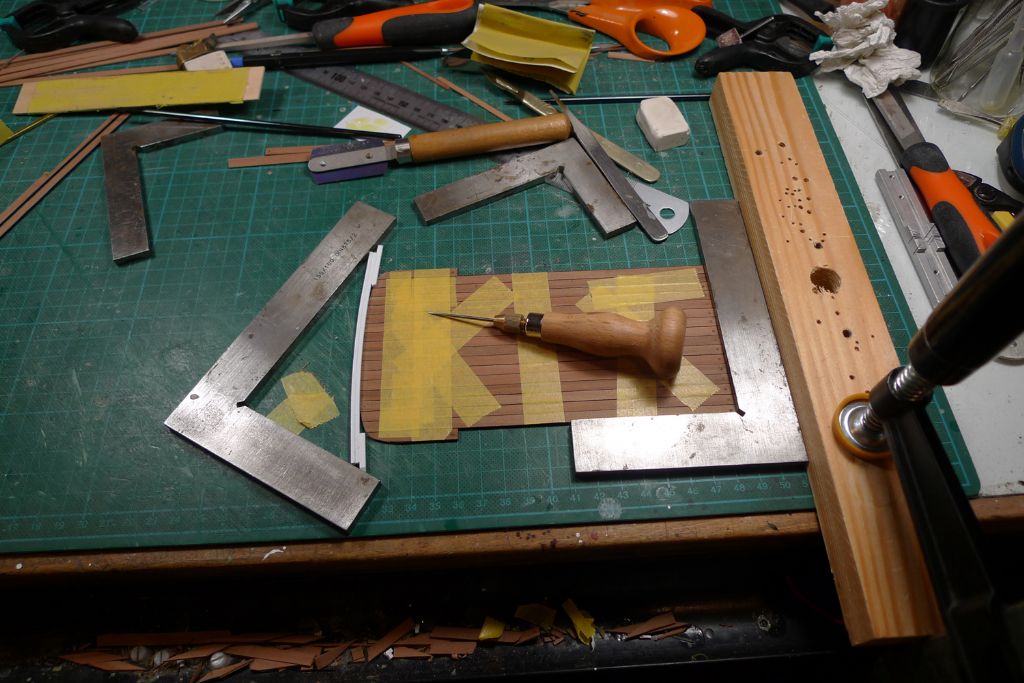
            Yesterday, I first glued together a flexible distance piece from styrene strip, and then set up the afterdeck planking in a temporary jig to prick out the positions of the after edge plugs.

            mbbygg454.jpg

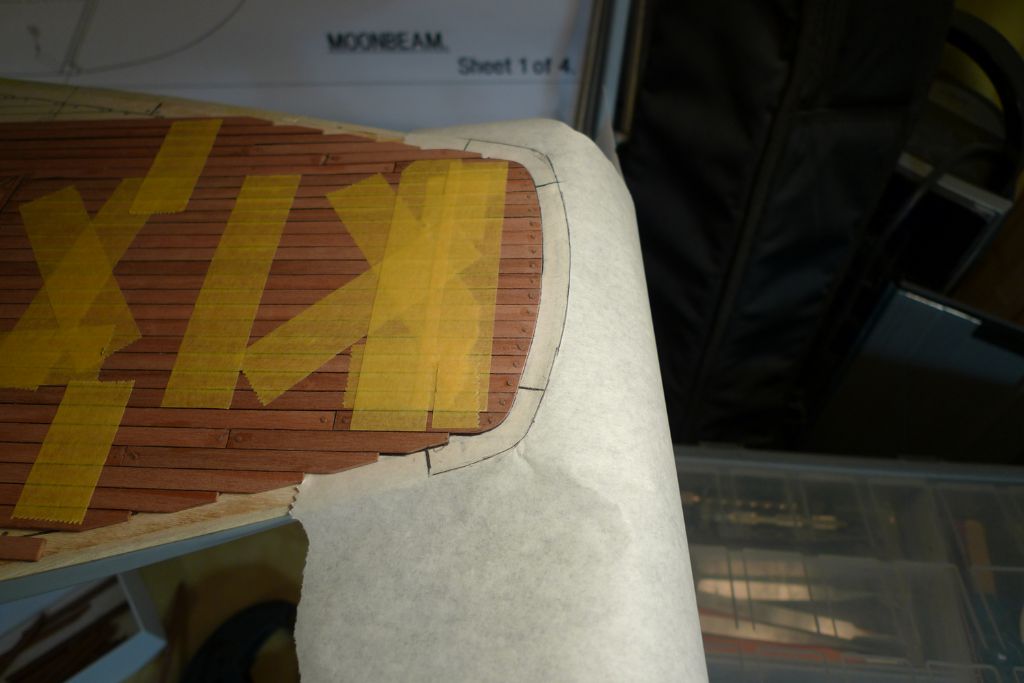
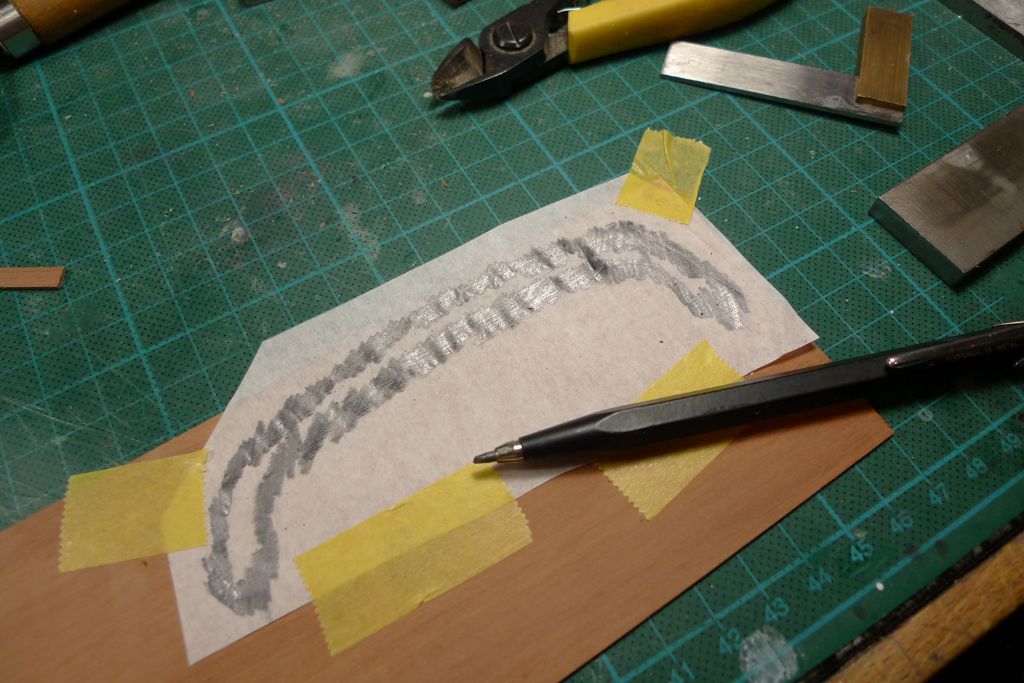
            I then made a first attempt to make up the stern waterway planks, using the method I'd been planning of sliding a piece of tracing paper under the plank ends, and tracing their contour on to the paper …

            mbbygg455.jpg

            … which was then turned upside down, taped to some pear sheet and rubbed vigourously on the back …

            mbbygg456.jpg

            … to transfer the traced lines to the wood.

            So far, so good. However, I soon found that these lines were not precise enough to permit me to cut out the shape to a satisfactory result, so this first attempt had to be dsicarded.

            mbbygg457.jpg

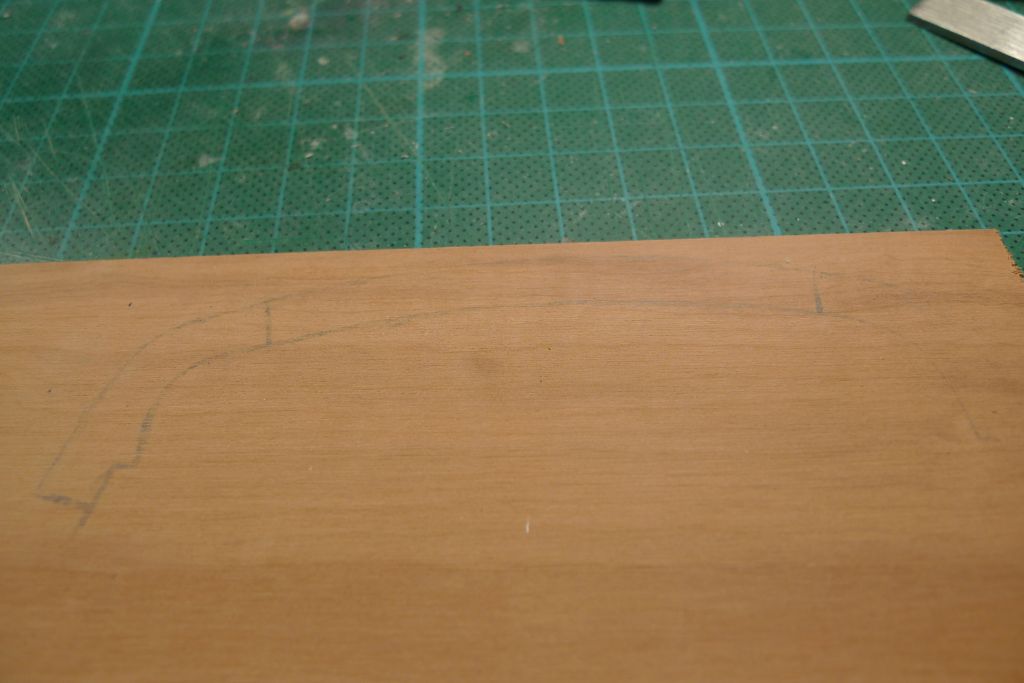
            Using parts of the discarded first attempt (mustn't waste expensive wood!), I then had another go, and produced the stern section by sliding the whole blank under the planking, and drawing the pencil line directly onto the wood.

            Although this went better, I was still not one hundred percent happy with the result (the curve of the line where it lies against the plank buttends is just a wee bit wobbly, as the below photo shows), but it was definitely a step in the right direction.

            However, when making up the two corner pieces, I hit upon the idea of using not a pencil but the tip of a scalpel to scribe the contours of the plank ends onto the blank! This was a vast improvement, for two reasons: the tip of the scalpel allows me to get a tighter fitting line, really close to the contour, and — most importatly — when cutting out the piece, I already have a correctly curved line cut into the wood that I could then (with great care, of course, butt still) follow with the same scalpel until the cut was made!

            As a result, the two corner pieces needed only the very lightest cleaning up before they fitted to my complete satisfaction!

            I will thus continue using this method with the rest of the waterways that, with the exception of the rounded bow piece, should be quite easy to produce, given that all cuts to be made are straight lines. But first I must make up all the remaining end planks, to have a contour to scribe against …

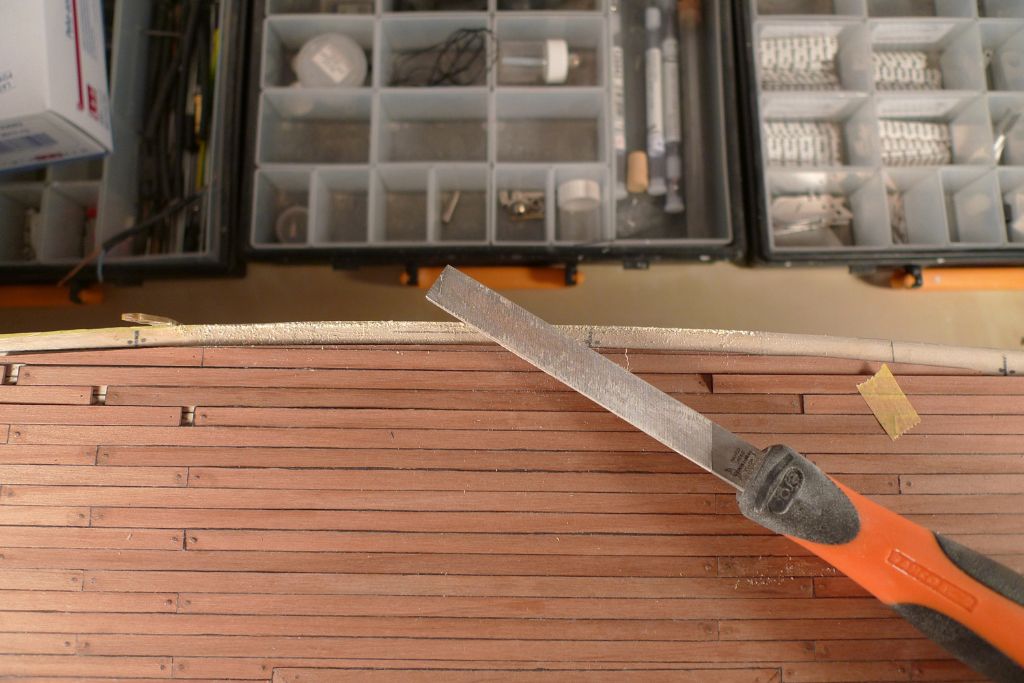
            Oh, and I should perhaps add that the outer edges of the waterways are as yet only very roughly trimmed to shape; they shall of course eventually be trimmed down to lay flush with the edge of the hull, but only after they've all been glued down.

            And I shall see if I can either improve the inner line of the centre stern aterway piece with some very careful sanding or if I shall have to make up a new one using the aproved scribing method …

            mbbygg458.jpg

            To be continued …

            /Mattias

            Edited By Banjoman on 25/08/2016 07:36:14

            #67324
            Bob Abell 2
            Participant
              @bobabell2

              Hi Banjo

              You are making good progress with the tricky areas now, you must have the patience of Jobe?

              Sanding the deck after the veneer is finish laid will be a treat to savour and make a meal of?…..eh?

              How will you sand the veneer with the grain going in different directions?……Scraper?

              Don't want to worry you, but there is a danger of the black lining dust, contaminating the veneer?

              All the best…..Bob

              #67326
              Banjoman
              Participant
                @banjoman

                Hello Bob,

                Actually (as my wife would surely be only to happy tell you), patience is one of my shorter suits — any new toy must be played with immediately, and I hate having to wait for things to arrive. However, one of my ulterior motives in building models is specifically to improve my patience, and to learn the dark art of letting things take the time they need to take to produce a result I am happy with.

                There's an anecdote from when I was a kid which doesn't really translate into English, but which is rather illuminating. When I as maybe 10 or so, I had finally gotten to the point in woodwork at school were I had done all the mandatory projects (such as planing a plank, or making a box with a hinged lid), and was allowed a free project of my own devising. I chose to design and build a Wild West fort out of plywood and, when it was finished, named it Fort Hjort (=Fort Deer in Swedish), and took it homw where I showed it to my dad who took one look and punned "yes, I can see that: fort gjort".

                Fort in swedish can mean either a fort (as in what I had built) or fast, quickly, rapidly (as in how I had built it), whereas the two words hjort (=deer) and gjort (=made, done) are pronounced exactly the same way (the initial h and g are both silent). My Fort Deer was indeed done quickly — and impatiently, which is of course the point my dad was trying to make, and which I certainly took (although it was quite a few years more before I even began to conquer this particular failing in myself).

                As for the sanding, yes: I have done some tests, and shall be using a scraper and my small plane to make everything as level as possible before I start sanding. I know from previous experience that no black paper caulking must be allowed to stand proud of the planking when sanding, or there will be surprising amounts of very pervasive (and invasive) black dust. However, the tests I've done indicate that as long as everything is well leveled before sanding, the result should be OK.

                Mattias

                #67327
                Bob Abell 2
                Participant
                  @bobabell2

                  Thank you, Banjo

                  I enjoyed your anecdote and story on the Fort……and your Father's comment…….In fact, my Dad used to say………"Typical Rummage and Finish"…..when I showed him my handy work……..It brings back a few momories……I made a similar fort for my son, way back in about 1975……. he's now 51 and his fort is still in the attic

                  Can I ask?………Why the numerous references to Swedish?

                  You're not that chap out of Abba who plays the banjo, are you?

                  I'm pleased you have pre considered my scaremongering…..Black dust etc

                  Bob

                  #67328
                  Banjoman
                  Participant
                    @banjoman

                    You're very welcome, Bob

                    The references to Swedish are because that is my mother tongue! I live in Belgium, but am Swedish. And although I most certainly play the banjo, I can (re)assure you that I am not, nor have I even been a member of Abba …

                    If your son is now 51, he must be the same age as I — I was born in 1965 — and my fort, too, was made in 1975, when I was ten! I'm afraid I haven't got it any more, though; it was cannibalised for its materials to build some model or other when I was in my teens …

                    Mattias


                    Edited By Banjoman on 25/08/2016 09:26:43

                    Edited By Banjoman on 25/08/2016 09:40:08

                    #67329
                    Bob Abell 2
                    Participant
                      @bobabell2

                      Thank you, Banjo………Apologies for being so nosey

                      What a coincidence with the dates though?

                      All the best

                      Bob

                      #67333
                      ashley needham
                      Participant
                        @ashleyneedham69188

                        My dad made me a fort when I was 6 yrs old, a "cowboy" fort, out of beech strips, probably an old school desk!, logs really, all cut by hand with the corners planed for the rustic look. One of my prized possessions. Must have taken him ages to make, all stuck together with Araldite (and not the rapid version).

                        I could probably have made the same thing easily in a day, with all my toys…bandsaw, bench sander, Araldite 5 min glue and so on.

                        ​A few choice tools in the workshop makes a massive difference (as numerous posts state).

                        Having the vacuum cleaner going when sanding should alleviate black dust ruining you smart planking?

                        Ashley

                        #67339
                        Ray Wood 3
                        Participant
                          @raywood3

                          Hi Mattias

                          I'm very impressed with your planking, you have reached the stage which has stopped me from attempting it, the joggled edge strip !! we wait with baited breath.

                          My dad built a sailing dinghy in our lounge when I was 5 years old in 1960 and took it out through the French windows to the garden, with a cover over the boom it was our playhouse for years I've been playing with boats large & small ever since.

                          Regards Ray

                          #67347
                          Banjoman
                          Participant
                            @banjoman

                            No worries, Bob — taking an interest does not equal nosey And yes: it is indeed a funny coincidence about the dates!

                            Ashley,

                            Indeed — what a difference a tool makes! And thanks for the vacuum idea — it should indeed be possible to hold its nozzle in one hand while sanding with the other, and so even further minimise the risk of getting black dust in the wood grain.

                            Hello Ray,

                            I take it that the dinghy at least occasionaly left the garden to get its feet wet? And may I guess that building a dinghy in the lounge made your dad very popular around the house while it lasted?

                            As for the joggled planking, I have been absolutely delighted to realise that it actuially is much less complicated than it looks! Once you understand the really very simple geometry involved, it becomes quite straight forward!

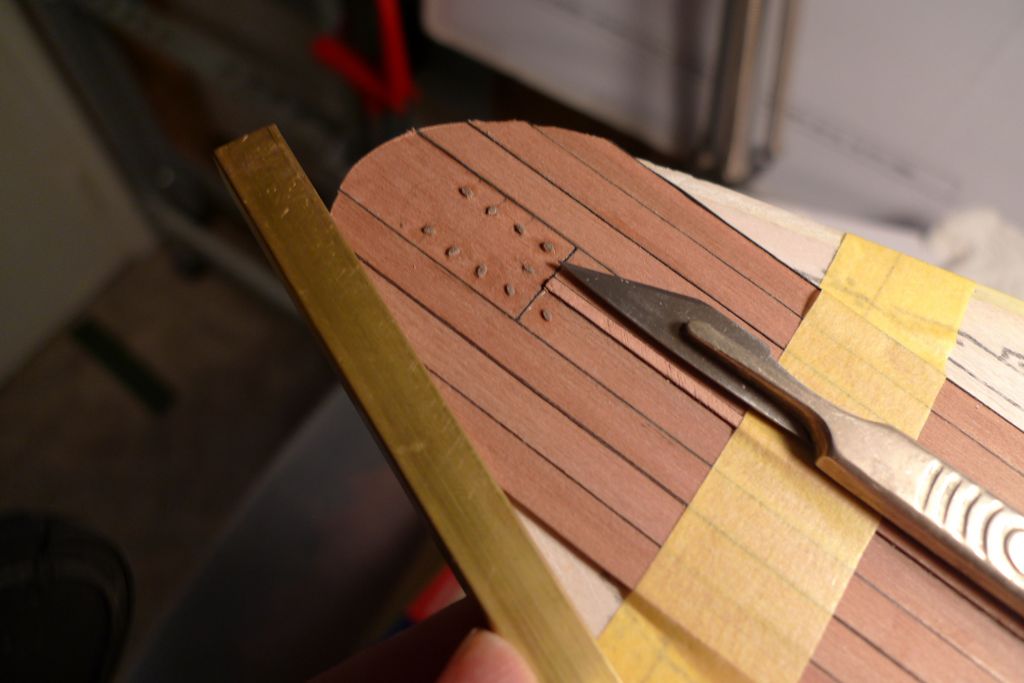
                            As I have already mentioned in a previous post, the deck end planks are cut across in a line that is parallell to the edge of the hull, except that it is a completely straight cut even though the hull line forms a continous curve. I plot this line by preparing a plank to finish just inside the deg of the hull, offer it up into place and then simply hold up a short length of brass L-profile to the edge of the hull and over the end of the plank. With a scalpel I then scribe a line along the edge of the brass profile.

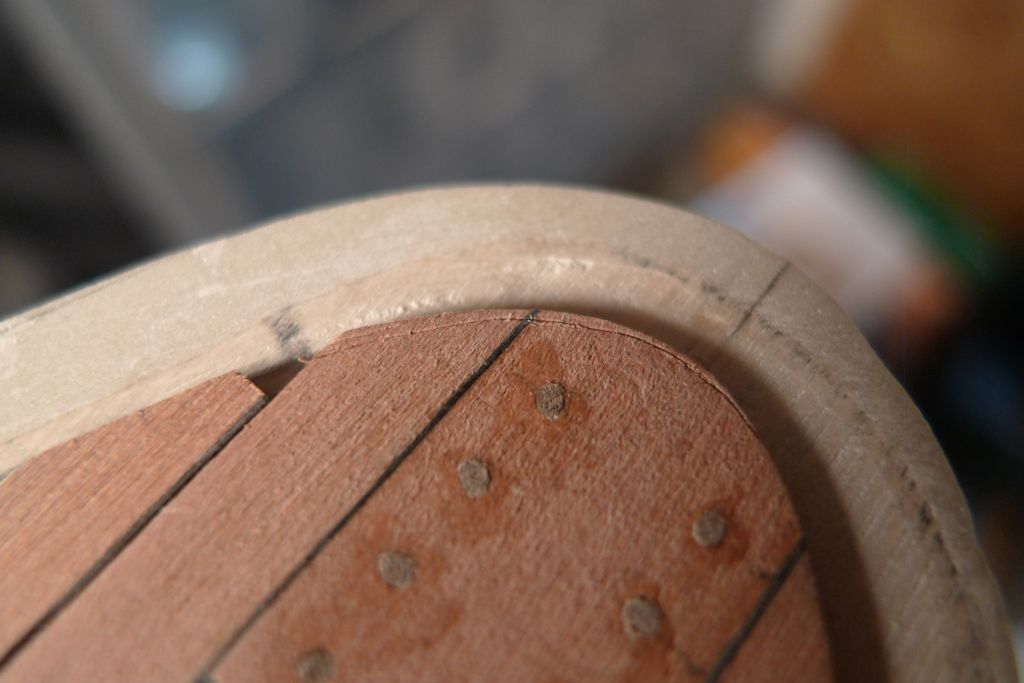
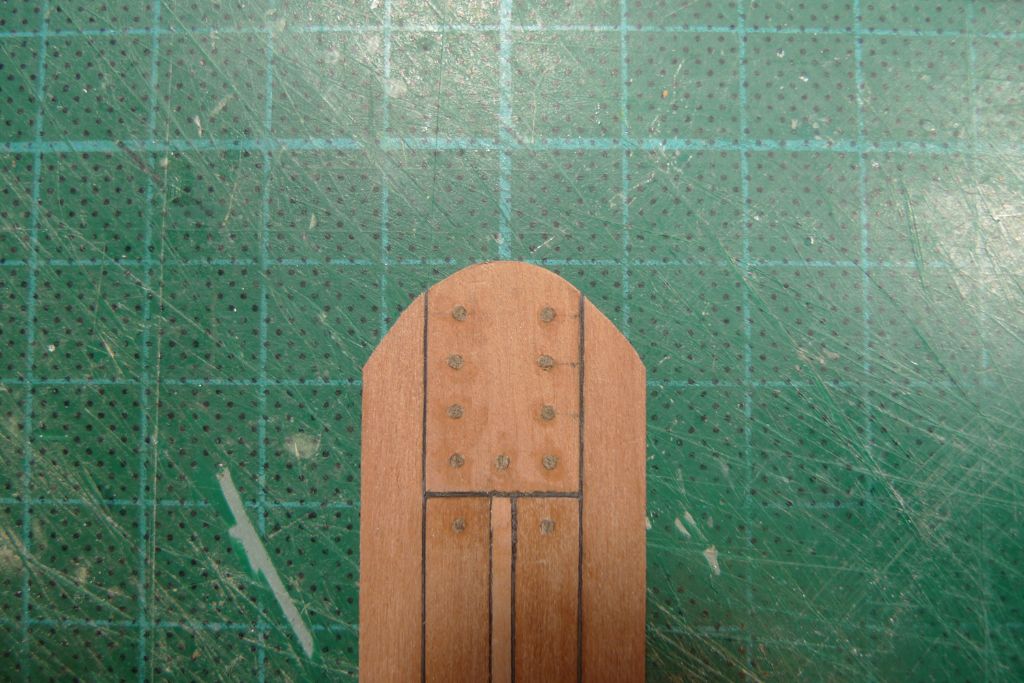
                            The plank can then be removed to the worktable, and cut off along the scribed line. This of course leaves the plank with a tapered, pointed end, which we don't want, and said end is therefore squared off at the point where the taper has reached a pre-defined width. I understand that common, fulll-size practice is to square off at the point where the taper reaches one third of the full plank width, although I have decided here to go with two fifths instead, i.e. at 2 mm wide, as I find that easier to measure in a consistent way than 1.67 mm …

                            mbbygg435.jpg

                            To be continued …

                            Mattias

                            Edited By Banjoman on 26/08/2016 08:44:46

                            #67348
                            Banjoman
                            Participant
                              @banjoman

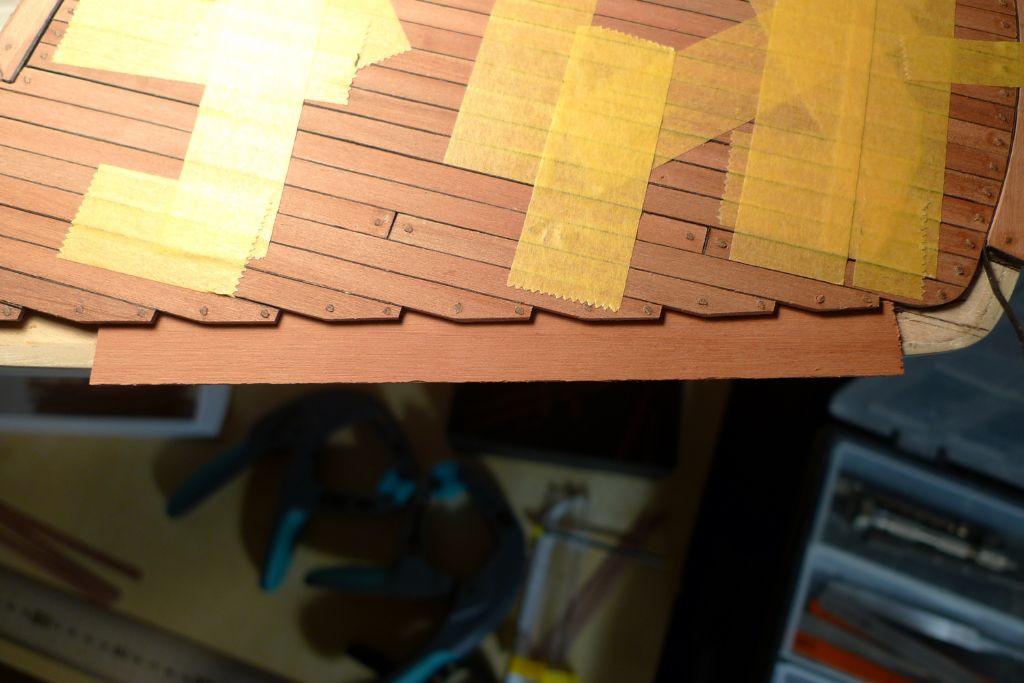
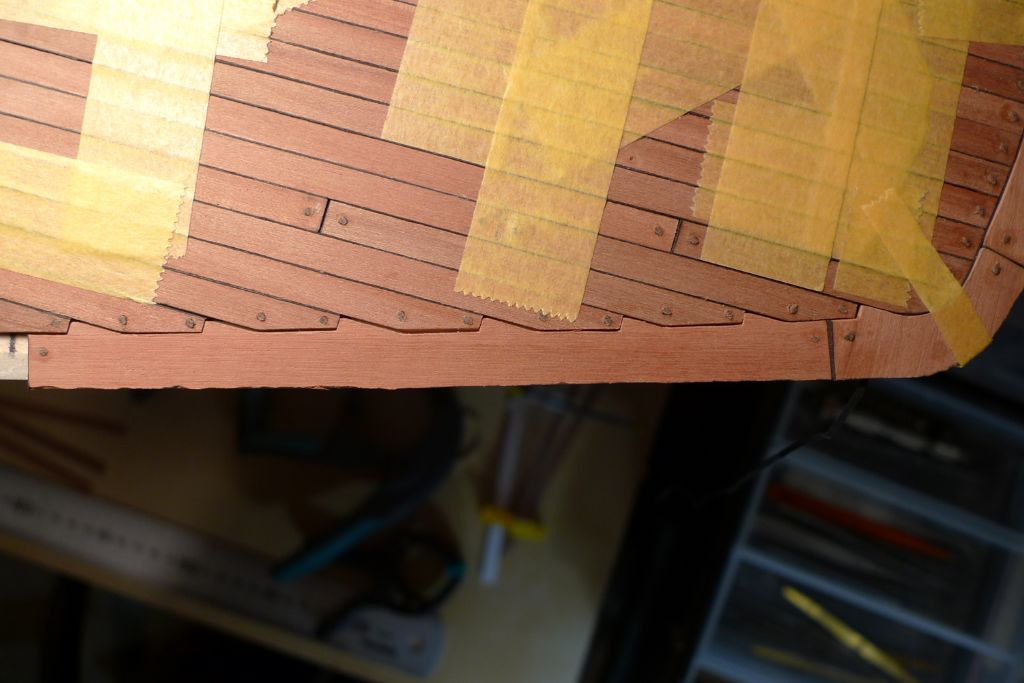
                              As far as the deck planks are concerned, the previous post really says all there is to it! Once you put them into place, they automatically create that lovely-to-look-at zig zag line (see first photo below)!

                              As for the waterway planks, in theory these could be calculated and produced fully apart, just based on the geometry of the thing, but in practice and at this klind of size/scale, it must be much easier to base them directly on the actual joggled deck planks.

                              Using the method I am about to describe, any small and almost invisible idiosyncracies in the shape of the joggles (for example one square-off might be 1.95 mm wide but the next one 2.05 mm; not so much as to be visible, but enough to upset a purely calculated cut-out) will be automatically accomodated.

                              So. Method.

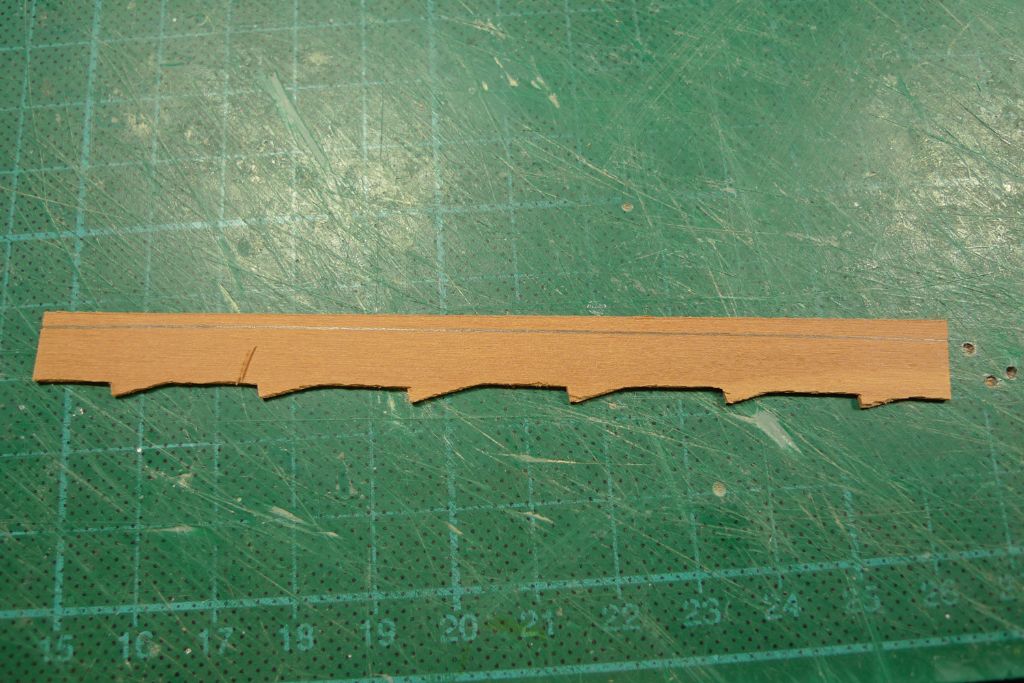
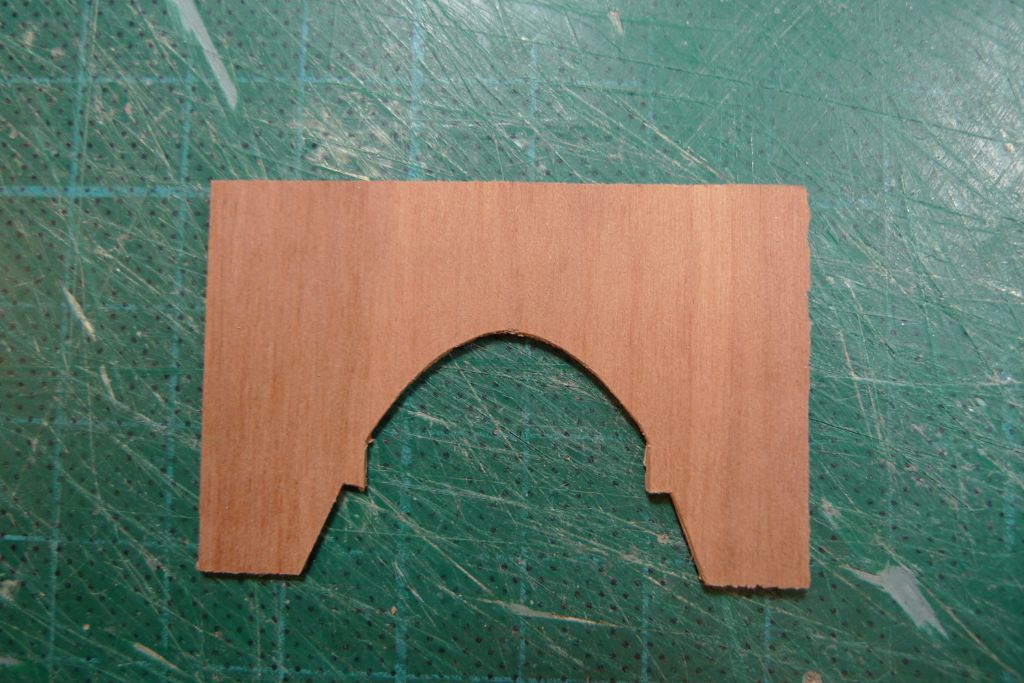
                              I start by cutting a suitably-sized blank from a sheet of wood, and then slide it under the deck plank ends, amking sure that it overhangs the edge of the hull the whole way.

                              mbbygg459.jpg

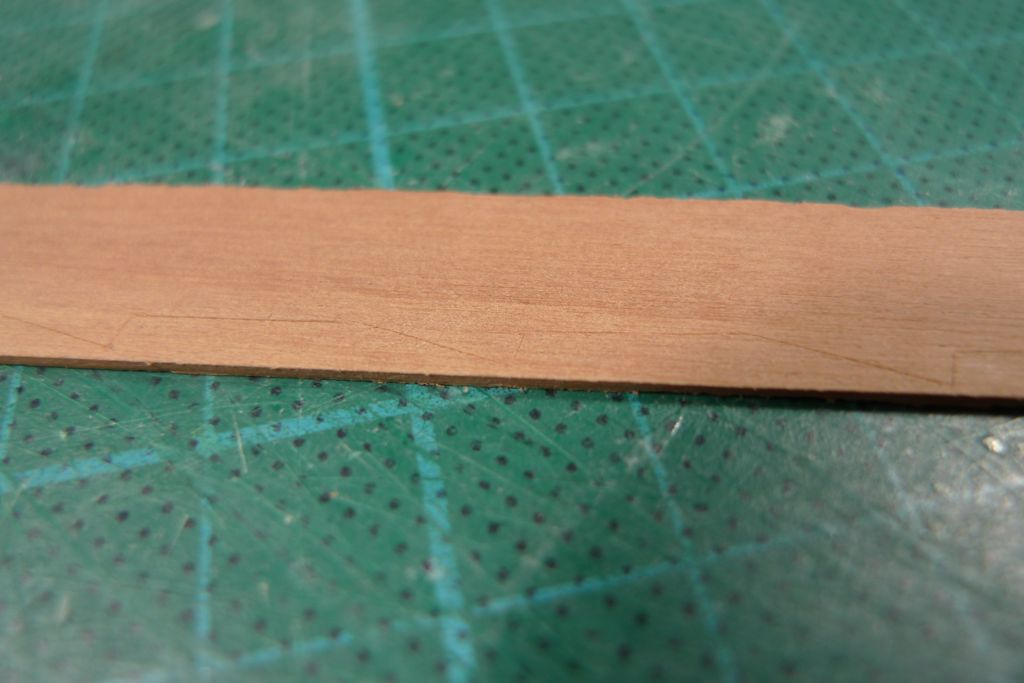
                              Very carefully holding everything into place, I even more carefully scribe the plank end contours onto the blank with the tip of the scalpel (which could of course also be a hobby knife or similar; it is just that I prefer scalpels) …

                              mbbygg460.jpg

                              … and then, yet again taking great care, deepen those cuts, again with my trusty scalpel and favourite blade, a #10A.

                              I start with the cross-grain cuts …

                              mbbygg461.jpg

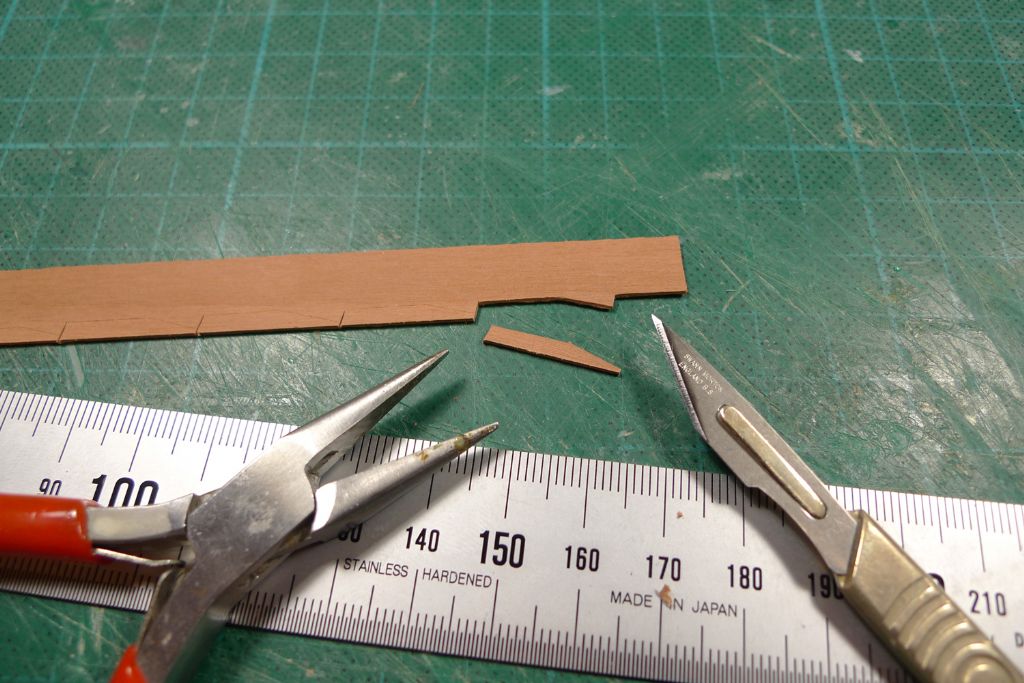
                              … and then move on to the cuts along the grain. After som trials and errors, I've found it best not to actually cut through the wood completely with the knife. Instead I score then wood three or four times with, and five or six times against the grain, and then with a pair of small pliers very carefully bend the piece to be removed upwards (against the cut) and then back and forth a couple of times until it comes away.

                              This requires much less force on the knife than cutting through would, and thus considerably lessens the risk of making too long a cut or the blade going the wrong way. Also, it means that the cut is done only with the thinnest part of the blade, which means that the edge of the cut is less likely to be slanted.

                              mbbygg462.jpg

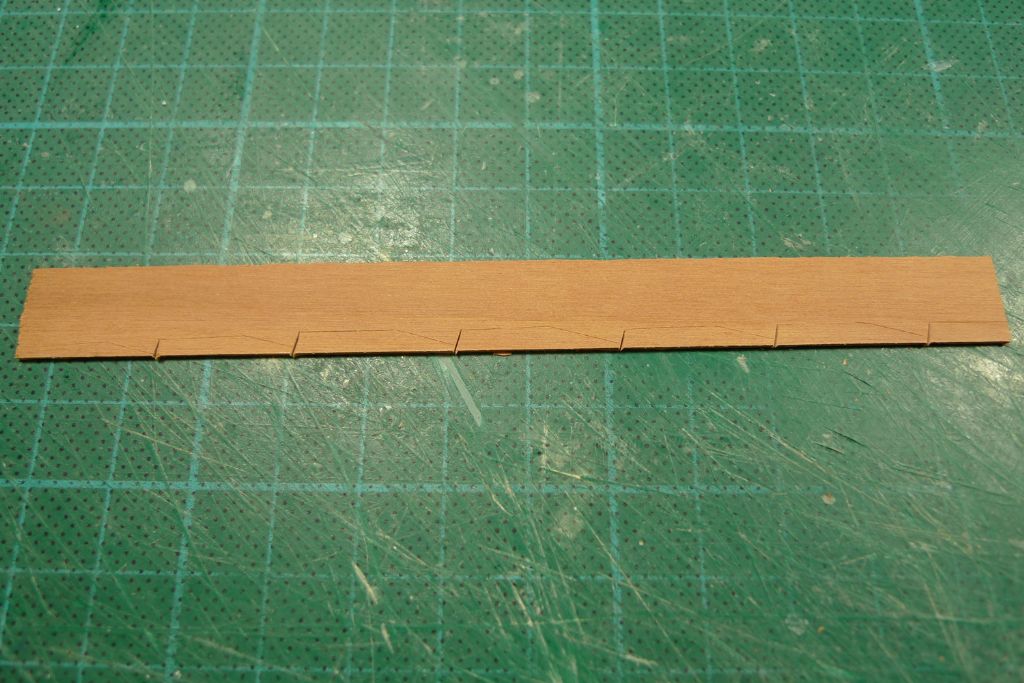
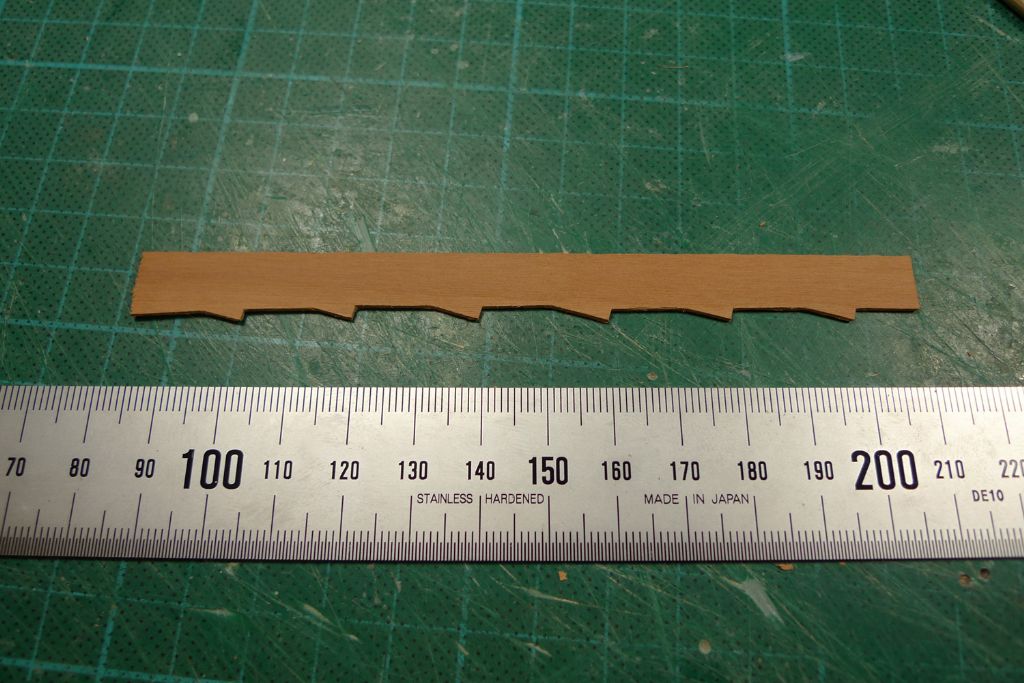
                              Anyway, the end result, with no further cleaning up or sanding, is this …

                              mbbygg463.jpg

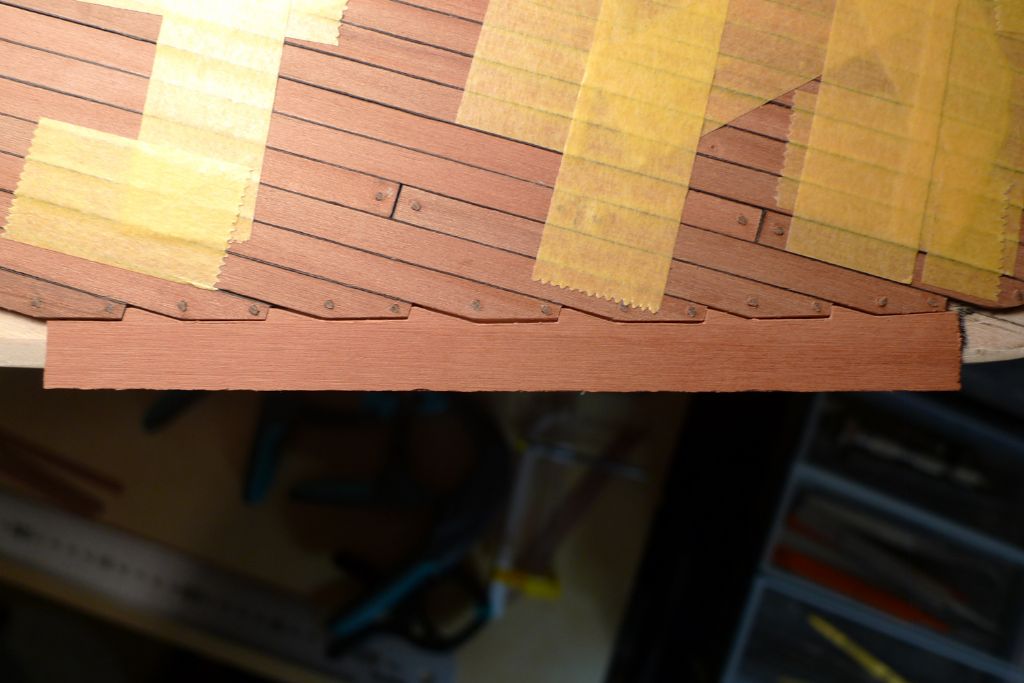
                              … which fits in place pretty much like a glove, straight away!

                              mbbygg464.jpg

                              The previous piece of waterway planking can the be held in place and overlapped to scribe the transversal cutting line …

                              mbbygg465.jpg

                              … while on the underside the hull edge contour is marked on with pencil.

                              mbbygg466.jpg

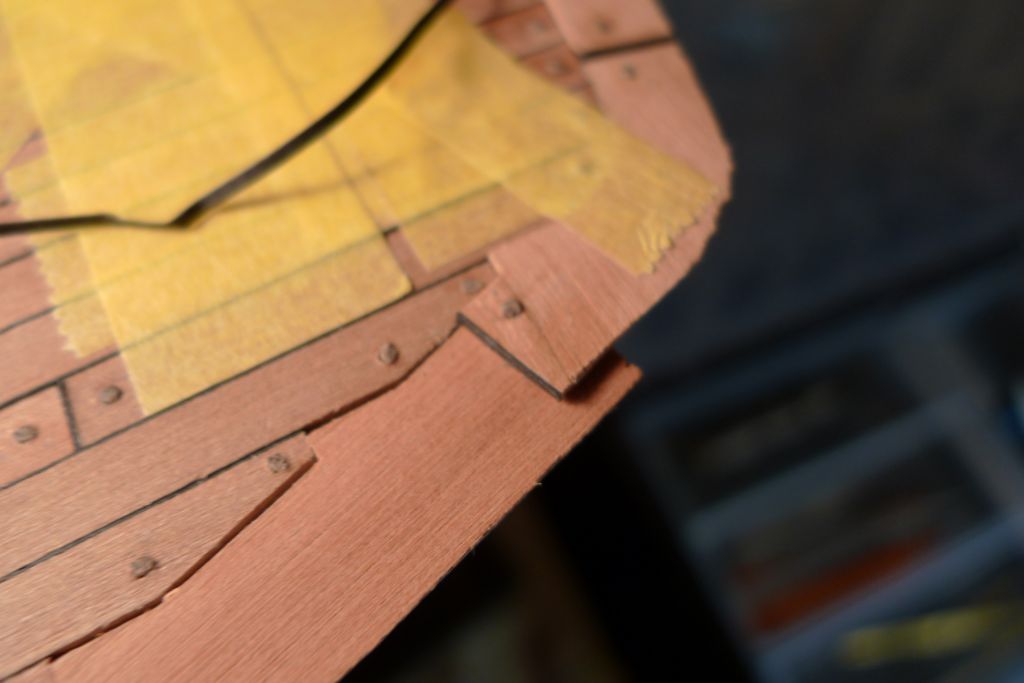
                              Finally, the outer edge is trimmed back to give just a small overhang of the hull, and the butt ends drilled and plugged, to produce the below waterway plank.

                              Here it is just dryftitted, and there is no caulking paper, but the fit seems to me quite satisfactory, while the process to achieve this was much simpler than I had expected.

                              mbbygg467.jpg

                              To be continued …

                              Mattias

                              Edited By Banjoman on 26/08/2016 08:43:52

                              #67349
                              Bob Abell 2
                              Participant
                                @bobabell2

                                Ah!…….So that's the secret?……Having access below the deck planks!

                                That's a good idea, Banjo

                                I'll remember that for next time………Suppose having quality wood is a help too

                                You are on the Home Straight now…….Heading for the Winning Post and the reward, you richly deserve!

                                Well done

                                Bob

                                #67353
                                Banjoman
                                Participant
                                  @banjoman

                                  Warmest thanks, Bob, for your kind words!

                                  I did say I had a cunning plan, though, didn't I … ?!

                                  But yes: the trick up the sleeve, as it were, was and is indeed to initially only dryfit the joggled endplanks so that they can be made to overlap the waterway plank blanks. I'd say, though, that of equal importance to the success is that all the rest of the planking has been properly glued down, to provide a strong and immovable datum against which to hold the loose end planks firm while tracing their contours.

                                  Also, you are quite right that the quality of the timber seriously facilitates the job.

                                  Mattias

                                  #67429
                                  Banjoman
                                  Participant
                                    @banjoman

                                    In the end I decided to make up a new middle section for the stern counter waterway planking; I was never completely satisfied with my first attempt.

                                    I also produced the first waterway plank to starboard, after which I looked at the result and found that in my eyes at least, it'll do now, as it creates at least a certain illusion of symmetry.

                                    mbbygg468.jpg

                                    With the stern sorted, I again turned my eye to the bows and the corresponding assymetry there. As already mentioned, I was not very happy with the shape the bow planking had to take if the waterways were to be kept to the same width to both port and starboard, something that I think is quite important if they're to look good.

                                    I therefore decided to take the bull by the horns (or should that be the hull by the borns … ?! ).

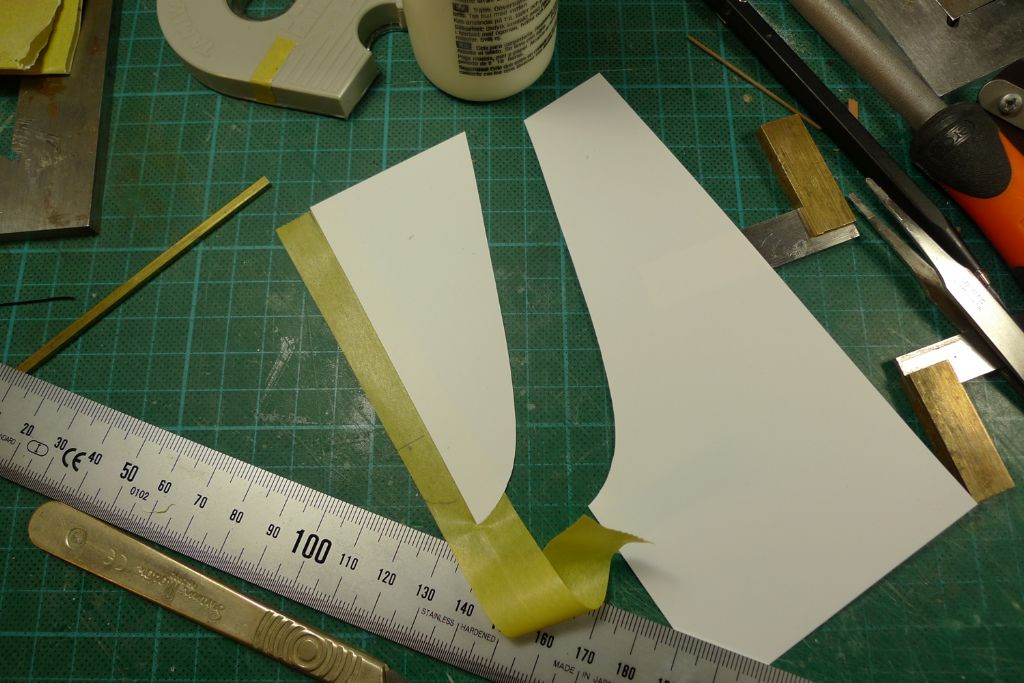
                                    In any case, I laid some thin (0.010) plasticard down on the starboard half of the foredeck, with one edge most carefully aligned with the centre line, and then scored the underside with a knife along the edge of the hull.

                                    mbbygg469.jpg

                                    A perfect representation of the starboard hull line could then be snapped off from the plasticard …

                                    mbbygg470.jpg

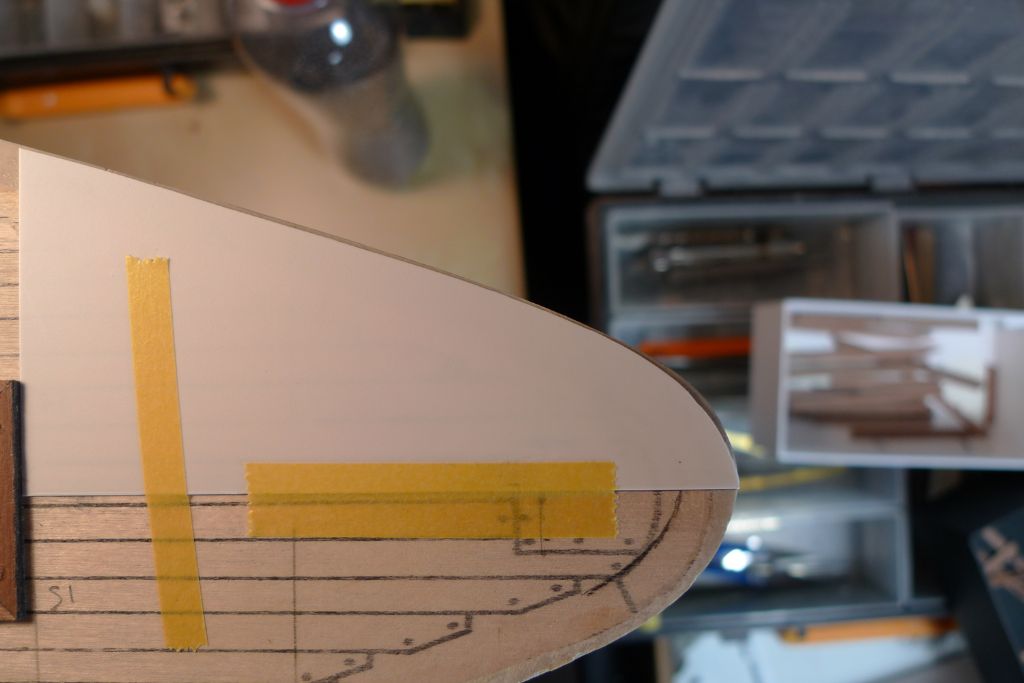
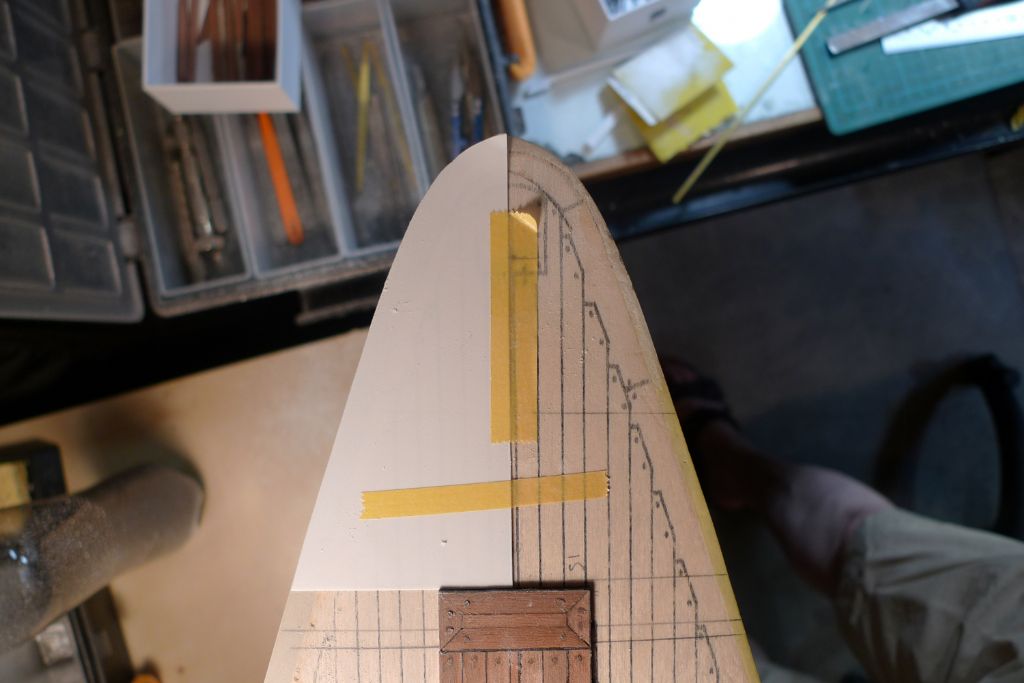
                                    … and taped on over the port half of the foredeck, making the difference in shape quite easy to see. It may not be huge, but it is enough to throw things out of kilter.

                                    mbbygg471.jpg

                                    I then proceeded to sand and file the port hull edge down until a decentish symmetry had been achieved.

                                    mbbygg472.jpg

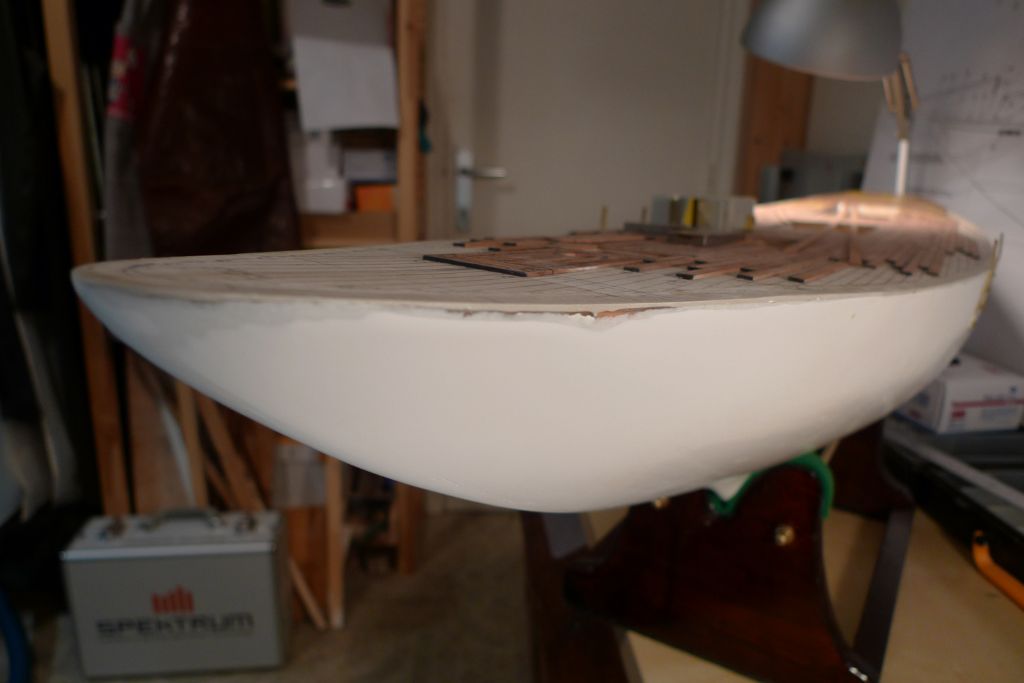
                                    The price I've had to pay for this improvement in the hull profile has been a slight detoriation of the port bow flare. As the below photo clearly shows, I have gone right through the GRP all along the top. This is fine, as there is a solid mass of different (and strong) materials (P38, epoxy and wood) behind the GRP at this point. Just below, however, there would only be the GRP shell, which is maybe 1.5 or 2 mm thick. In other words, I did not dare continue the filing any further, and if the hull is looked at from dead ahead, there has been a slight but noticeable detoriation of shapeliness. All in all, I think it'll do, though.

                                    mbbygg473.jpg

                                    Anyway, the central foredeck plank ends could now be re-scribed with their new, improved shape based on the new, improved hull lines …

                                    mbbygg474.jpg

                                    … and cut to a much better shape (cf. my posting of 22 August on p. 15 of this thread) than before.

                                    mbbygg475.jpg

                                    Once I was happy with the general shape of these planks, and those surrounding them, a piece of sheet wood was slid under them, scribed …

                                    mbbygg476.jpg

                                    … and cut out …

                                    mbbygg477.jpg

                                    … to produce the central part for the bow waterway planking. As usual, the outer edge of this has been cut overlarge by a couple of millimeters as part of my next cunning (ha!) plan …

                                    mbbygg478.jpg

                                    To be continued …

                                    Mattias

                                    Edited By Banjoman on 29/08/2016 07:15:04

                                    #67433
                                    Banjoman
                                    Participant
                                      @banjoman

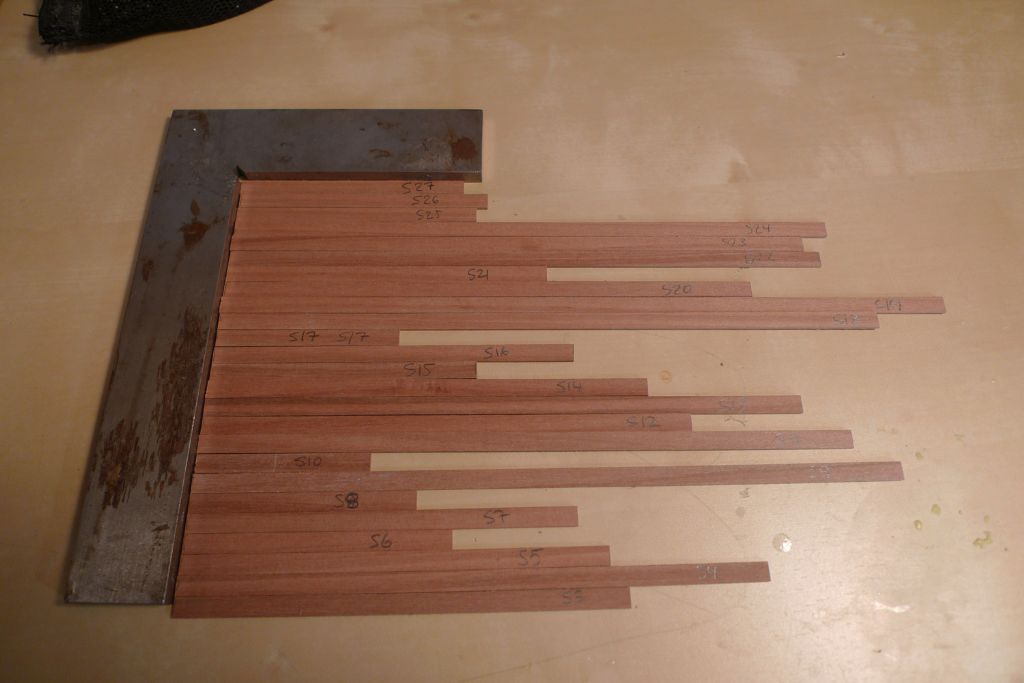
                                      With both the stern and bow planking configurations sorted, it was time yesterday to crack on with the remainder of the end planking, and I thus cut off to rough length the planks needed for the starboard side, ## S3 to S27 …

                                      mbbygg479.jpg

                                      … and then proceeded (starting with plank S3 towards the bows) to add caulking strips as needed and to joggle the ends.

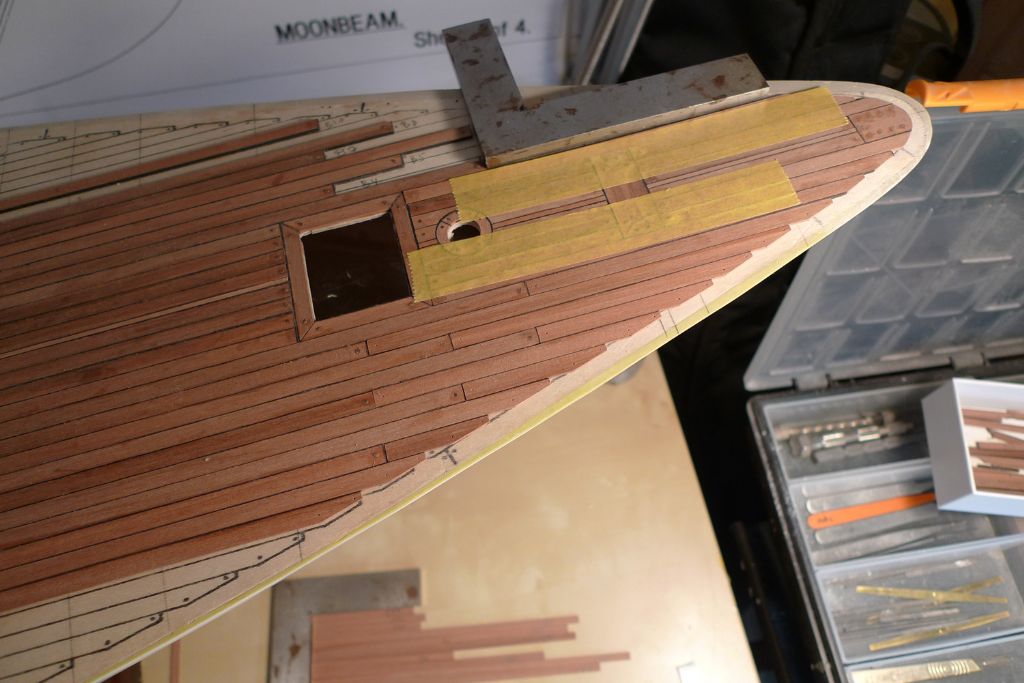
                                      I also pricked out the positions for the plug holes, but will wait with drilling and plugging these planks until everything is made up. It is faster and easier to do that as a batch job, and I don't want to keep moving around those planks that for the time being are only dryfitted and held in place with masking tape for fear of messing with any datum.

                                      mbbygg480.jpg

                                      In the meantime, all planks except the remainder of the waterway have been prepared to starboard …

                                      mbbygg481.jpg

                                      … and I must say I am rather pleased …

                                      mbbygg482.jpg

                                      … with how the lay and the flow of the joggle line turned out.

                                      Next up will be the same job to port, after that the waterways and then I will finally be ready to glue it all down and finish the planking …

                                      mbbygg483.jpg

                                      To be continued …

                                      Mattias

                                      Edited By Banjoman on 29/08/2016 09:08:37

                                      #67473
                                      Banjoman
                                      Participant
                                        @banjoman

                                        Over the first half of the week I've been busy preparing the port side end planks, too, and once these were ready I could come back to the final bit of hull assymetry that I'd noticed fairly early on, namely the fact that midships the hull is a tad rounder and wider on the starboard side.

                                        Originally there was a difference of between 1.5 and 2 mm in relevant locations, and my first plan was to deal with this by doubling the amount of caulking strip between a strategic number of planks to starboard — at +/- 0.2 mm per strip, five to ten such additions would pretty much have done the trick.

                                        However, because I also had to factor in how to deal with the similar issues around bow and stern, and the ensuing need to introduce a very subtle oblique to the planking aft and forrard of the waists, I decided against it, as it would have risked making this slight crookedness to the run of the planking lines too obvious.

                                        Instead I used said slight oblique and accompanying offset to starboard around the hatches (see previous posts) to already claw back between 0.5 and 1 mm.

                                        The remainder still needed to be dealt with, though, unless I would have been willing (which I was not) to accept a too wide midships waterway plank on the starboard side.

                                        One option would have been what I've tried in the photo below, namely to add a narrow, rounded off strip of wood outside the final actual planks. It looks nice enough on its own, but did not really please me, though, as it would have meant a difference in the planking patterns on the two sides.

                                        mbbygg484.jpg

                                        Instead, I decided to take the port side as datum, where the final, straight planking at the widest point of the hull comes to lay at pretty much exactly 7 mm from the hull edge, and as 7 mm is the basic width of the waterway planks, no filler strip is needed here (nor would there have been room for one).

                                        mbbygg485.jpg

                                        I therefore got out files and sandpaper, and reduced the width of the hull to starboard by the requisite +/- 1 mm, until I was pretty close to the shape and run of the port side.

                                        mbbygg486.jpg

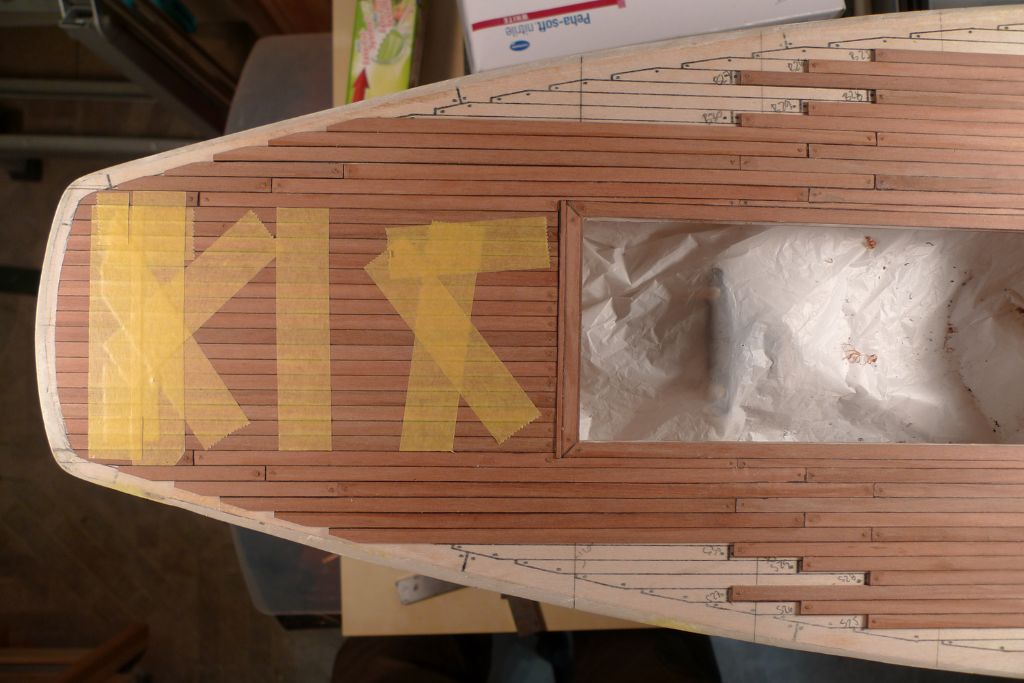
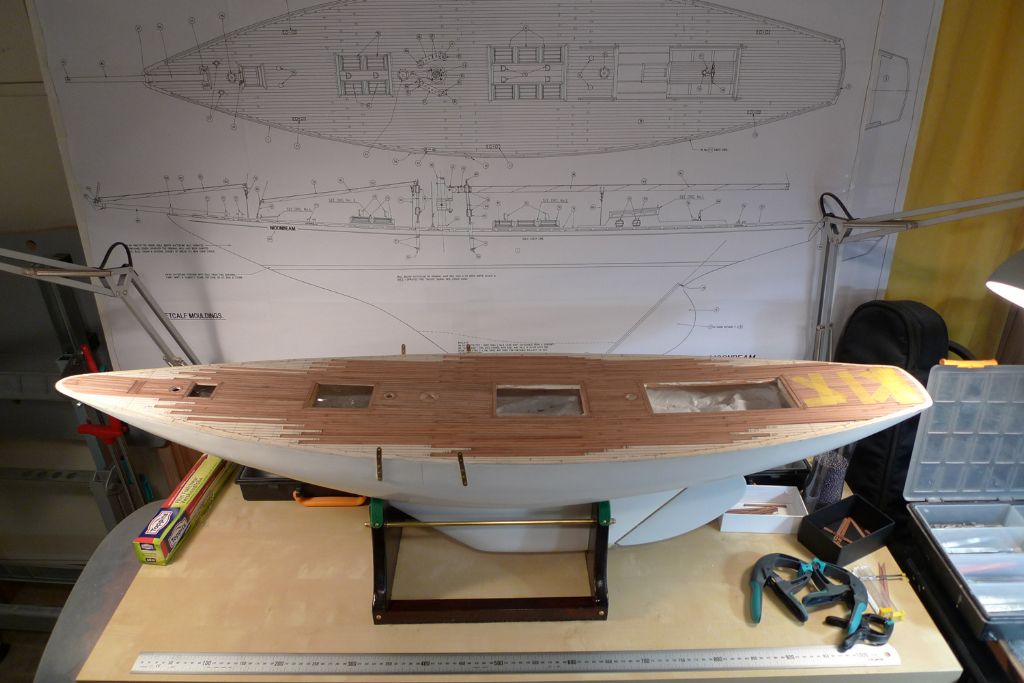
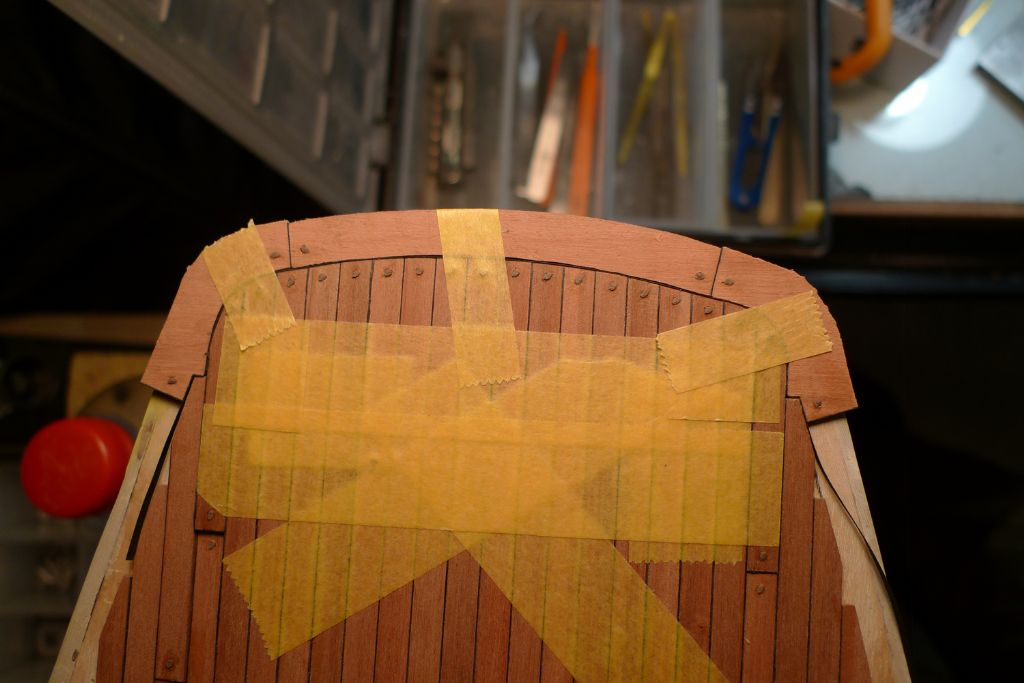
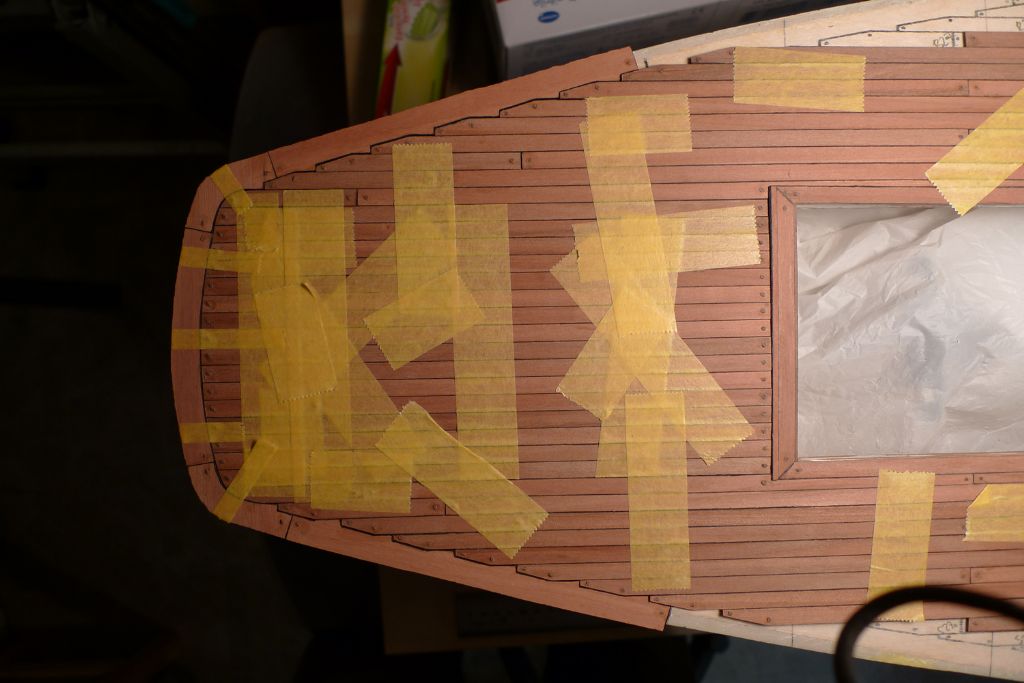
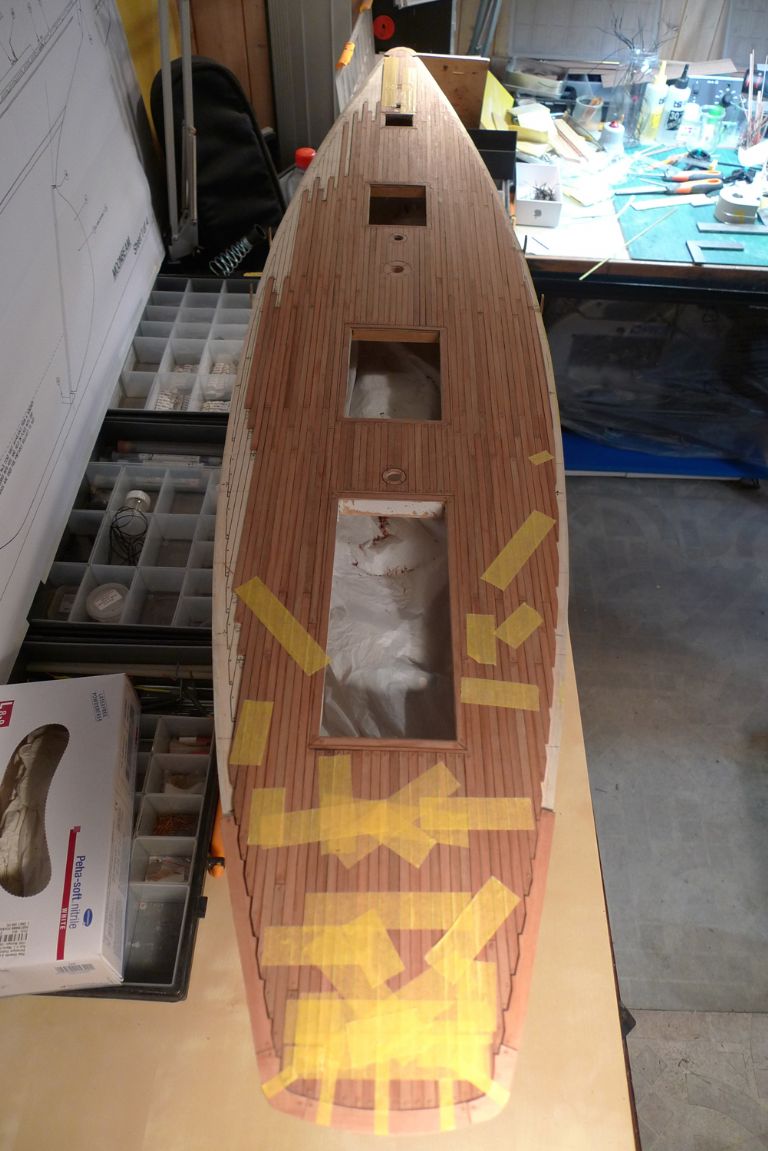
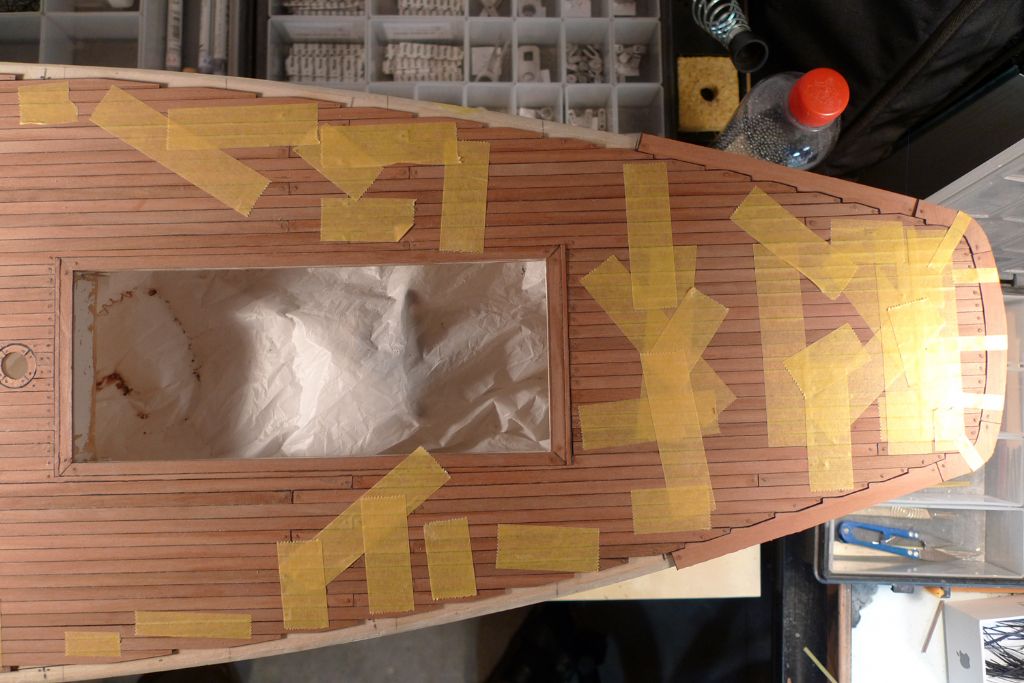
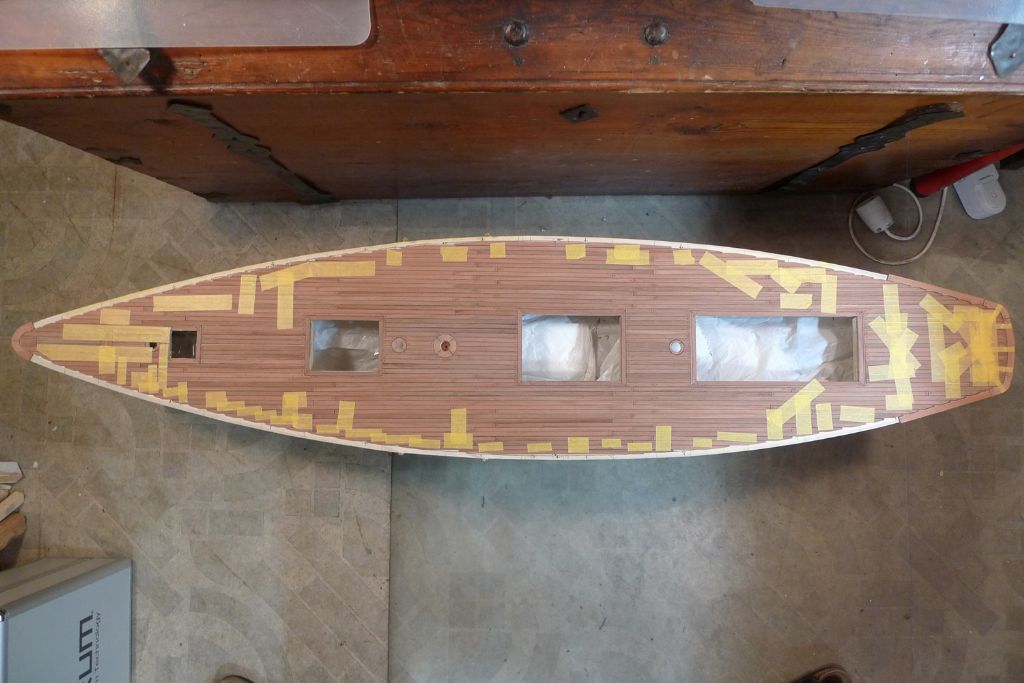
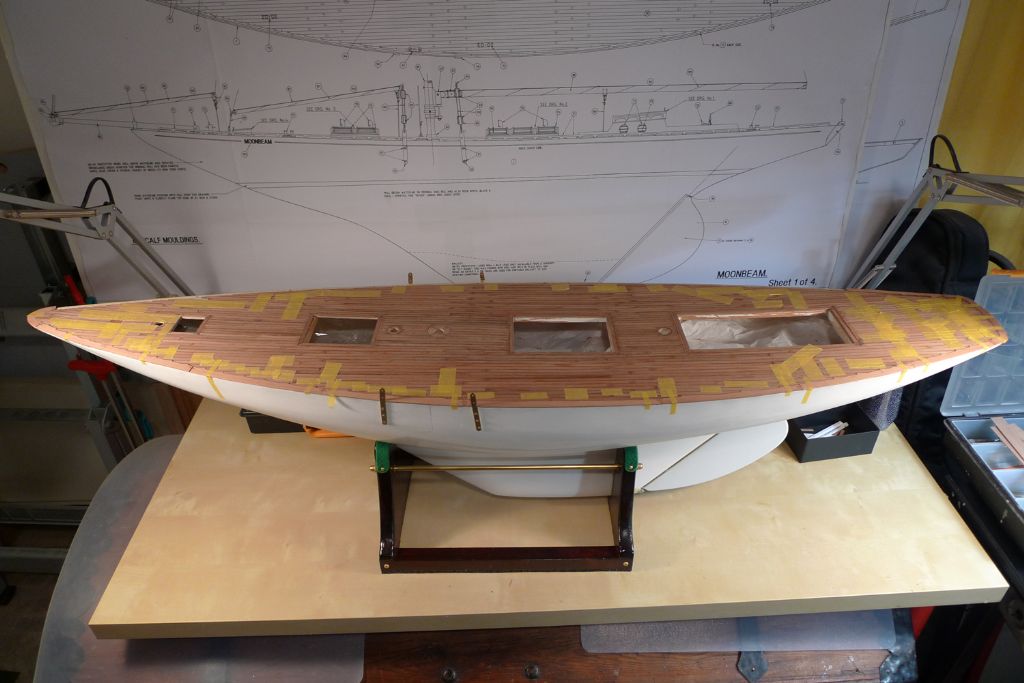
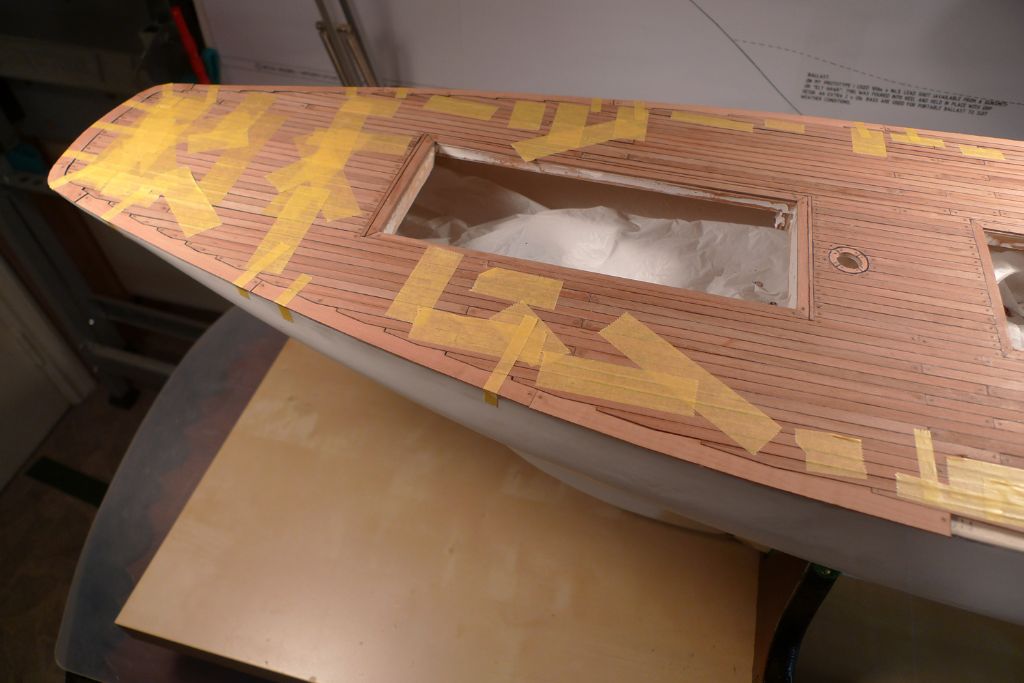
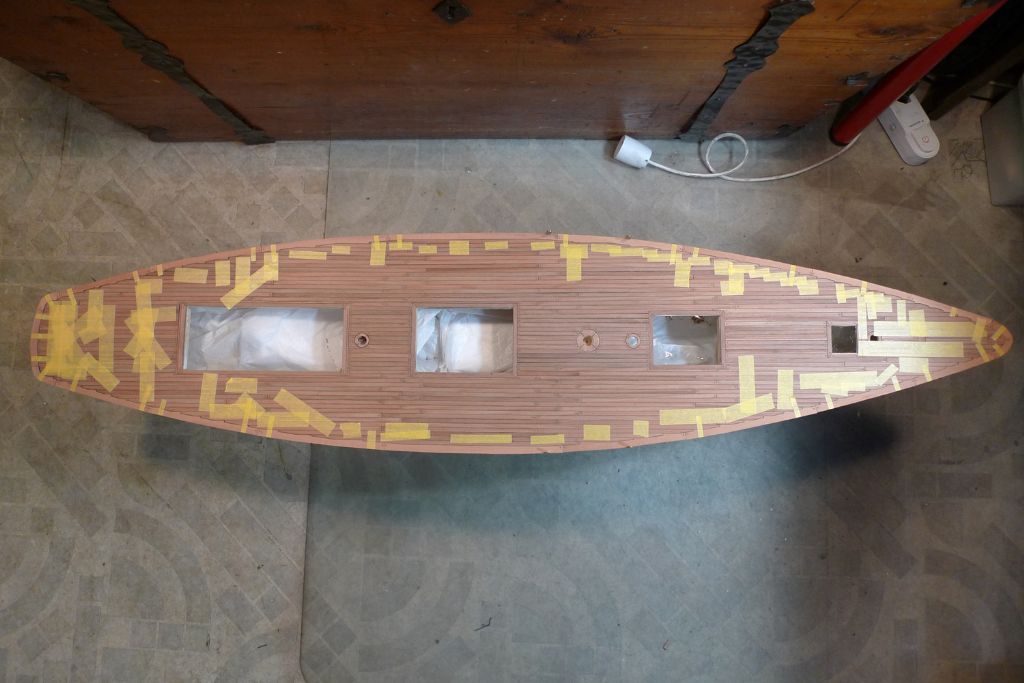
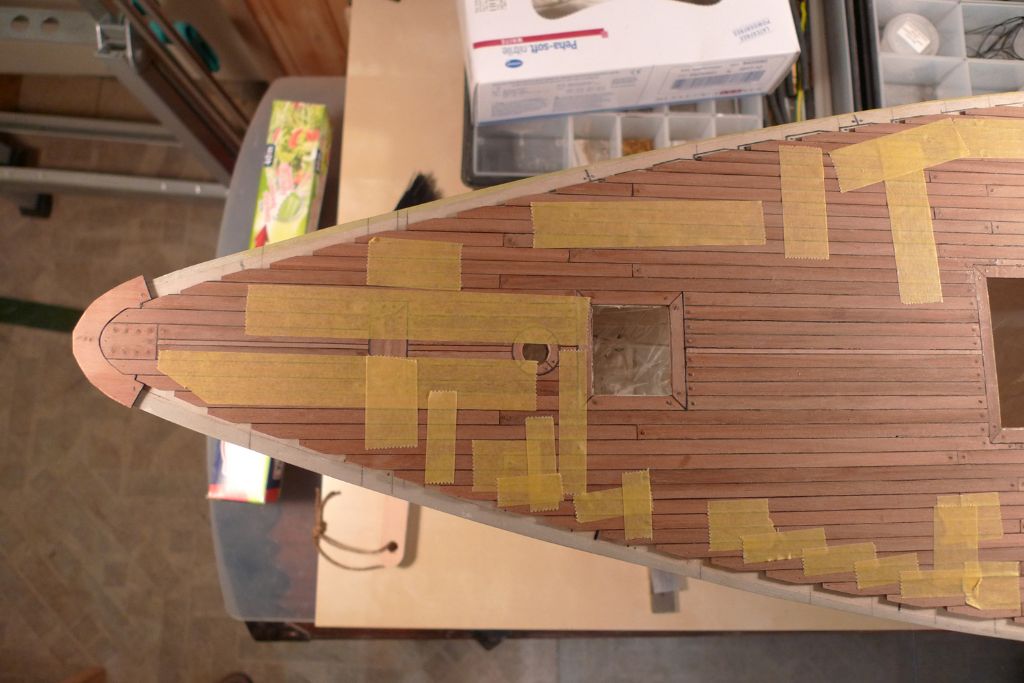
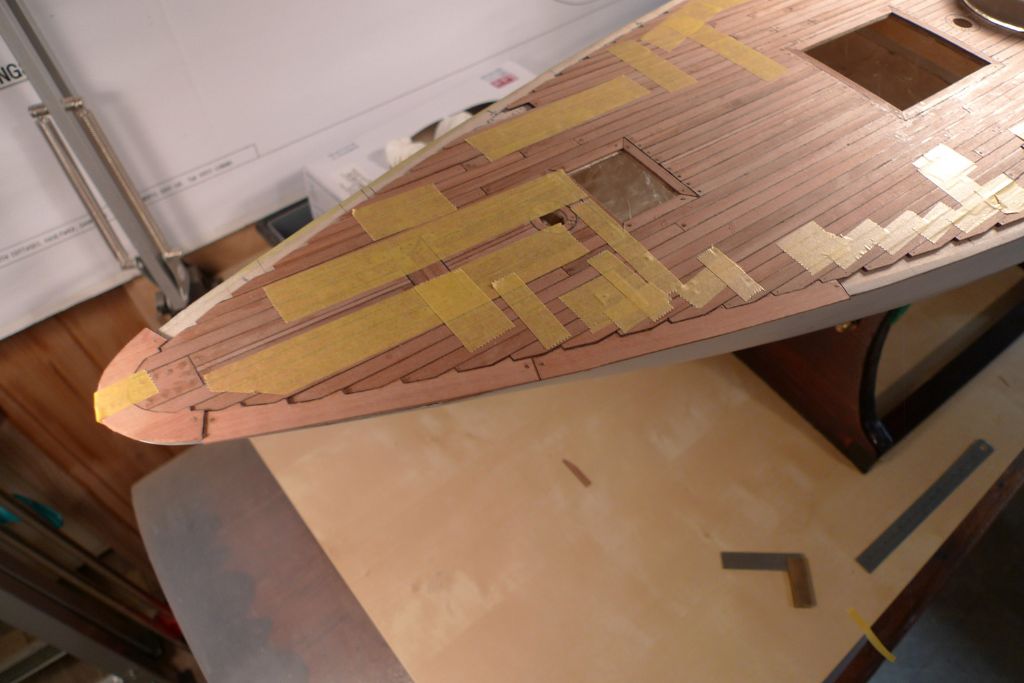
                                        All end planks to port could now be dryfitted and held in place with masking tape in the same was as I'd already done on the starboard side, producing this result at the bows …

                                        mbbygg487.jpg

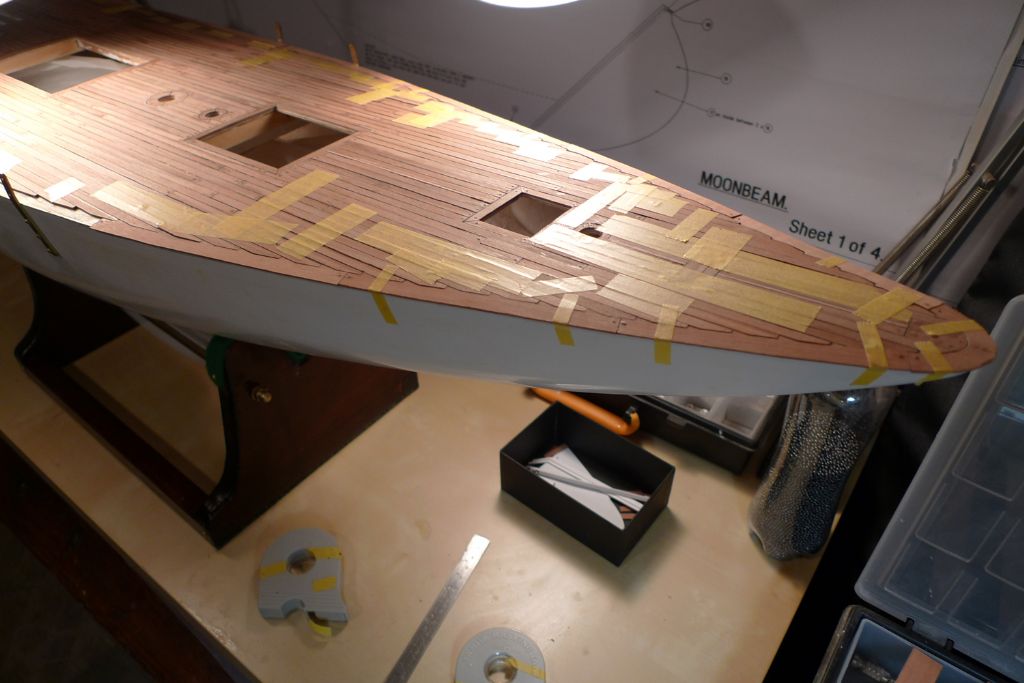
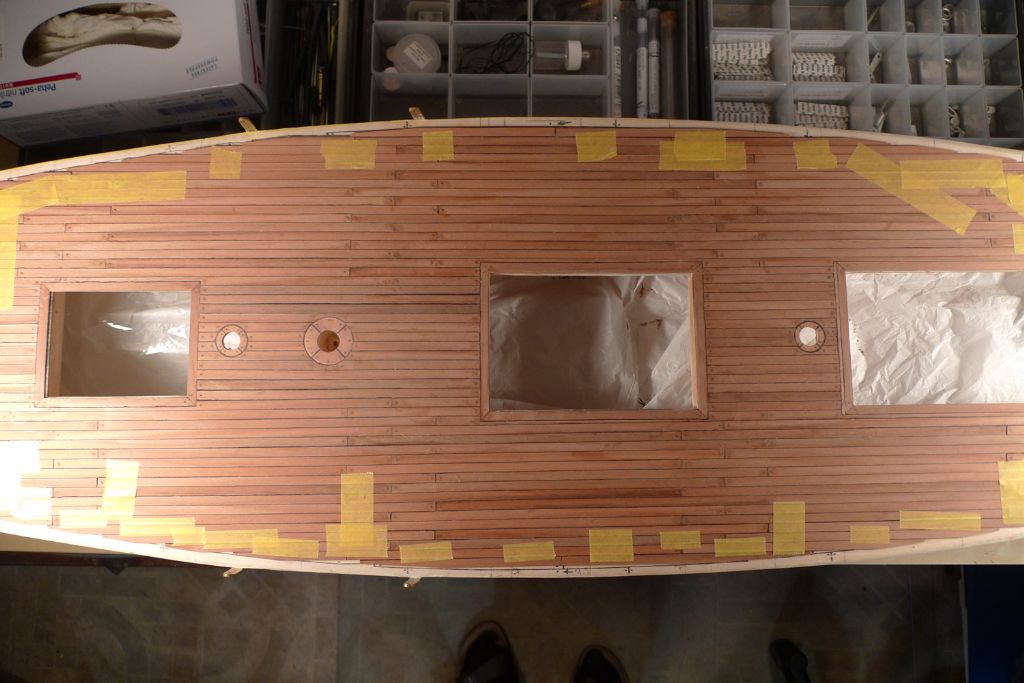
                                        … midships …

                                        mbbygg488.jpg

                                        … and at the stern.

                                        mbbygg489.jpg

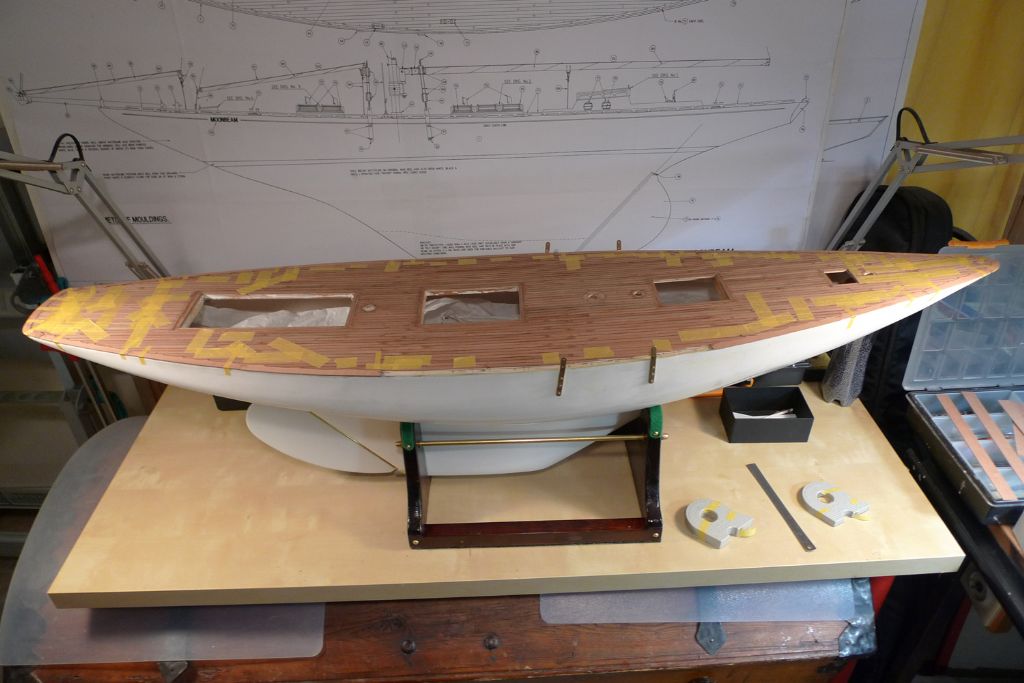
                                        Although the helter-skelter pieces of masking tape makes it difficult to properly see the lines of the planking runs (sort of dazzle camouflage effect, eh wot?!), I think that it'll do now!

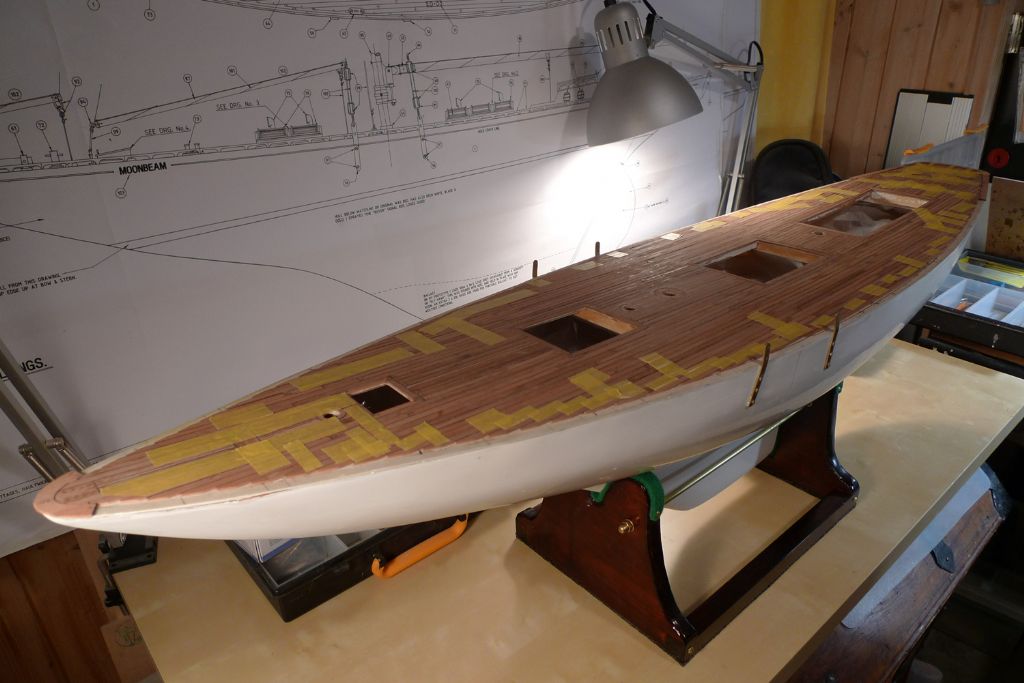
                                        mbbygg490.jpg

                                        I therefore spent an hour last night cleaning up my worktops, getting rid of the debris from over a month of preparing and fitting planks …

                                        mbbygg491.jpg

                                        … and will next crack on with the final bit of deck work, i.e. making up the remainder of the waterway planks.

                                        After that, and scraping down and sanding the deck, it'll finally be time to finish preparation of the hull surface, and then, paint-ho!

                                        mbbygg492.jpg

                                        To be continued …

                                        Mattias

                                        #67474
                                        Bob Abell 2
                                        Participant
                                          @bobabell2

                                          Well done, Banjo…….Your sanity is almost restored now?

                                          So it`s taken about 4 weeks?……….It`s been well worth it!

                                          Now, don`t forget, Banjo…….No "Jumping the gun" with the painting, otherwise, the rivet counters will be onto you…..Like a Shot!

                                          Hope you can understand my little sayings?……..Colourful stuff….eh?

                                          How will you fill the vacuum, once your model is done and dusted?

                                          A nice problem

                                          Bob

                                          #67475
                                          Banjoman
                                          Participant
                                            @banjoman

                                            Thank you very much, Bob!

                                            Actually, I find this kind of job more restorative of sanity than the opposite! The slightly hypnotic effect of the repetitive element combined with interesting problem solving and the slow bu steady progress really helps me relax and feel good. Therapeutic is the word, I think.

                                            Yeah, I know. I'm weird. I play the banjo, too, you know …

                                            All in all, I think I will have spent around five weeks (the first planks was laid on Sunday, July 31st) and +/- 100 hours on planking this deck.

                                            As for the rivet counters, apart from the fact that this build has no rivets to count, I don't think any guns'll be jumped on the painting front …

                                            Once the deck has been glued down, scraped and sanded, I will mask it off, leaving the waterways slightly proud of the hull edge for the time being.

                                            I'll then turn the hull upside down, and (provided the U-Pol #5 passes it's paint compatibility test, which I'm reasonably confident it will) spray on some U-Pol #5 filler primer to deal with any remaining minor imperfections in the hull surface, including any small gaps in between the hull edge filler and the underside of the waterway planks.

                                            Once this is done, it'll be time to plane and sand down the waterway edges to make them flush with the hull. The whole hull will then be smoothed down with 1500 and 2500 grit wet paper, and finally degreased with methylated spirits to prepare it for the primer paint. Before I start painting, all the deck wood will be masked off again.

                                            After primer paint is on and dry, I will apply gloss white paint in a belt around the hull at the waterline height. The waterline will be marked out and then masked off for the remainder off the painting, with the keel painted bright red and the top of the hull cobalt blue.

                                            At this point, again once everything is properly dry, the boat's name will be applied and also some gold trimline along the top of the hull sides. The waterline will then be unmasked and the whole hull given a number of coats of gloss varnish, after which the deck will also be unmasked and gloss varnished.

                                            All paints and varnishes will be waterbased acrylics from the Vallejo Premium RC range (**LINK**), applied with an airbrush.

                                            As you see, I have the sequence pretty much thought out for the next steps …

                                            Oh, and I am not worried about what to do next! I actually have a list of projects considerably longer than my arm, but next up will be a Fairey Huntsman 31 from the recently published set of plans by Dave Milbourn, and after that I have the (ex-) Metcalf Mouldings kit for the RNLI Rother class lifeboat Alice Upjohn sitting in my attic … and after that … I shall have to live and keep a steady hand until at least 120 years of age if I'm going to have even a small chance of making any significant inroads into said list …

                                            Mattias

                                            Edited By Banjoman on 01/09/2016 08:49:54

                                            Edited By Banjoman on 01/09/2016 09:00:12

                                            #67494
                                            Ray Wood 3
                                            Participant
                                              @raywood3
                                              Hi Banjo

                                              Your doing a brilliant job with the deck, I imagine you wished you'd scratch built the hull to do justice to the effort with the deck now ? I'm glad you have future building programme planned, I'm hoping to live to at least 200 to build all the kits etc up in my loft

                                              Regards Ray

                                              #67526
                                              Banjoman
                                              Participant
                                                @banjoman

                                                Thank you ever so much, Ray!

                                                Well, yes, in a way I usppose a scratch build would have had its upsides, as any errors would have been entirely of my own making … However, on the whole, no – I'm quite happy with building this model from a kit.

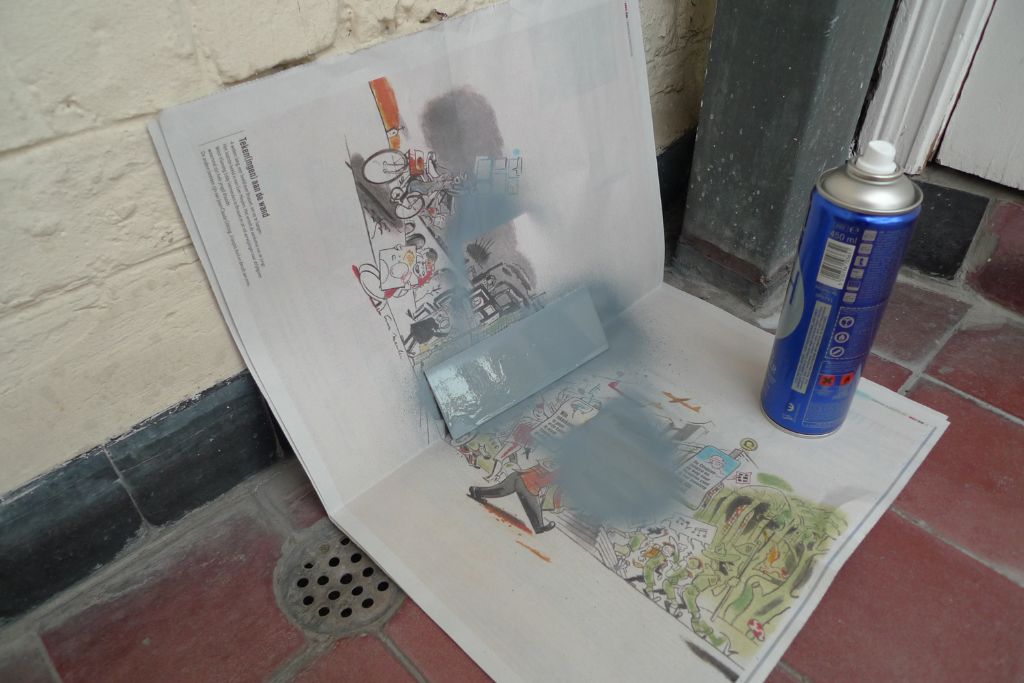
                                                As discussed above, and just mentioned in another thread here, I wanted to test the chemical compatibility between U-Pol High#5 spray filler and the water-based acrylic Vallejo RC Premium paints I shall use to paint Moonbeam.

                                                I therefore prepared a test piece of some plasticard, and sprayed it with filler.

                                                mbbygg494.jpg

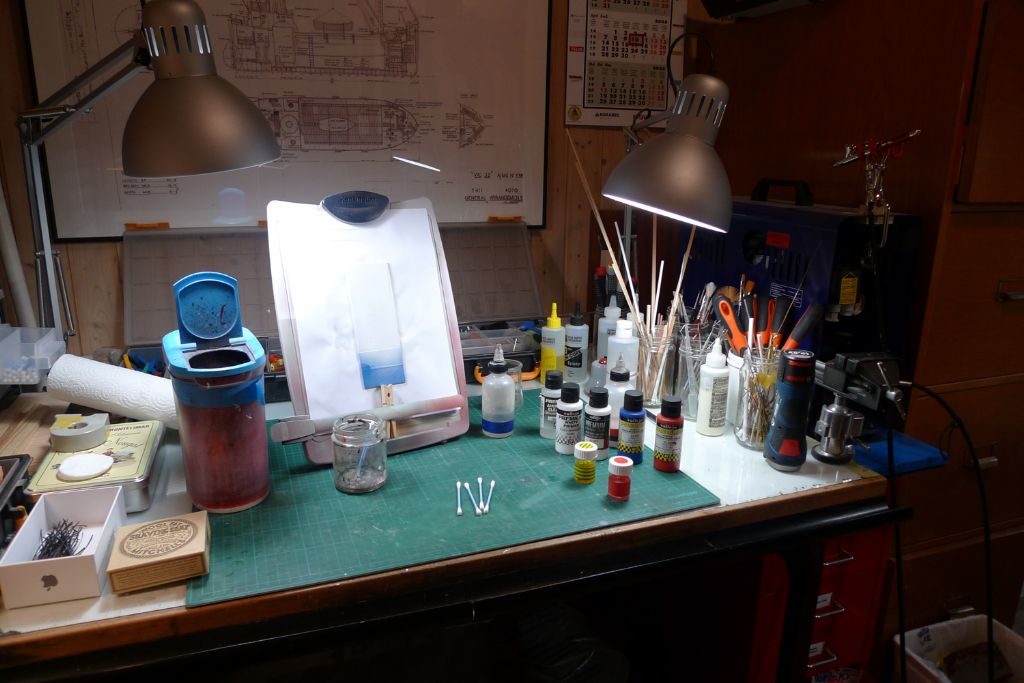
                                                Once the filler had gone off completely, I tubbed it down with 800 and 1500 grit wet paper, and then got out the airbrush equipment and the relevant paints.

                                                I first painted on some white primer, but to also test if there would be a difference with and without primer, one end of the test piece was masked off at this stage.

                                                mbbygg495.jpg

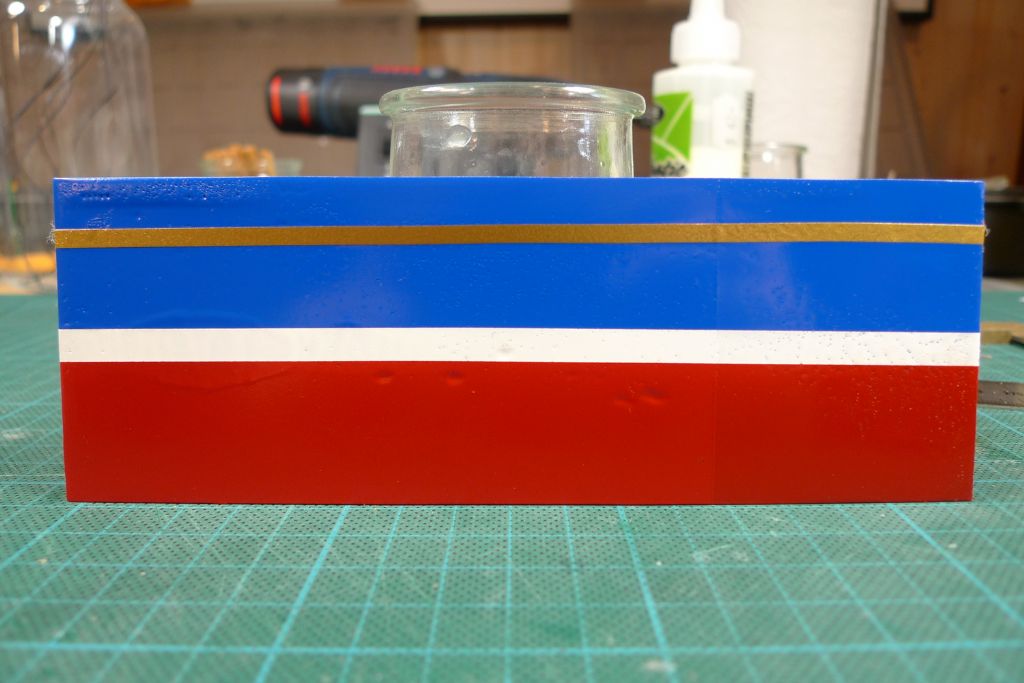
                                                … I then painted a middle stripe white and, once dry, masked it off with some 6 mm masking tape and blew on some cobalt blue paint above and some bright red below.

                                                Finally, I added a short length of gold trimline, and sprayed the whole thing with a couple of coats of gloss varnish.

                                                The final result should not be inspected for quality of paint finsih – it has been quite a rush job – but I am happy to report that the test outcome seems to be fully positive – I have noticed no adverse reaction as yet, and even when seriously bending and flexing the piece of plasticard, everything stays nicely together with no cracking or peeling.

                                                I am also quite happy with the choice of colours, although it should be noted that the blue is in reality a tad darker than it appears in the photo.

                                                mbbygg501.jpg

                                                To be continued …

                                                Mattias

                                                #67530
                                                Banjoman
                                                Participant
                                                  @banjoman

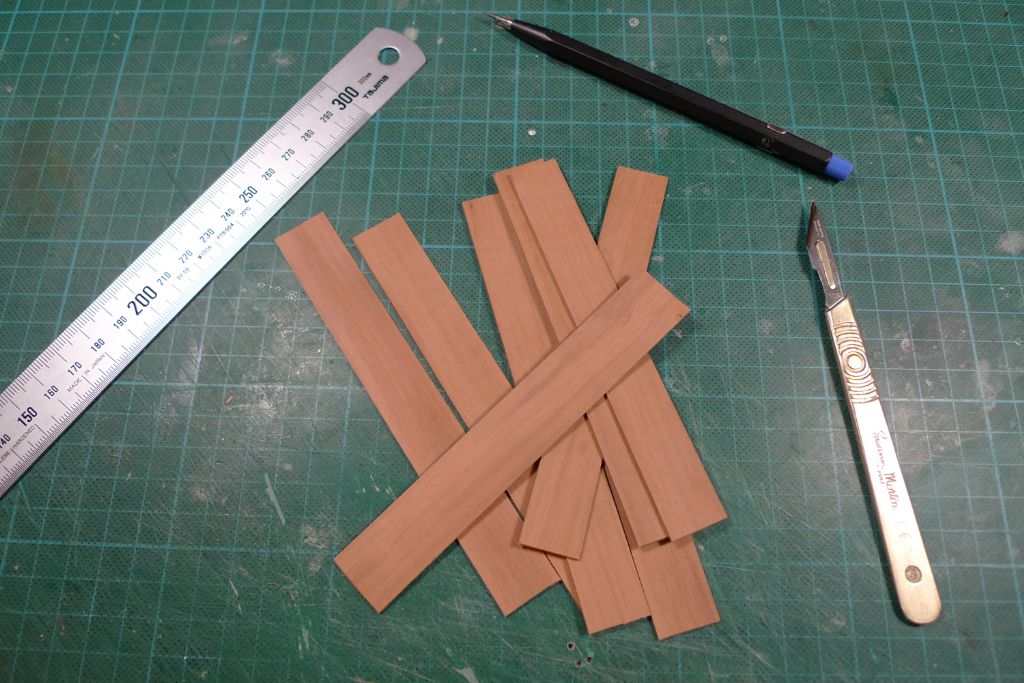
                                                  I have not just been playing with my crayons over the weekend, though, but have also continued to make progress with the waterways planking, first cutting blanks from a pear wood sheet …

                                                  mbbygg496.jpg

                                                  … and then shaping and fitting lengths of waterway.

                                                  mbbygg502.jpg

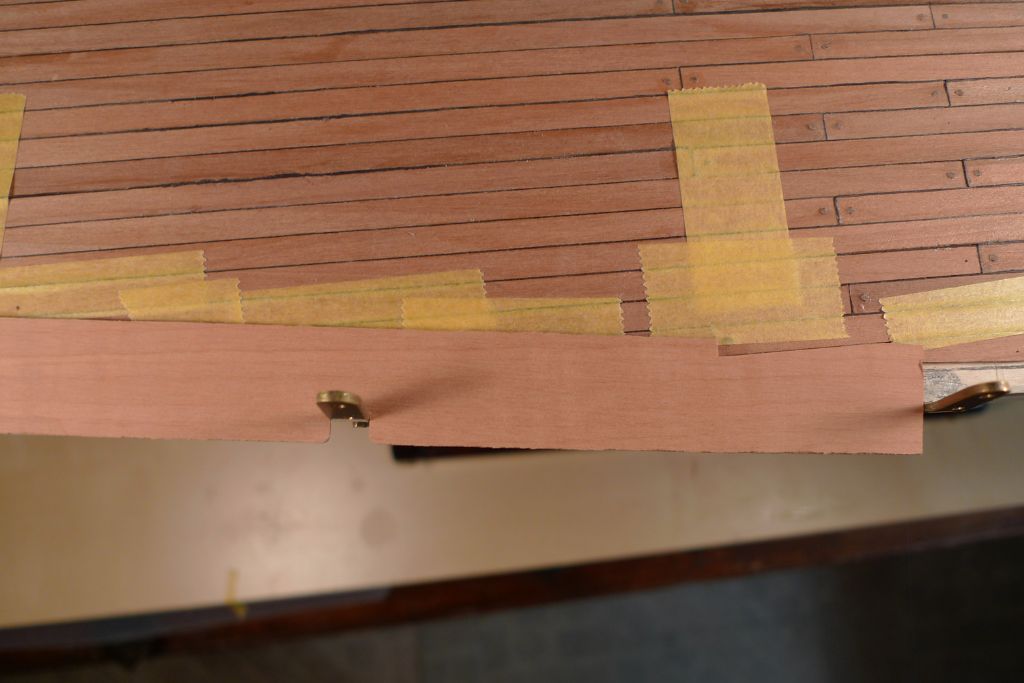
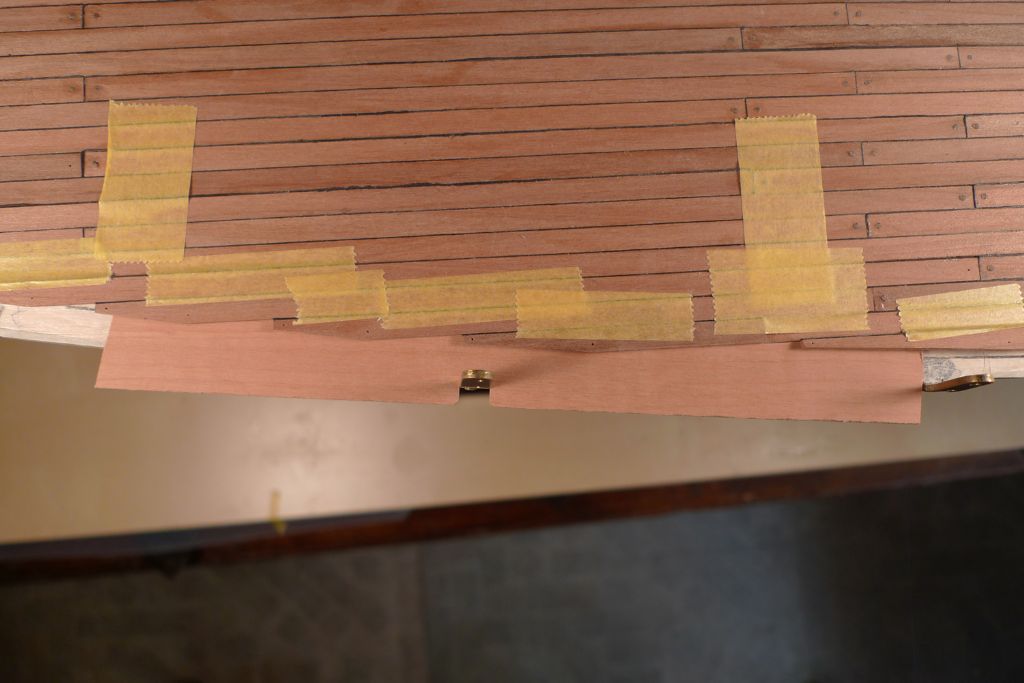
                                                  The two pieces that fits up to the inboard sides of the shroud plates needed some extra care, to get them to fit just so between their respective shroud plates and the standard deck planks inboard lof those that were already glued down.

                                                  With some careful and gradual cutting out …

                                                  mbbygg503.jpg

                                                  … a proper fit was acheived, the end planking contour scribed unto the waterway plank …

                                                  mbbygg504.jpg

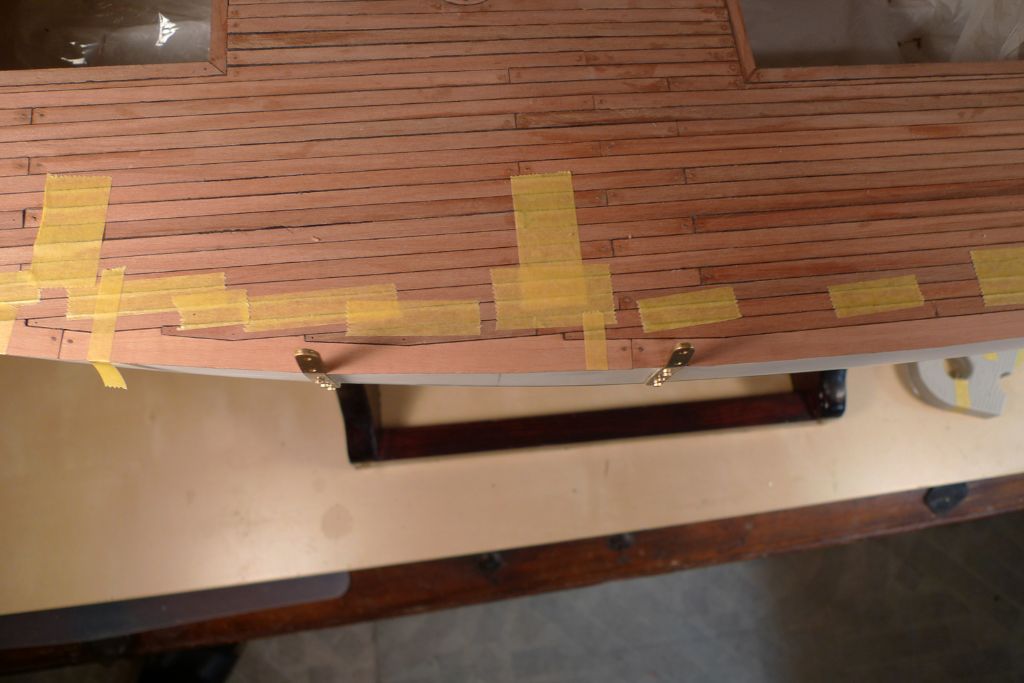
                                                  … and the whole thing fitted after caulking and final finessing of the shroud plate cut-outs.

                                                  mbbygg505.jpg

                                                  This completed the port side waterway planking; now only the starboard side remains to be made up, before general glueing-down can commence …

                                                  mbbygg506.jpg

                                                  To be continued …

                                                  Mattias

                                                  Edited By Banjoman on 04/09/2016 17:13:54

                                                  #67552
                                                  Banjoman
                                                  Participant
                                                    @banjoman

                                                    Yesterday evening saw two more waterway planks added to the starboard quarter …

                                                    mbbygg507.jpg

                                                    … and three more to the starboard bows …

                                                    mbbygg508.jpg

                                                    … which means I now only have the two final, midships waterway planks to starboard left to do, before the final deck glue fest can get into swing …

                                                    To be honest, I can't say that I mind — my right hand index finger is starting to develop calluses from pressing down on the scalpel handle …

                                                    mbbygg509.jpg

                                                    To be continued …

                                                    Mattias

                                                    Edited By Banjoman on 06/09/2016 07:26:25

                                                    Edited By Banjoman on 06/09/2016 07:27:43

                                                    #67557
                                                    Banjoman
                                                    Participant
                                                      @banjoman

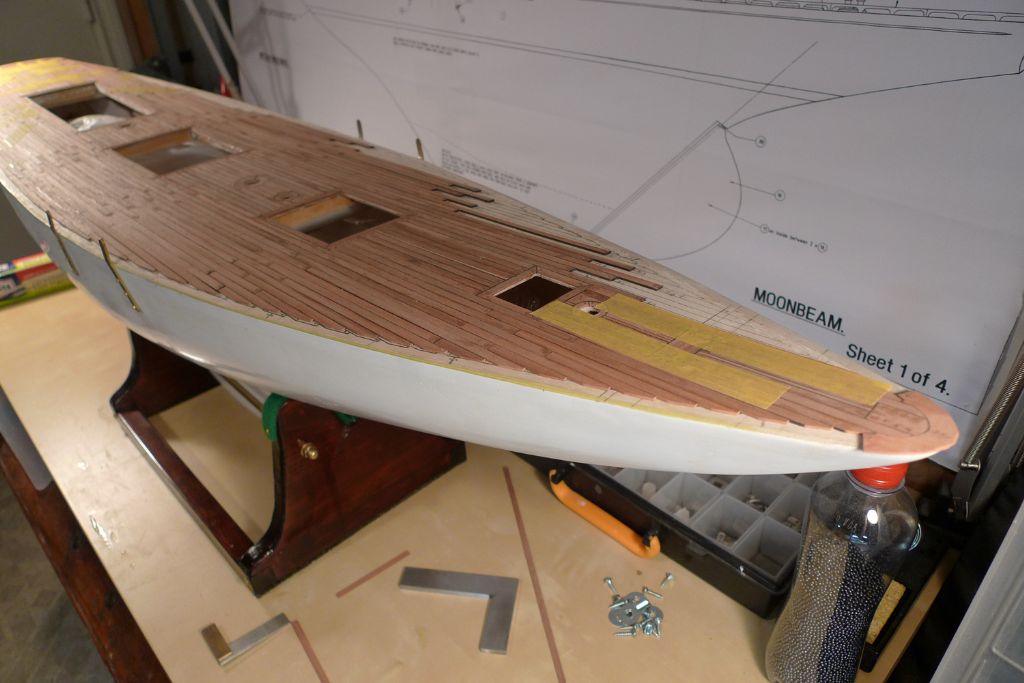
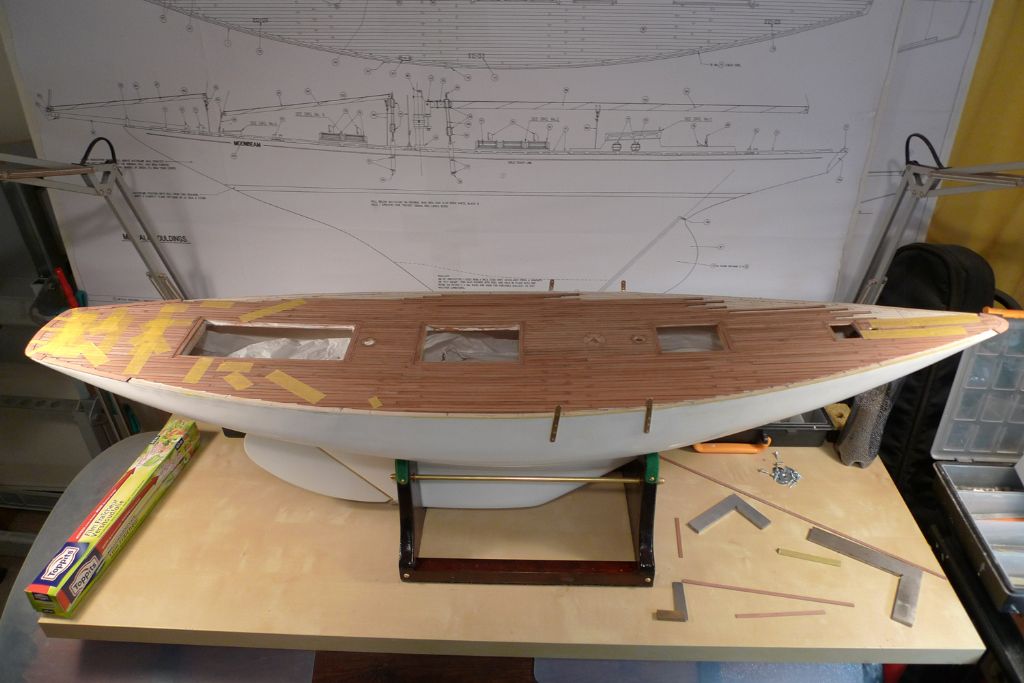
                                                      Aaand … there it is! The two final waterway planks to starboard have been made up, too, so tomorrow I'll get the glue out and start fixing in place those parts of the deck that are as yet only dryfitted (the masking tape gives a pretty good clue as to which parts that might be) …

                                                      mbbygg510.jpg

                                                      To be continued …

                                                      Mattias

                                                      Edited By Banjoman on 06/09/2016 17:59:24

                                                      Edited By Banjoman on 06/09/2016 18:00:06

                                                    Viewing 25 posts - 151 through 175 (of 440 total)
                                                    • Please log in to reply to this topic. Registering is free and easy using the links on the menu at the top of this page.

                                                    Code of conduct | Forum Help/FAQs

                                                    Latest Replies

                                                    Home Forums Sailing Models Topics

                                                    Viewing 25 topics - 1 through 25 (of 25 total)
                                                    Viewing 25 topics - 1 through 25 (of 25 total)

                                                    View full reply list.