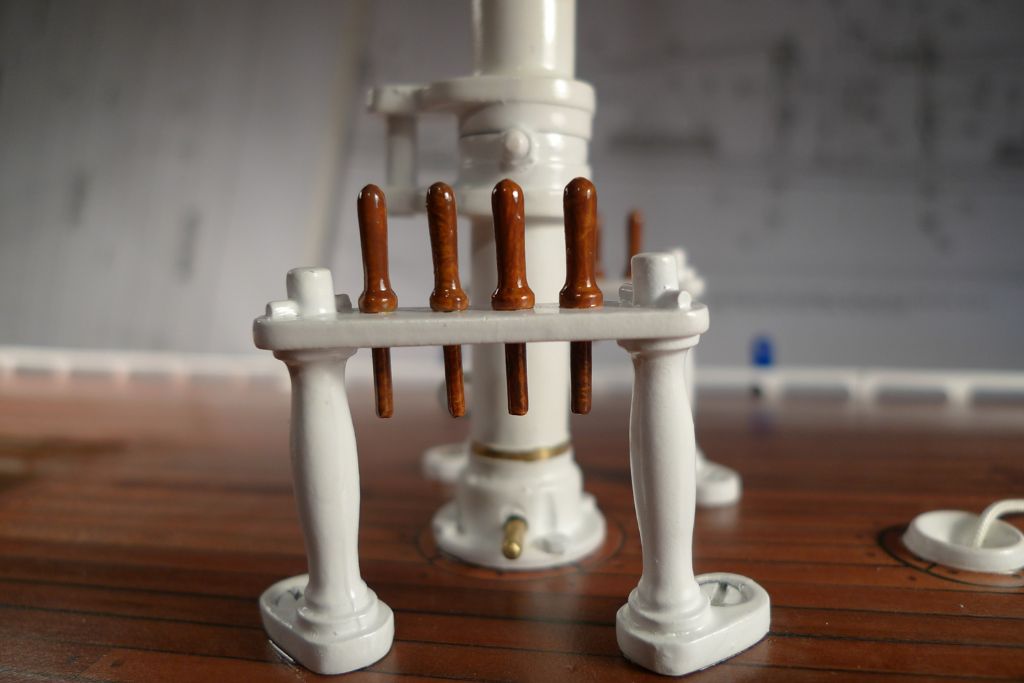
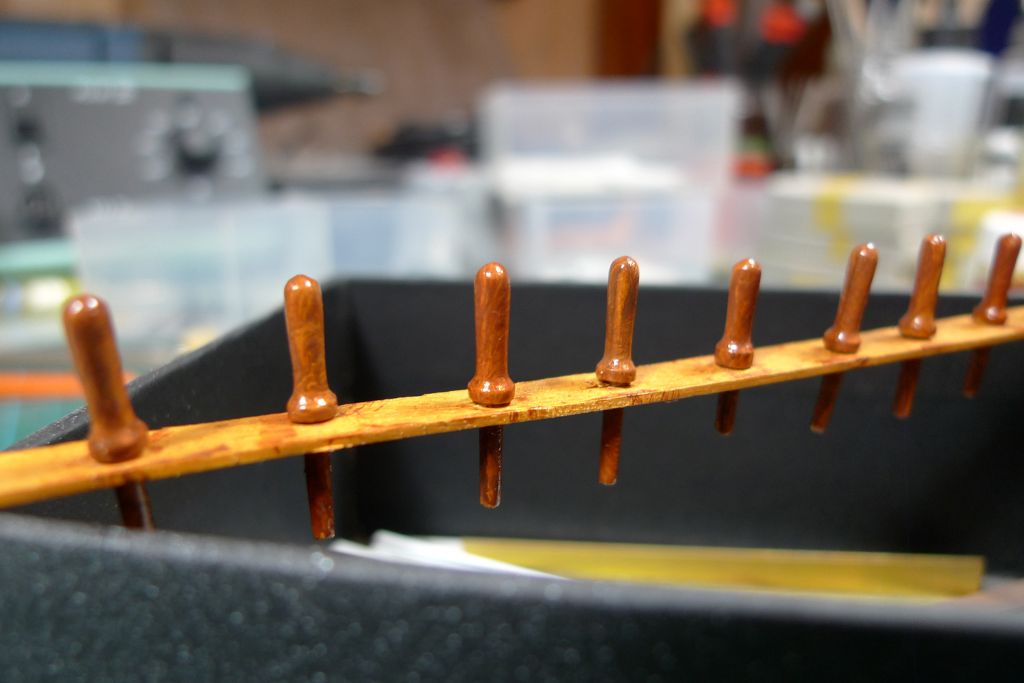
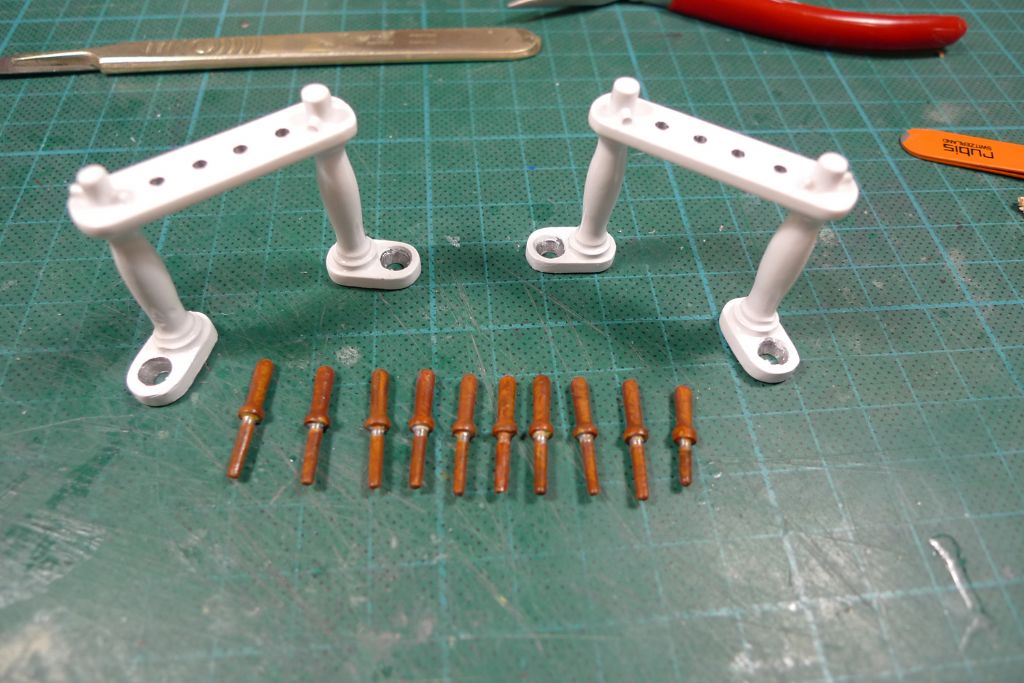
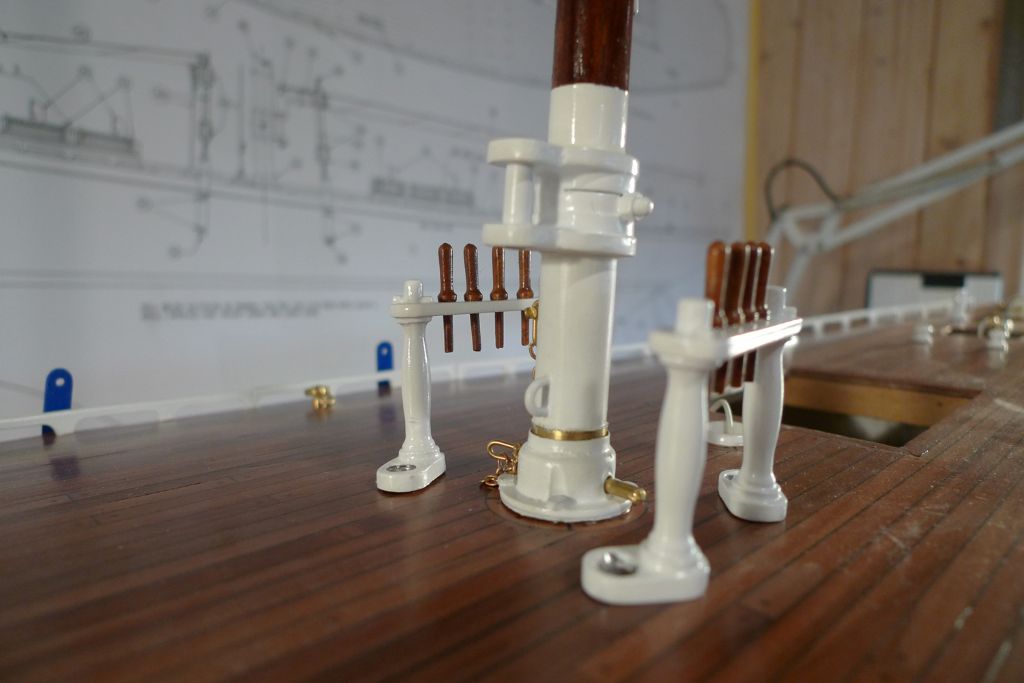
With the belaying pins secured to the pin rails and varnished, it was time to screw down and epoxy glue the pin rail assemblies …
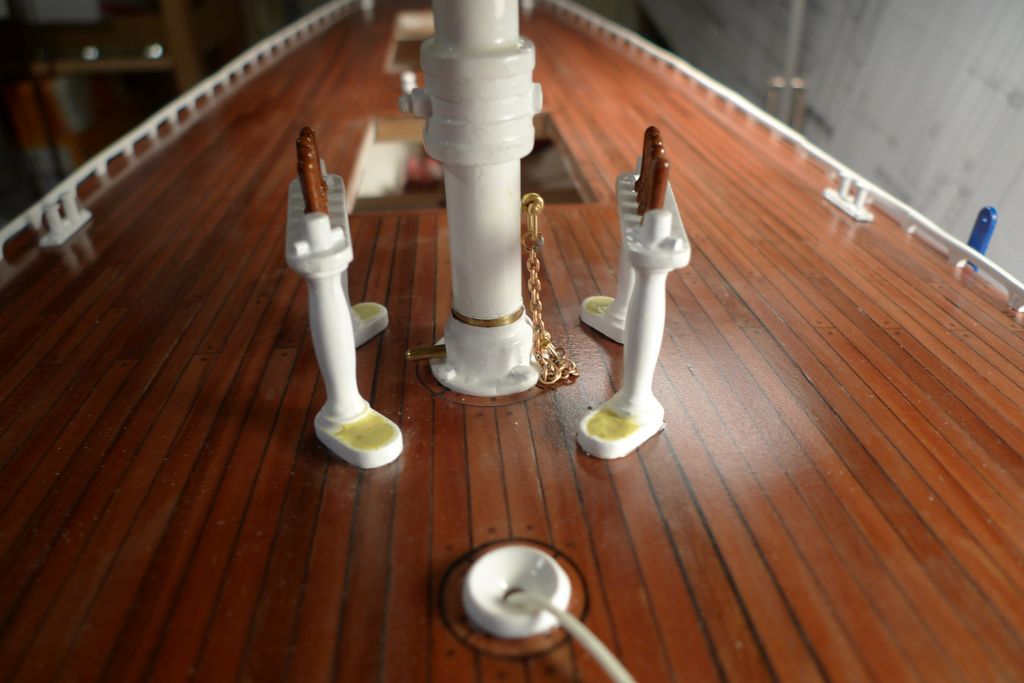
… and, once the epoxy had gone off, to fill in the screw heads and their holes with some Milliput.
Inbetween and while waiting for various slow-curing substances to cure, I began work on the main boom. According to the plan and instructions, this should be made up from 10 mm dowel to be just plain cylindrical, but I think such a spar looks so much better if given a slight taper.
I thus set up the blank in the micro lathe — fortunately a 10 mm dowel will pass through the spindle — and turned the very tip down to 7,5 mm, put on a slightly more pronounced taper for the first 50 mm or so of spar, and then sanded an ever so gentle taper on to the rest of the length.
To stop the excess blank sticking out behind the spindle from whipping about, I drafted in my wife who, wearing thick leather work gloves, acted as a living steady; the same was then done on the right hand side of the lathe for sanding the butt end part with the tip just sticking out into free air.
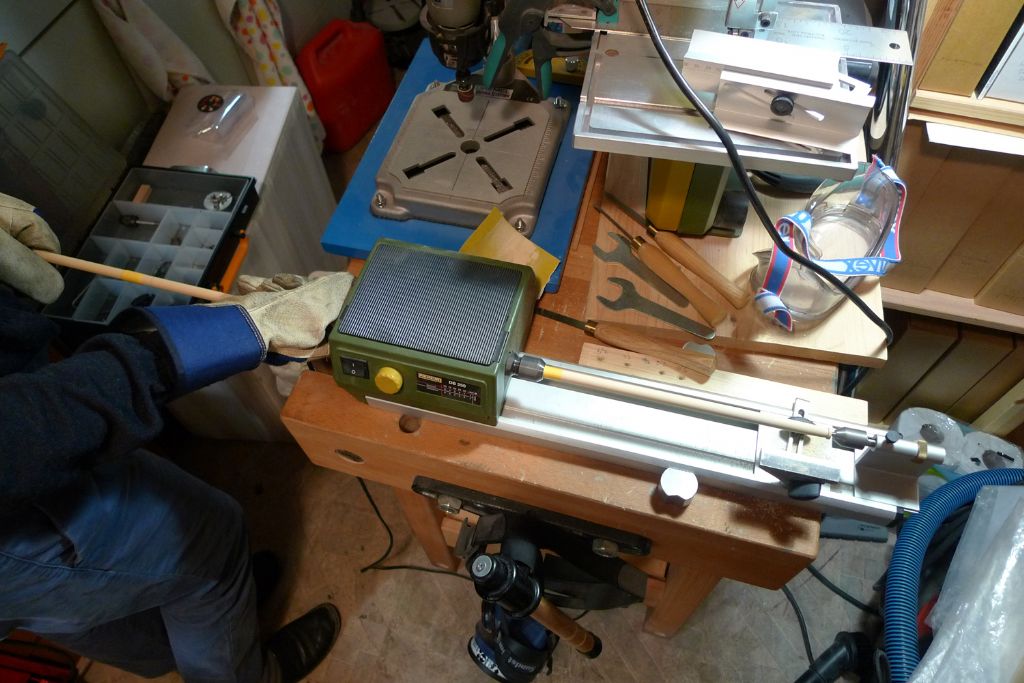
In any case, the taper is really not very pronounced, but I think gives the spar a slightly less clumsy look.
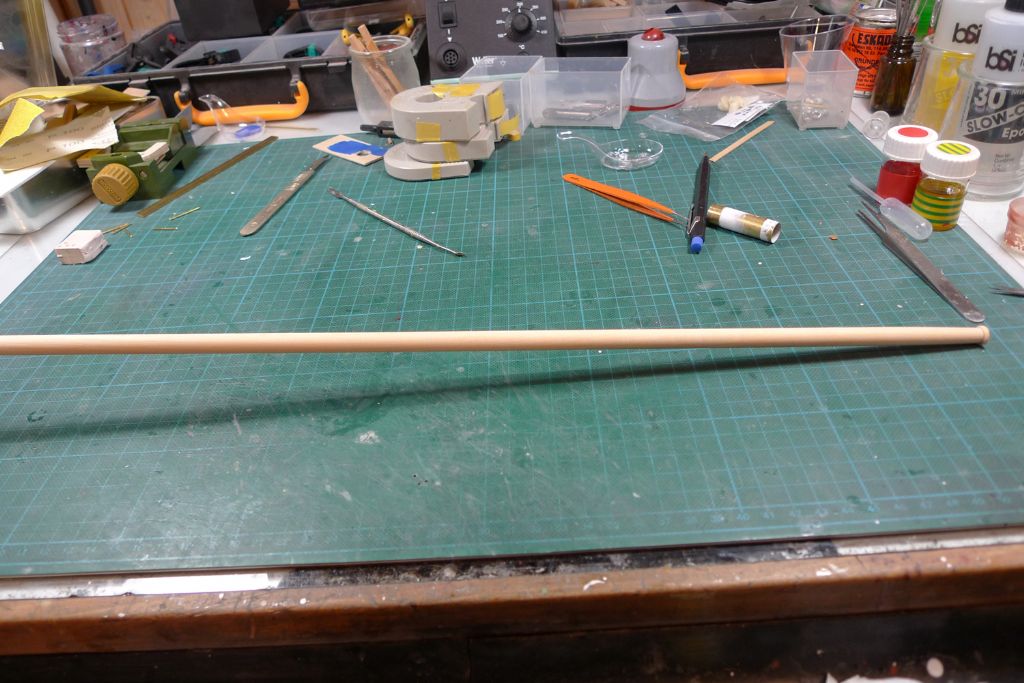
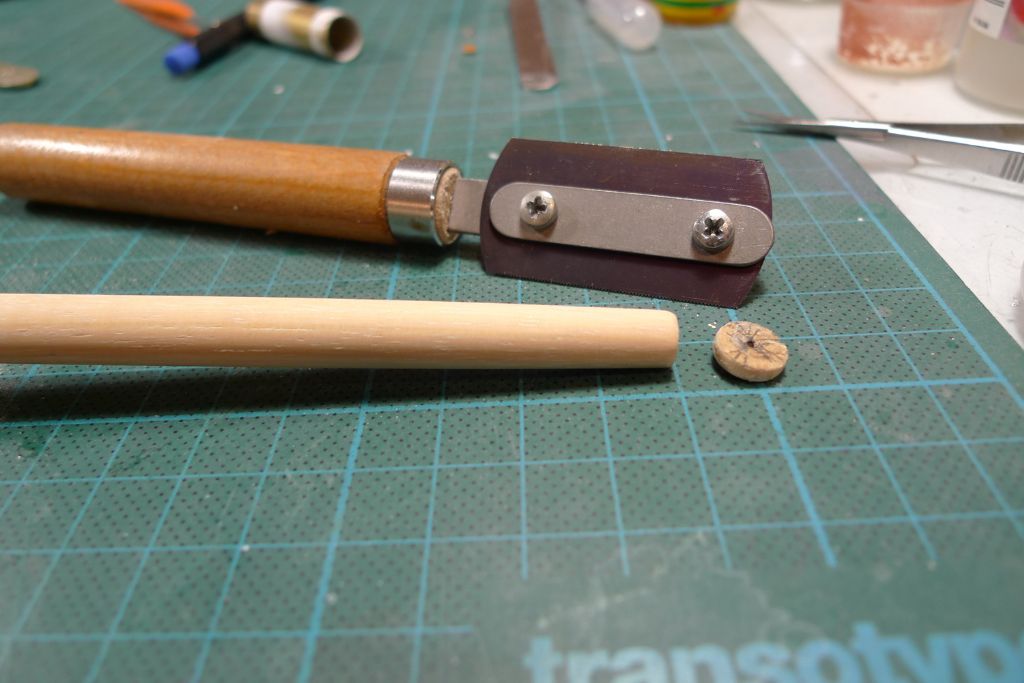
The outermost two mm of the tip, which had not been reduced in diameter, was then sawed off to remove the tailstock centre hole.
I have also fettled and generally cleaned up the white metal gooseneck parts and also the gaff end jaws, and gotten out the fastenings I shall use: an M3 nut-and-bolt for the gooseneck hinge, and four M2.5 nuts-and-bolts for securing the end fittings to their respective spars.
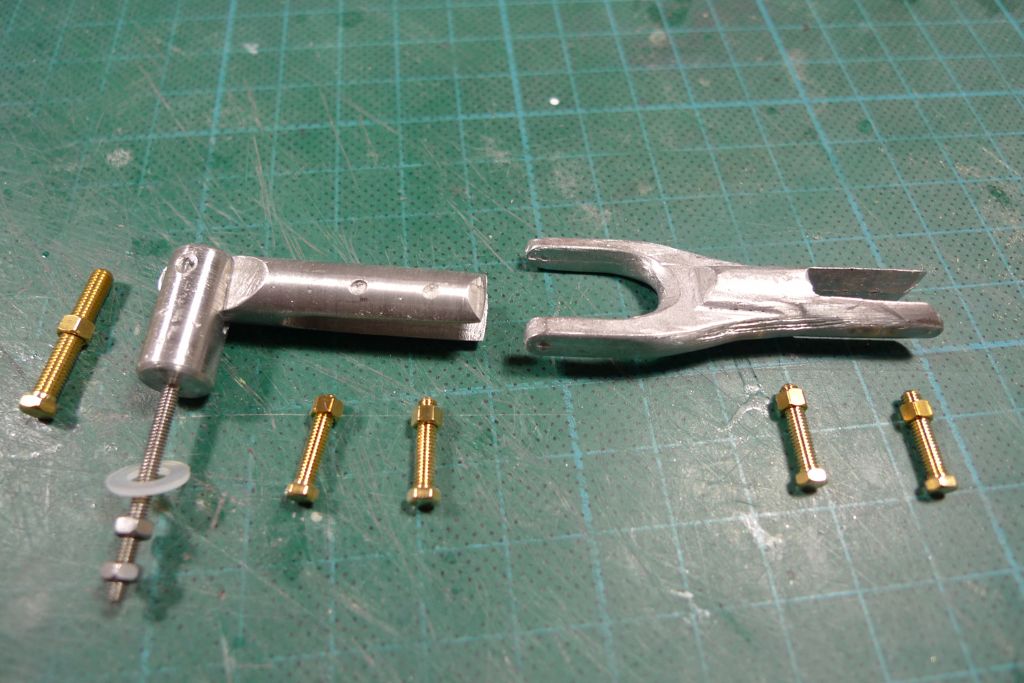
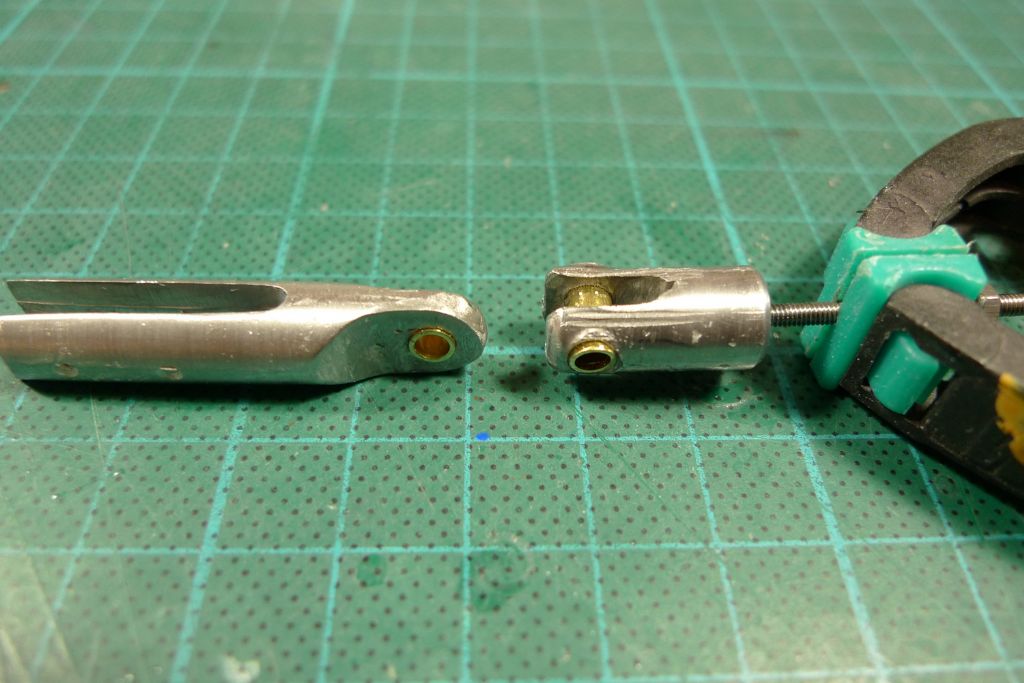
As usual, I don't particularly trust white metal as a bearing material, and I therefore drilled out 4 mm holes through the gooseneck swivel …
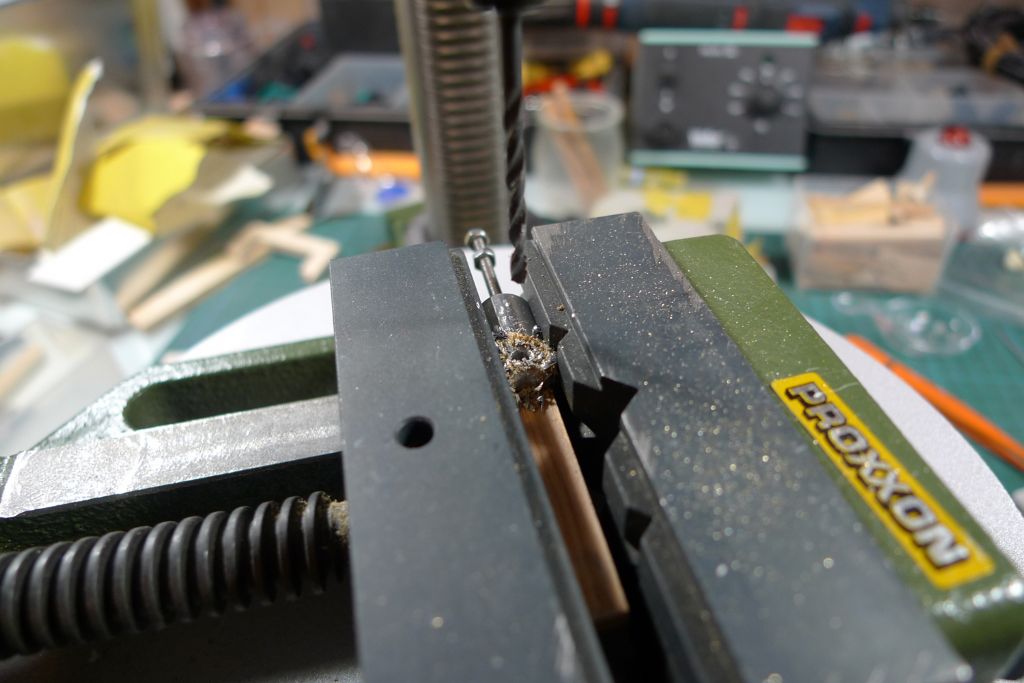
… and boom end fittings, into which bushings from 4 mm brass tube were epoxied. Obviously, the central part of the bushing going through the swivel shall be cut away once the epoxy has gone off, but by inserting it in one piece like this, I can be sure that both the resulting holes will be neatly aligned.
The boom end has to be chamfered to take the end fitting, so I set it up in a machine vise (with some masking tape to protect the wood against the jaws), marked out the top centre line with some 1 mm wide tape, and finally copied the shape of the boom end fitting jaws onto some masking tape, cut it out and applied it to the top of the boom end …
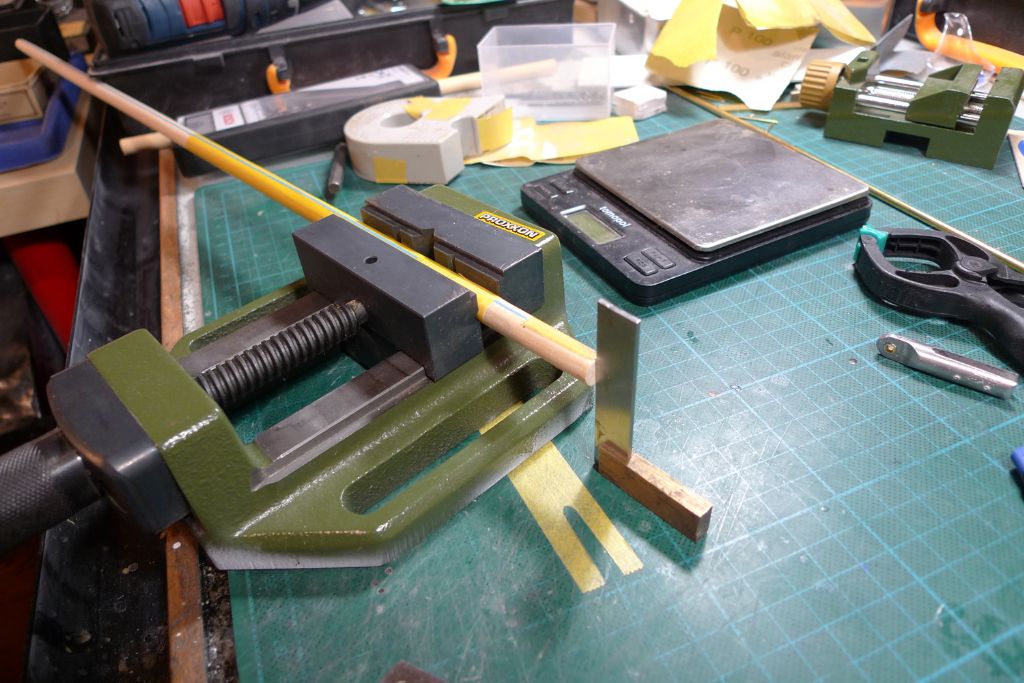
… to provide a guide for roughly cutting away the excess boom material on the band saw …
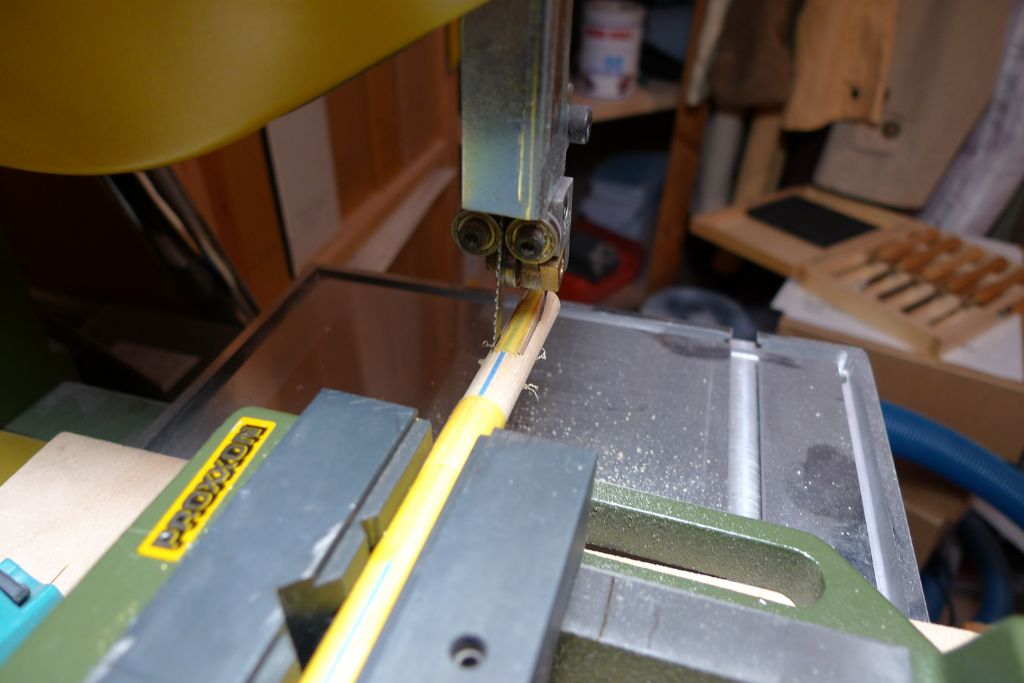
… and thus get the rebating started with both faces quite perpendicular to the marked-out centre line.
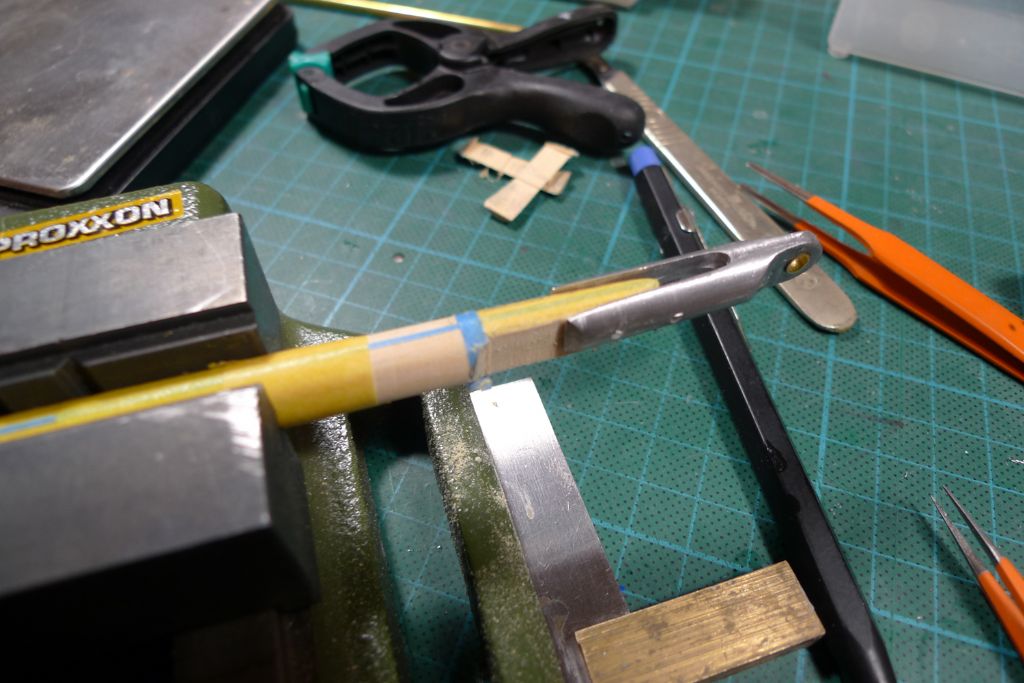
Before removing the spar from the machine vise, I also marked out and drilled for the two brass rod loops required on the underside of the boom, one for attaching the kicking strap and one for the main sheet to hook on to, thus making sure they are based on the same plummet line as the rebated boom end faces.
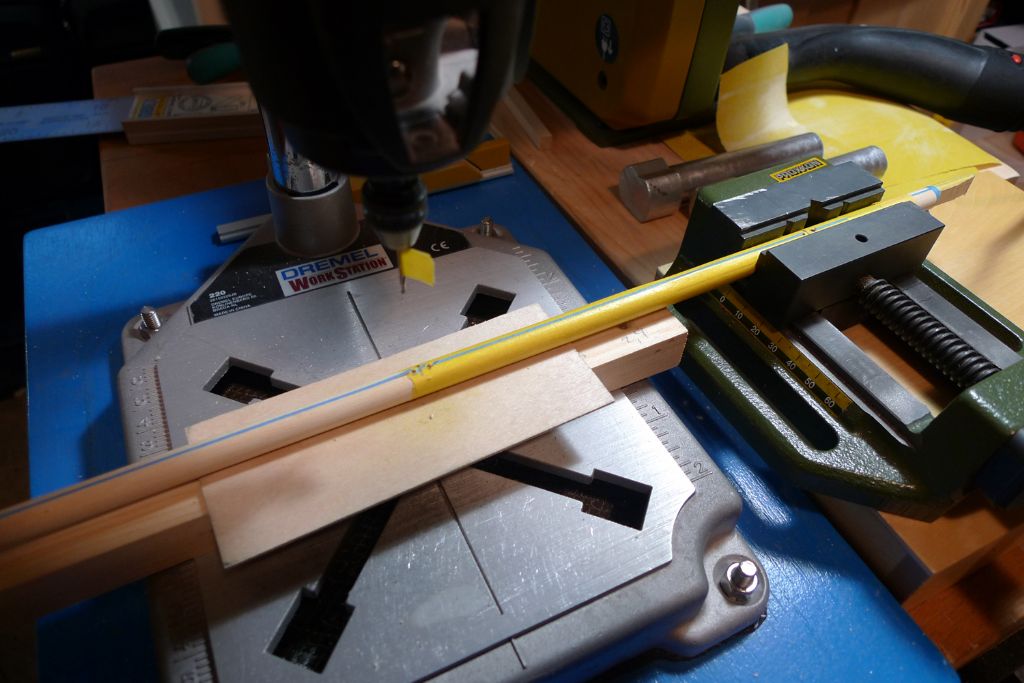
A little more filing and sanding will still be needed for the boom end fitting to be a good eough fit, but on the whole it is there.
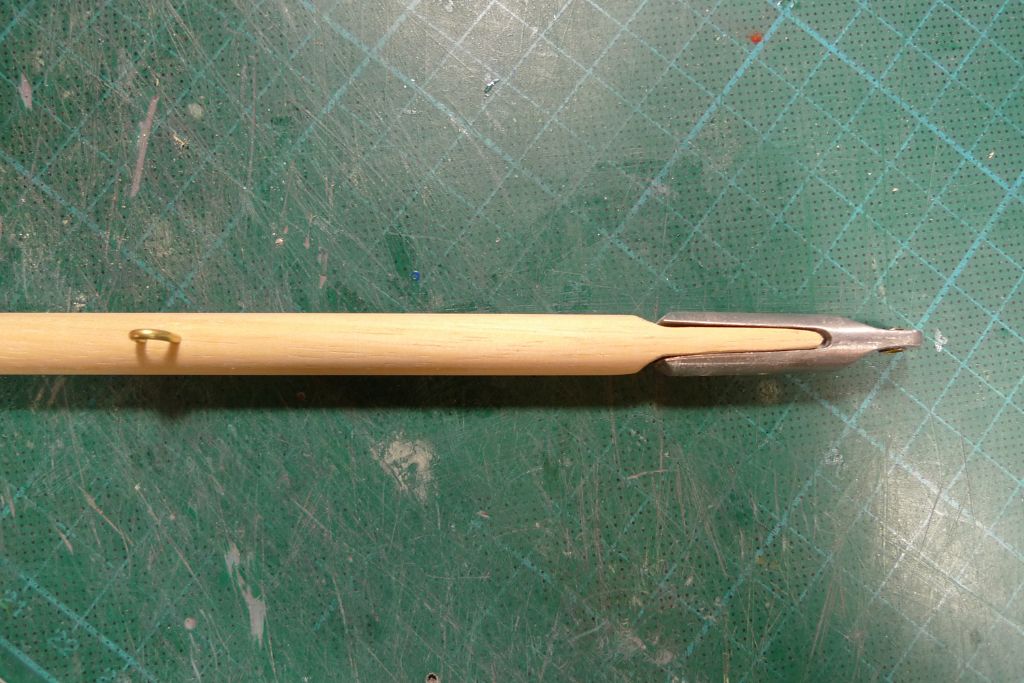
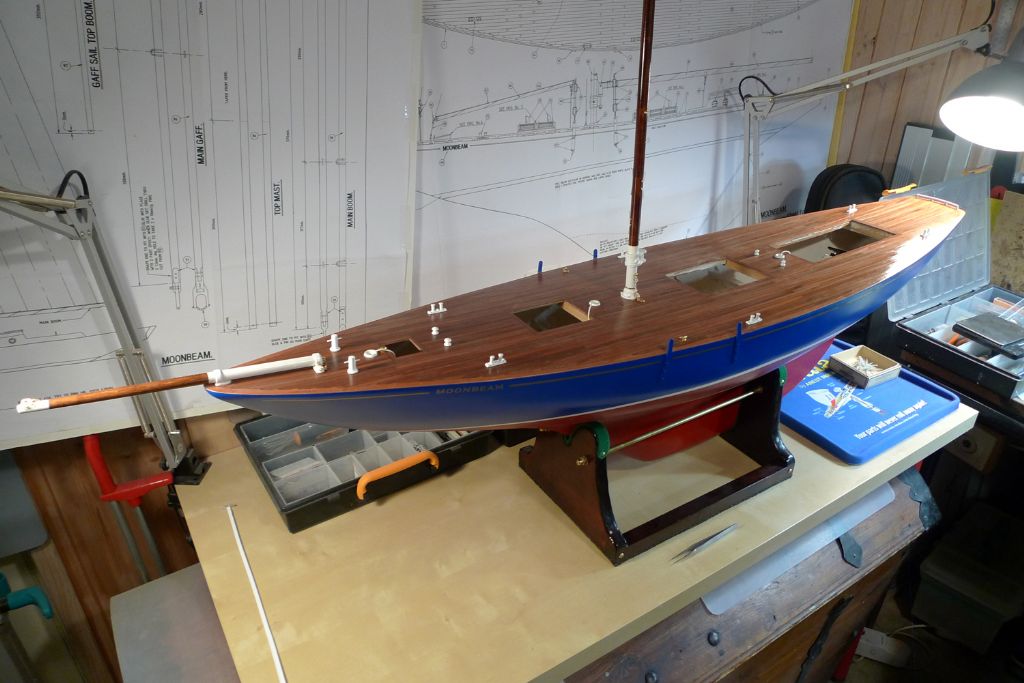
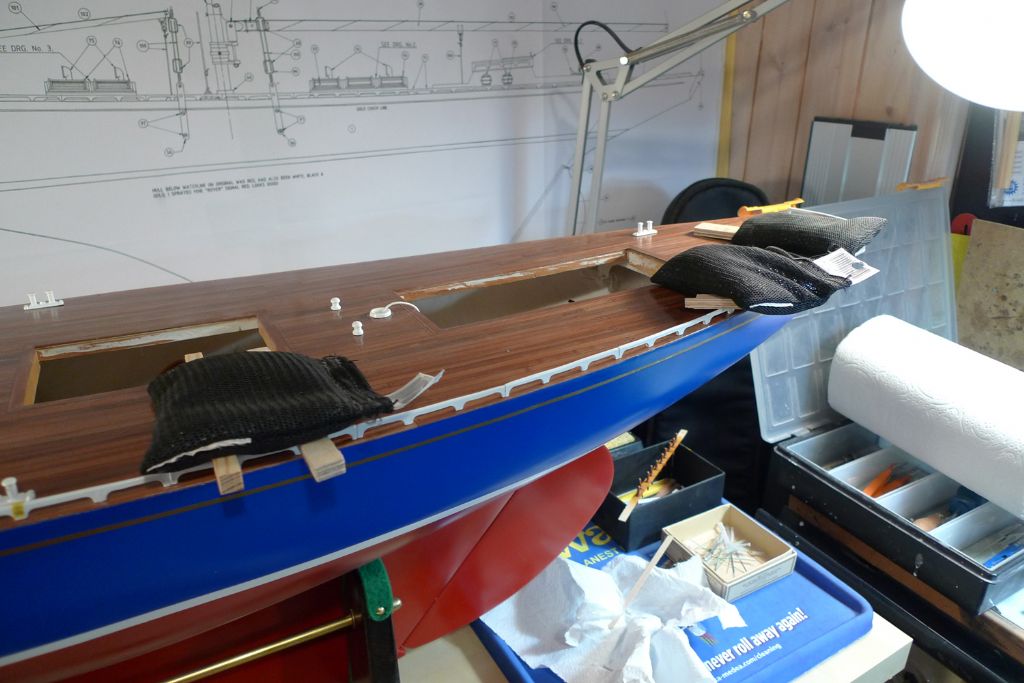
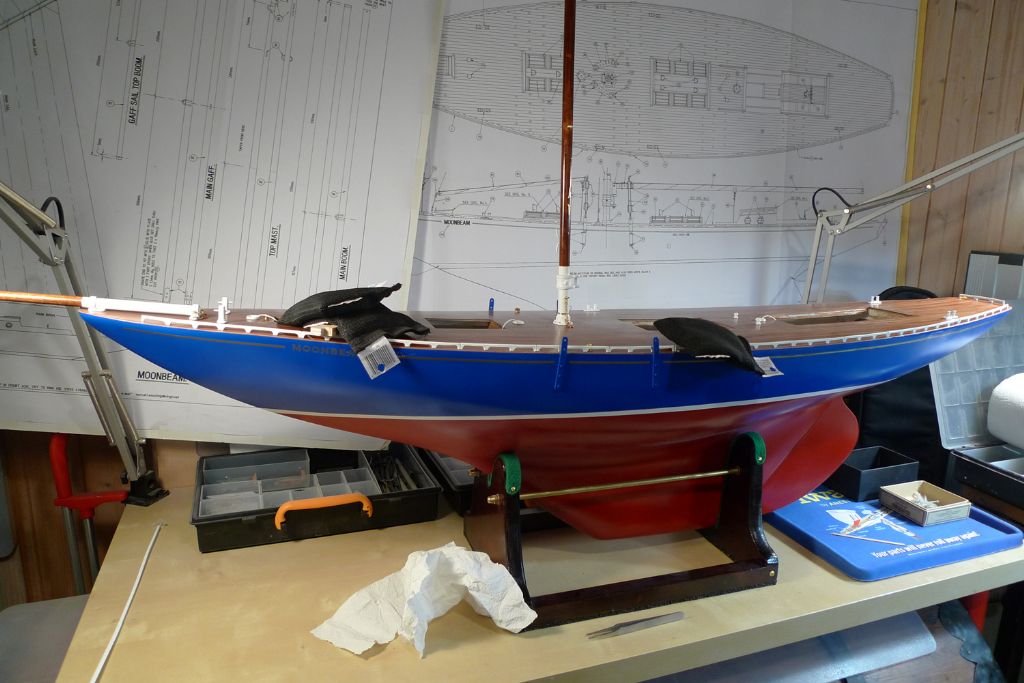
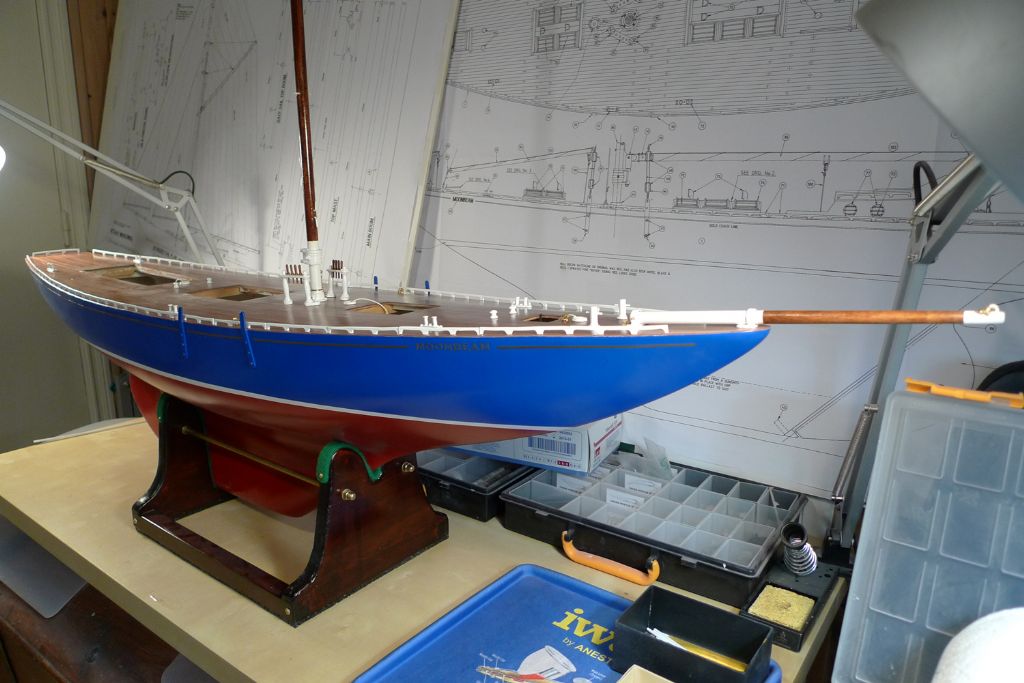
With the Milliput also gone off, the pin rail feet have been painted and varnished, which means that the deck fittings are now complete and finished.
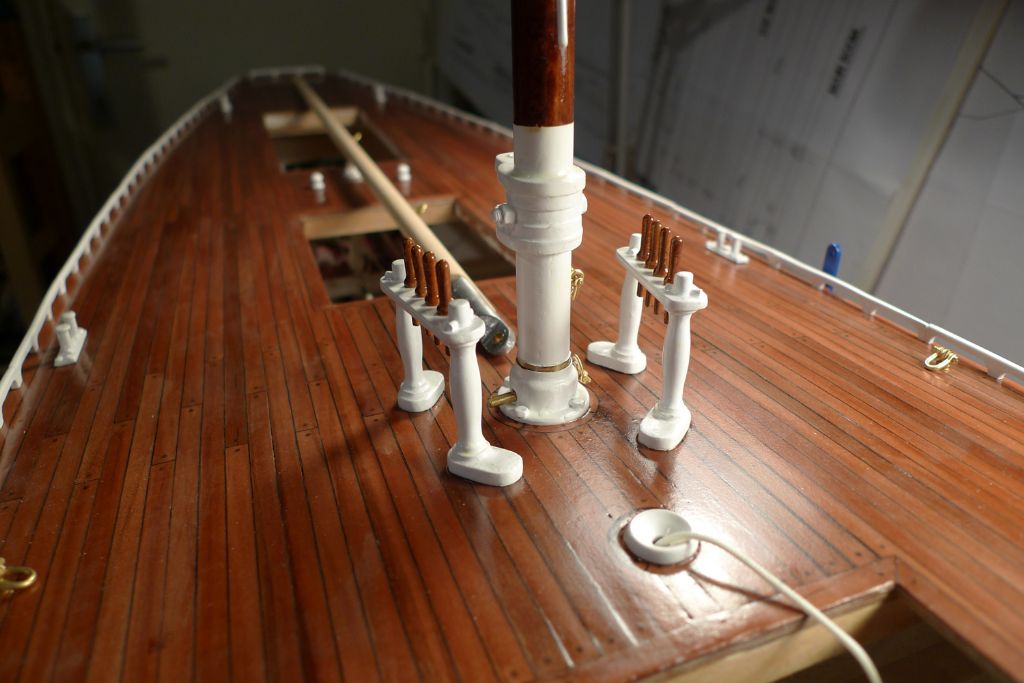
To be continued …
Mattias
Edited By Banjoman on 30/01/2017 09:03:48
Edited By Banjoman on 30/01/2017 09:05:01

Bob Abell 2
@bobabell2
Hello Banjo
The belaying pins look very woody and realistic!
As do the rest of the fittings, of course
We look forward to the cabin constructions with interest……….Same old belt and braces?
You are doing a good job, all the same
Bob

Banjoman
@banjoman
Thank you very much, Bob! 
And yes, oil paints really are the bee's knees and the feline's nightshirt, I find, for a painted wood effect.
The construction of the various cabins/skylights/hatches will to some extent be more straightforward, as these are more or less purely decorative (well, they fill the function of closing off the hull openings, but otherwise do nowt but look pretty), but I do indeed have a few ideas for certain bits where I might decide to deviate somewhat from the plans and instructions. And I have yet to decide whether or not to stick with the pre-printed lines and patterns on the plywood parts, and just stain them, or if at least some of those patterns should be replicated in loose wood … ??? The jury is still out on that one, but the judge is likely to send out to them soon and ask if they need any further clarifications of the case in order to reach a decision.
Any road, yesterday I cut away the central part of the swivel brass bushing …
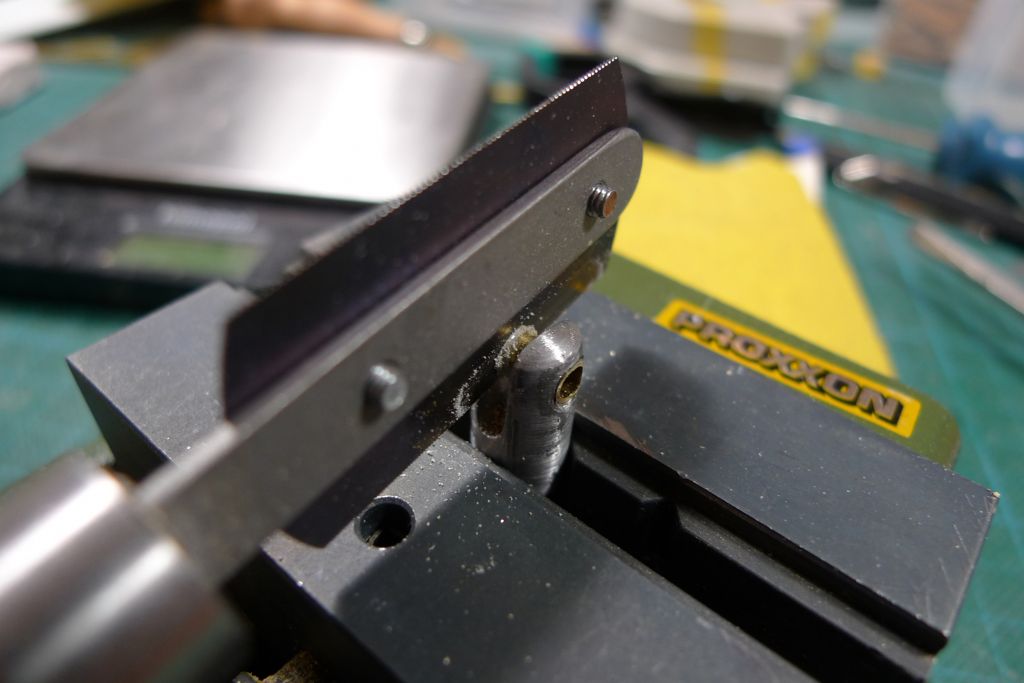
… and filed it and the boom end fitting …
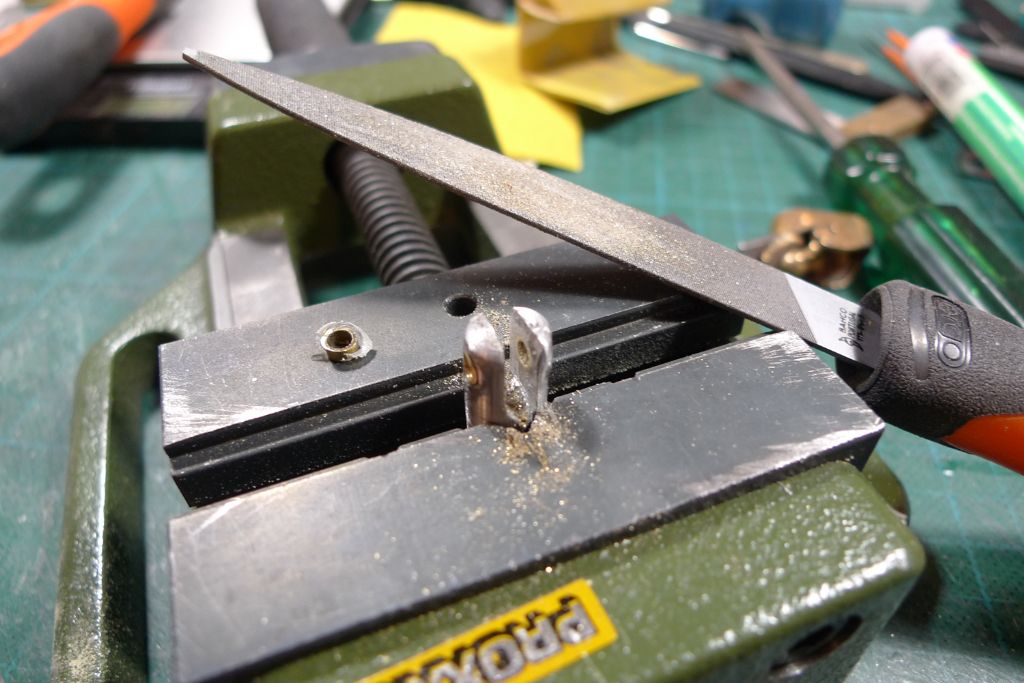
… to fit nicely with an M3 bolt as hinge pivot. The swivel has been set on a M4 nylon washer to get a nice, smooth and low friction surface for it to pivot on.
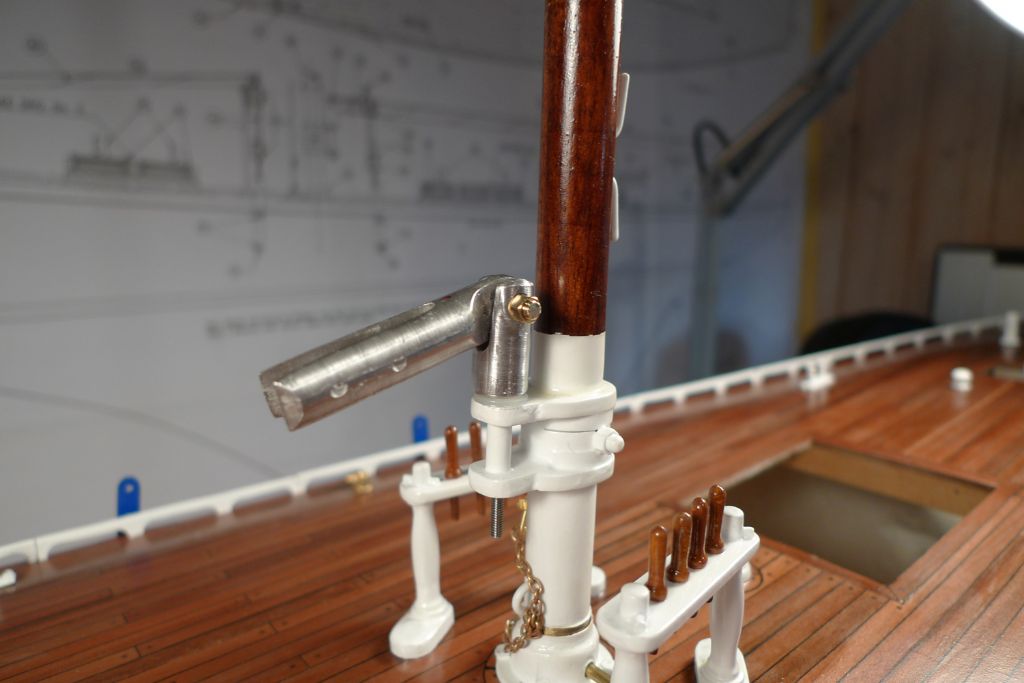
Next, I drilled through the boom end fitting and the boom end …
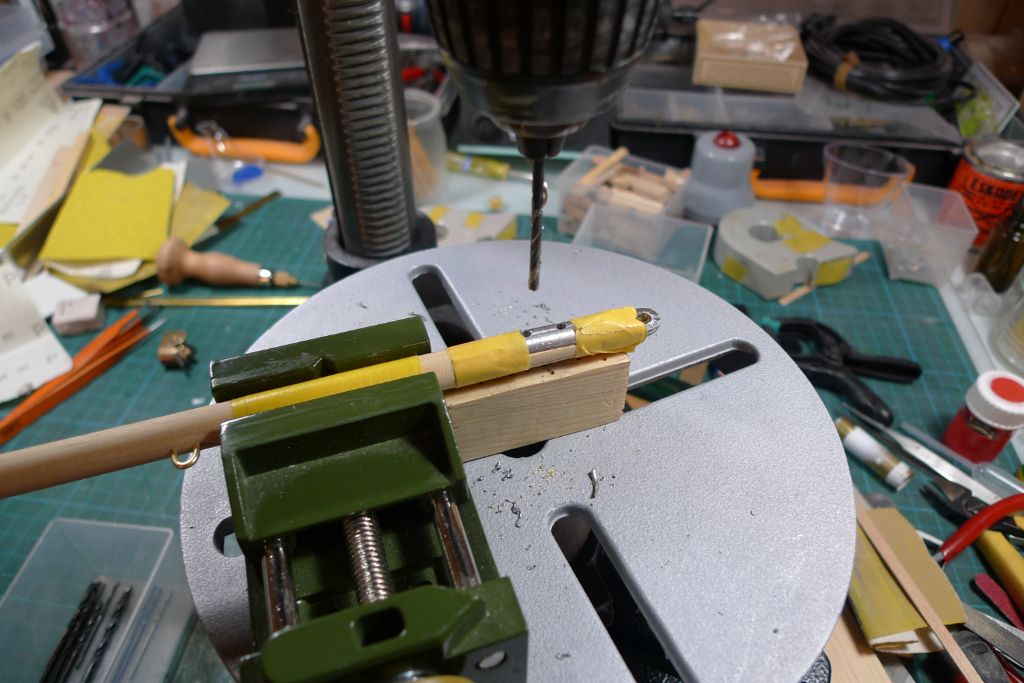
… to take two M2.5 bolts, and then epoxied and bolted it all together …
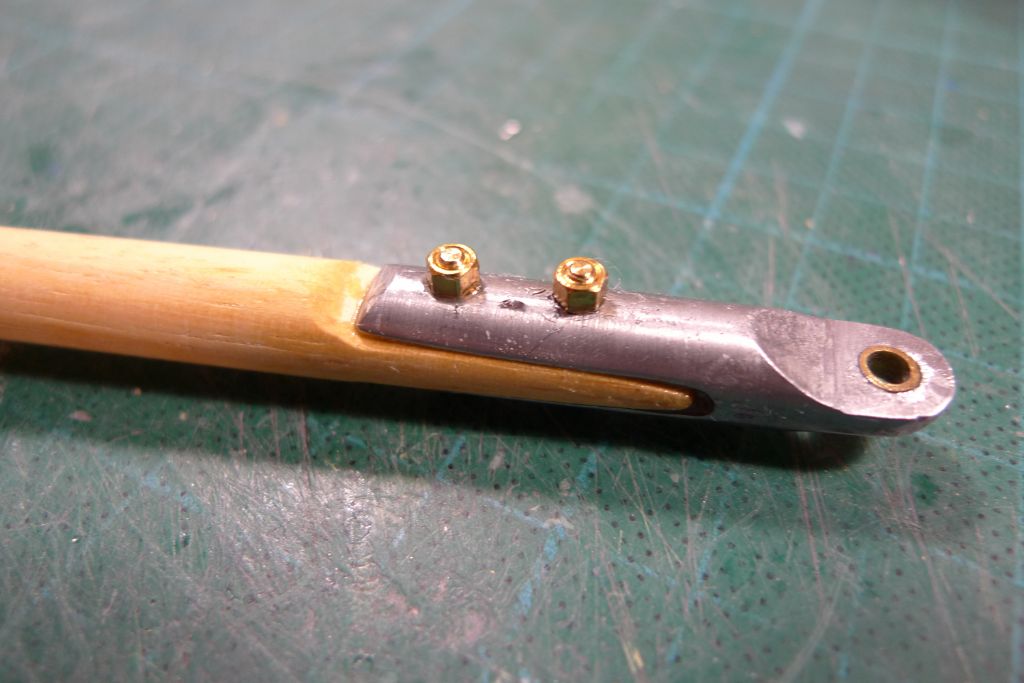
… ater a final dryfit to check that things fit as they should, which they did.
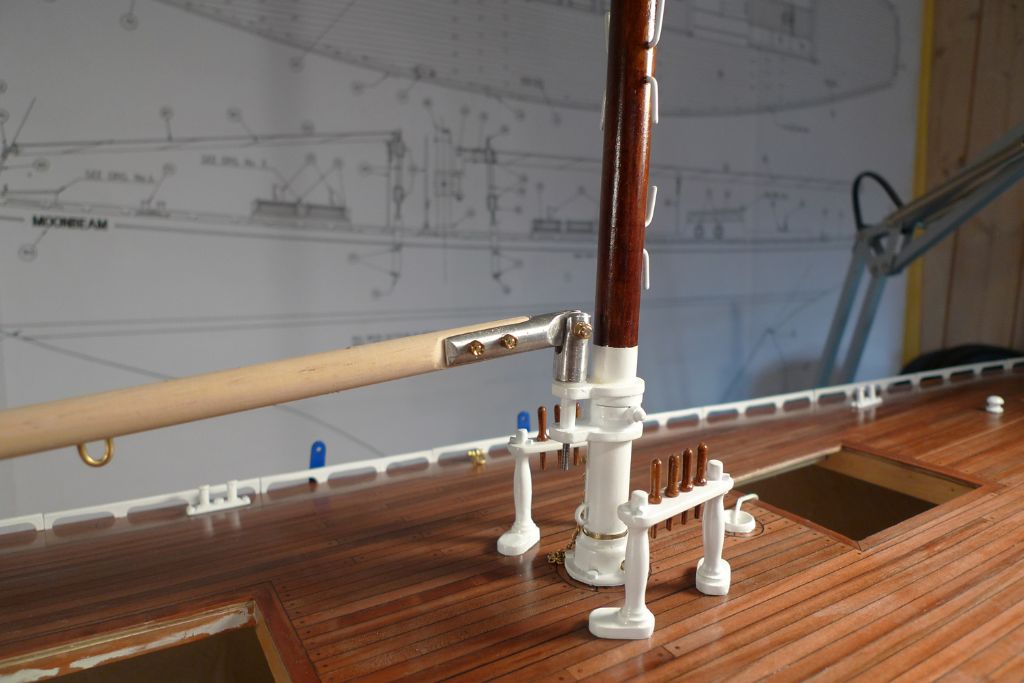
To be continued …
Mattias
Edited By Banjoman on 31/01/2017 08:31:09
Edited By Banjoman on 31/01/2017 08:31:28
Edited By Banjoman on 31/01/2017 08:33:11
Banjoman
@banjoman
With the boom more or less sorted, next up was the gaff!
After putting a taper onto the wood blank in the same way as for the boom, again with my wife doing duty as a lathe steady, and having cut it to length and also sawed a tang onto the jaw end, I set the white metal gaff jaws up and drilled a 2 mm hole all the way through it. According to the plans, the throat halliard should be made fast to a loop of brass rod glued into the top of the jaws …
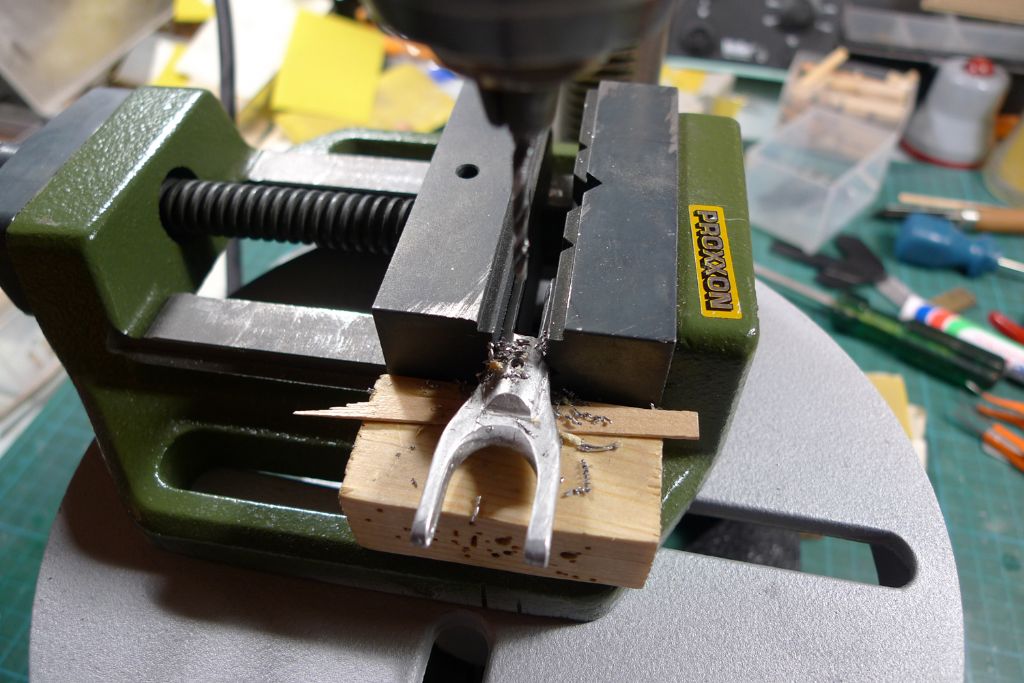
… but I preferred to use an eyebolt and schackle instead, as it is likely to be a bit stronger, and a fair amount of the weight of the mainsail, boom and gaff will rest on this point.
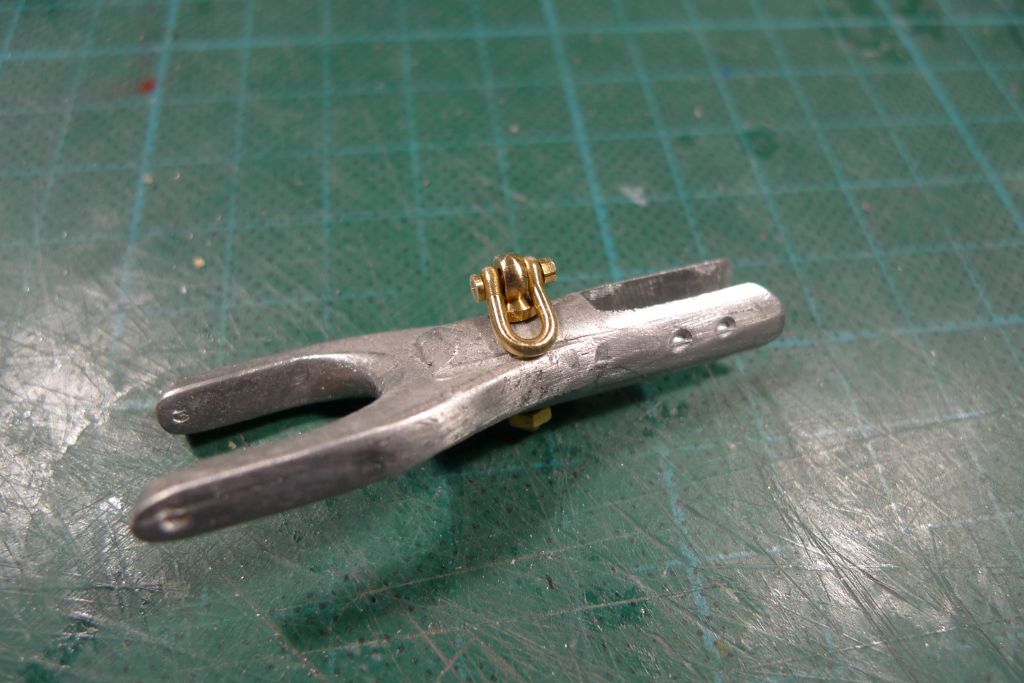
Differently from the boom, where the gooseneck assembly is and clearly may be seen to be a separate fitting from the actual boom, I decided to try to make the spar and the jaws fit together as seamlessly as possible, and therefore used Milliput rather than epoxy to join the jaws to the spar tang.
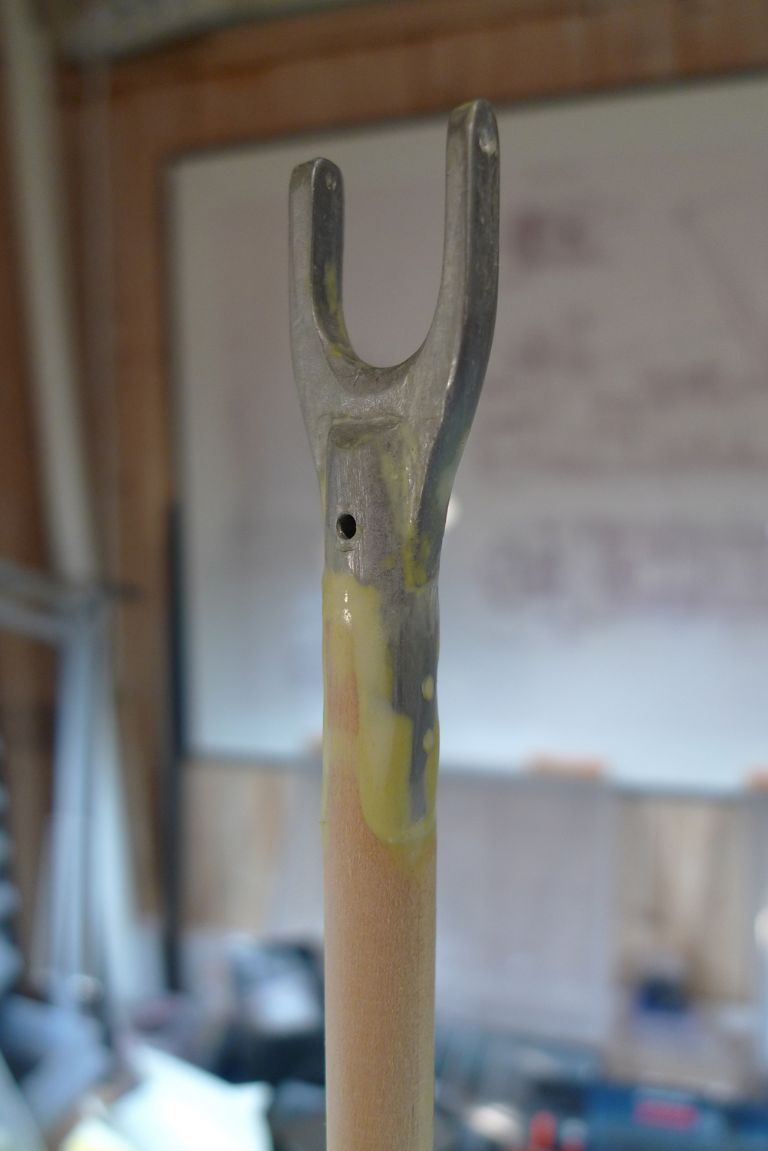
Once the Milliput had gone off completely, the connection was quite solid, so I set it up in the lathe once more and, with some 320 and 600 grit paper, sanded the joint quite smooth and round …
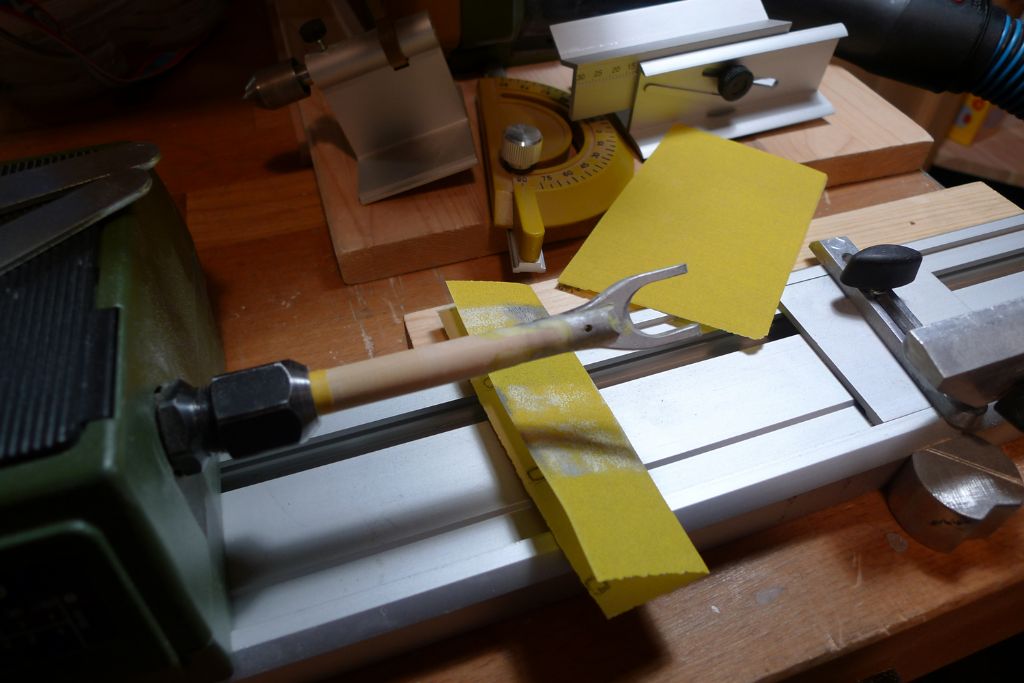
… then moved it to the machine vise with the jaws at 90 degrees to the horisontal …
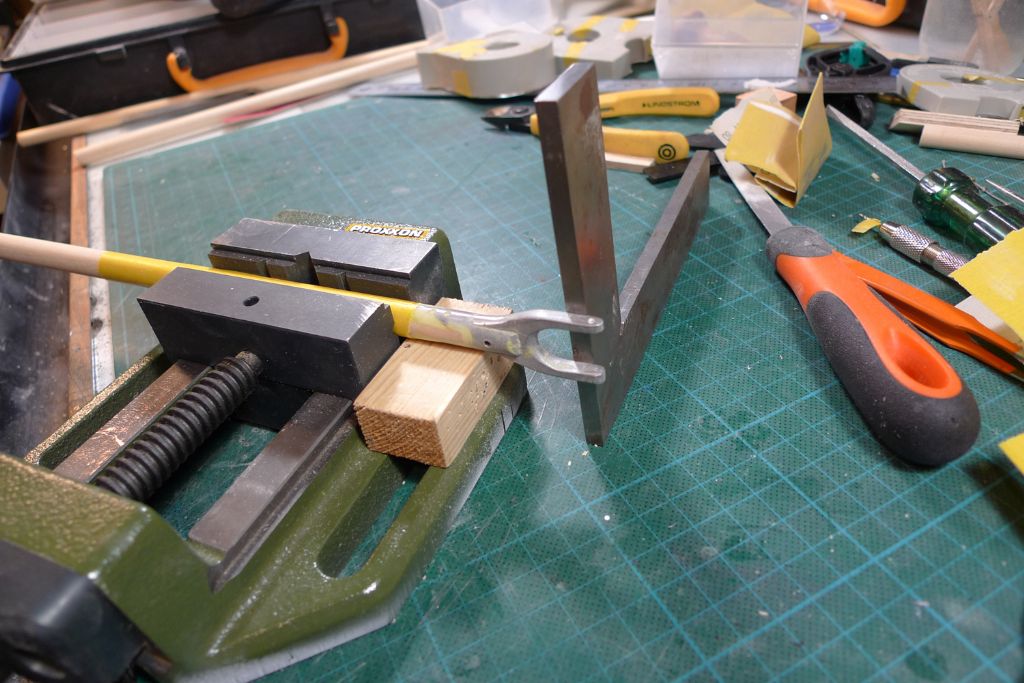
… drilled through twice …
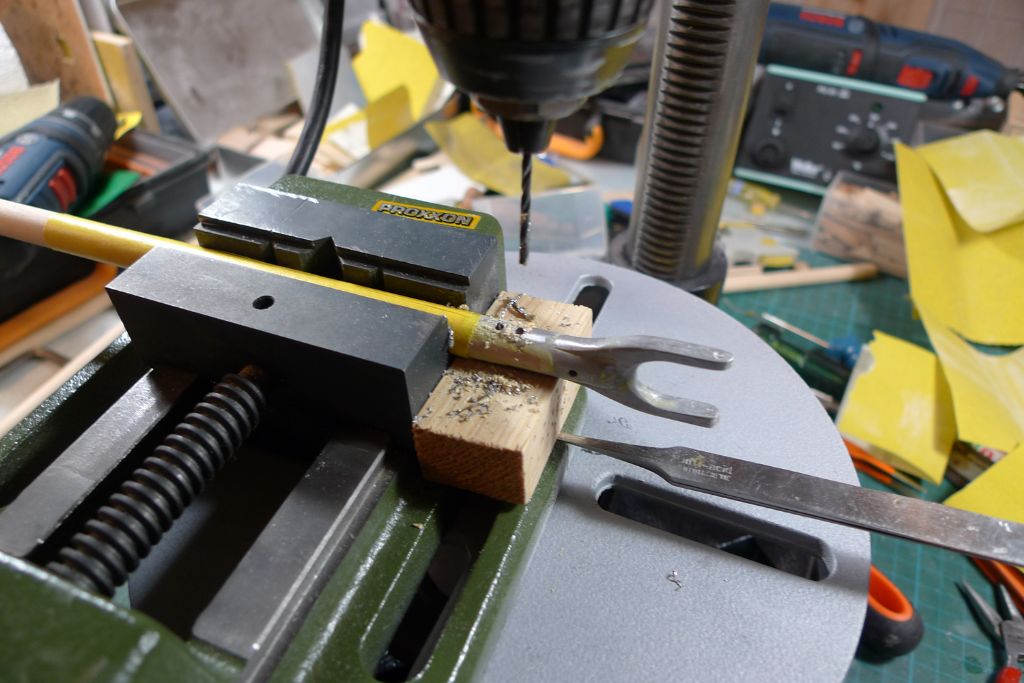
… and secured the joint fully with two M2 bolts, not only well tightened but also epoxied in.
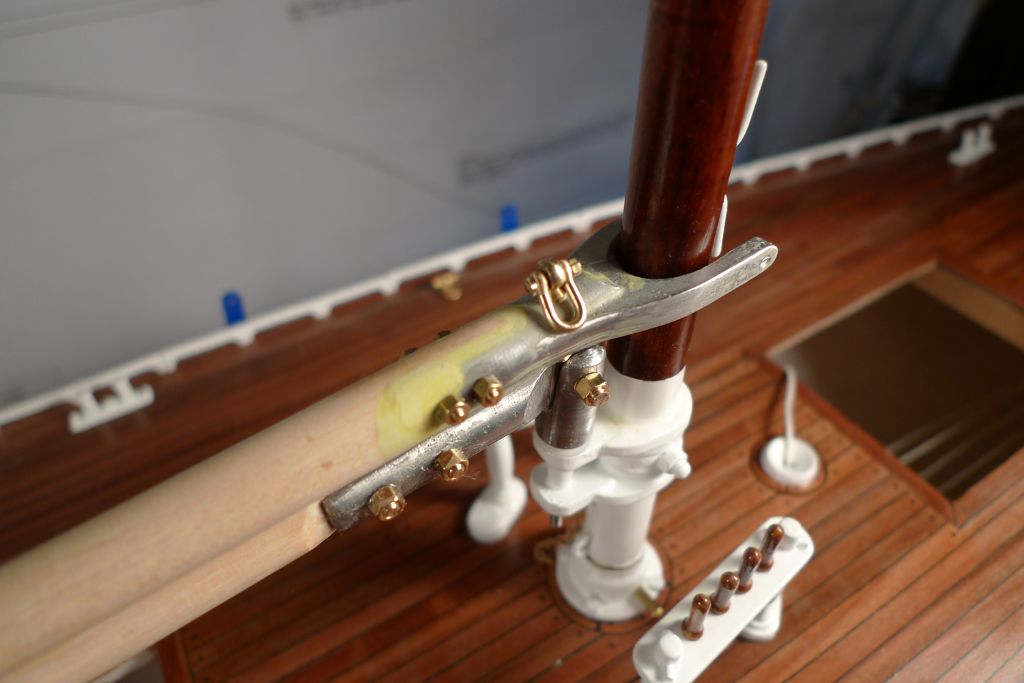
Two more holes were then drilled in the top of the gaff, to take the attaching point at the peak and a block two fifths in from the peak, both for the peak halliard, and shown here loose on deck in front of the boom and gaff.
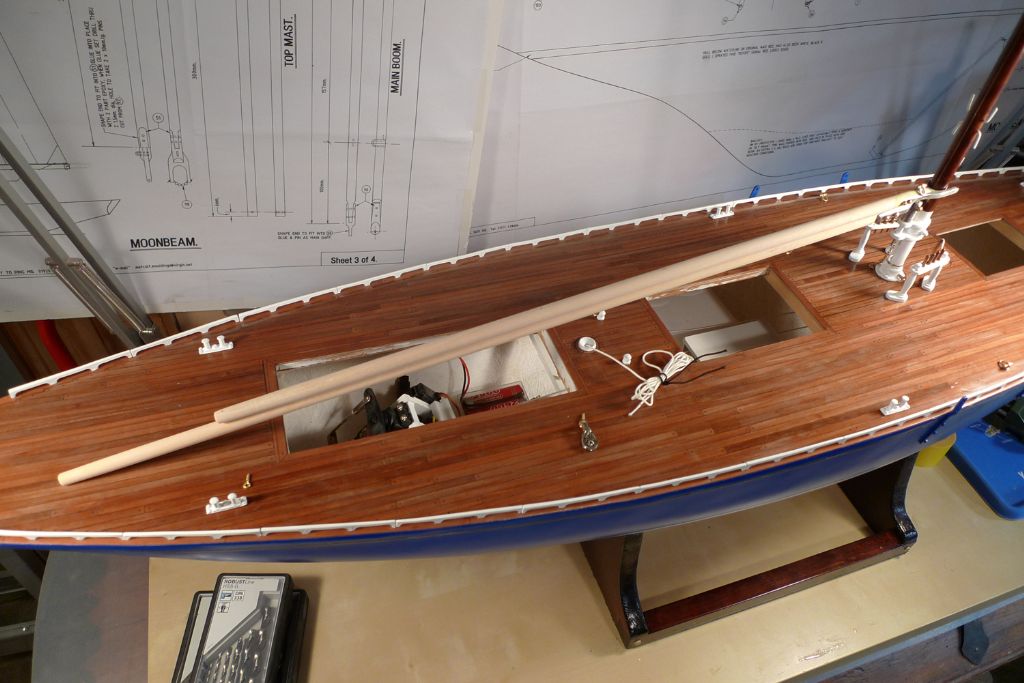
Finally, both spars needed a small, transversal hole drilled through the peak for fastening one end of line that will be used to attach the main sail to them.
Again according to the plan, these holes should sit 3 mm in from the peak and the boom outer end respectively, however as I have added 10 mm to each spar at their outer ends (as I think it will look better that way), these holes should rather be 13 mm in.
Furthermore, the lines will be secured with simple stop knots, and in order to hide these I decided to partially line the holes with some 2 mm o/d and 1.1 mm i/d copper tube, cut to 3 mm length.
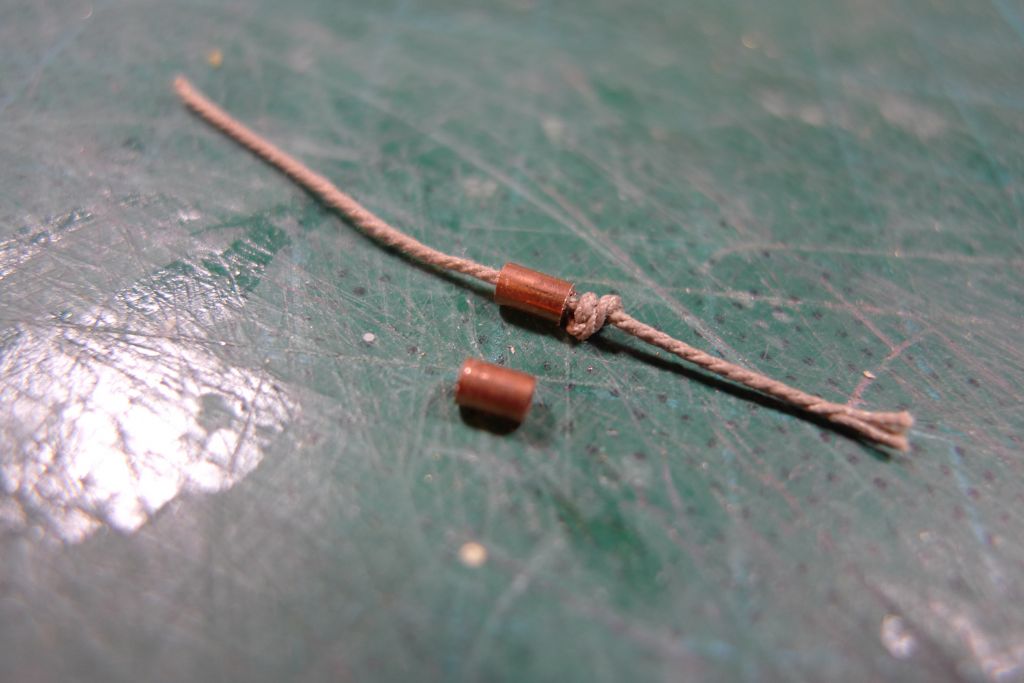
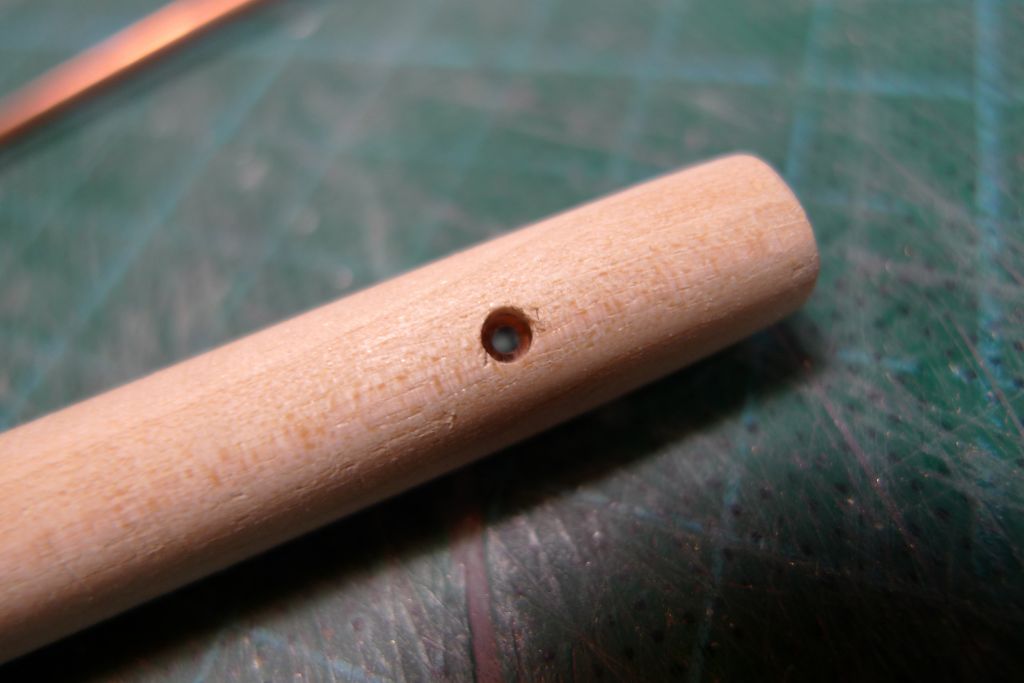
A 1.1 mm hole was then drilled all the way through the spar, which here has a diameter of about 8.5 mm, and the resulting hole then enlarged to 2 mm from one side and about 5.5 mm into the wood. Finally, the short piece of copper tube was inserted to create a sunk flange against which the stop knot can be securely held while also being kept more or less out of sight.
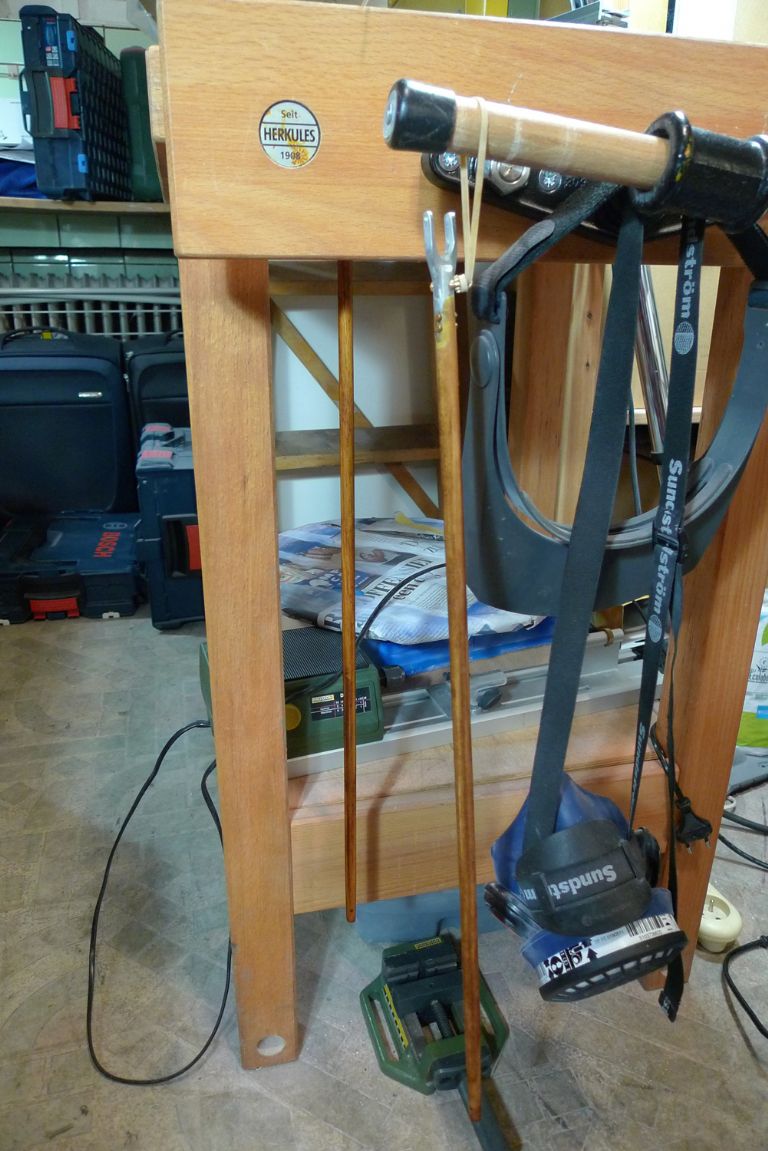
The final job of the day was to give the boom and the gaff a coat each of some oak stain, diluted with water to a 50/50 mix, after which they were hung up to dry. At least one more coat of stain will be needed, after which the ends shall be painted white and the complete spars varnished.
To be continued …
Mattias
Edited By Banjoman on 01/02/2017 21:42:28
Edited By Banjoman on 01/02/2017 21:42:58
Edited By Banjoman on 01/02/2017 21:44:19
Bob Abell 2
@bobabell2
Lovely splendiferous work, Banjo
But can I make a suggestion, please?
Of course you can, Bob lad…….What are friends for?
The nuts on the Boom and Gaff, look a bit OTT?………..Why not glue the screws in and file off the heads and nuts?
Or then them off, somewhat?
Or even dark wood dowels etc
Just a suggestion, old chap
Bob
Banjoman
@banjoman
Hello Bob,
And thank you very much for your kind words!
I have given some thought to those nuts and bolts, and would agree that right now they do stick out a bit; however, I wouldn't want to file them down, as I do want the mechanical bond that they provide. Had it just been a question of pinning the fittings to the spars, I would of course not have used nuts and bolts but rather some brass rod or similar.
However, I am quite confident that they will look much better, in the sense of sticking out much less, once the fittings and the ensuing first 50 mm or so of these spars are painted all white, same as I already did with the mast, topmast and bowsprit.
If you go back to for example page 28 of the thread (**LINK**) and look at the pictures there of the boom swivel plate before and after painting, the M3 bolt with which it is secured to the mast stands out much before before painting, when it is a different material and and a different colour, than after.
In any case, I will choose strength over elegance here, and stick with the bolts
Mattias
Banjoman
@banjoman
Well, we've been away for the weekend, so progress over the last few days has been rather minor; however, before we left, I had time to put on a second coat of oak stain and, once that was dry, to mask off the boom and gaff …
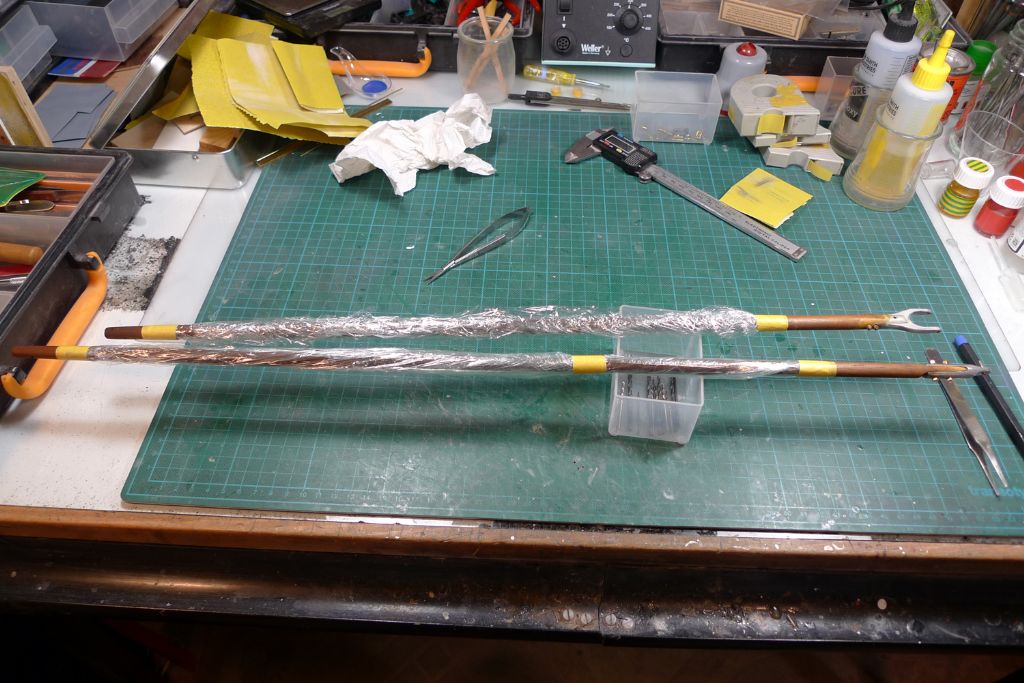
… and apply a coat of primer and a coat of gloss white, followed since we came back by two more coats of gloss white.
The gooseneck swivel has been given the same primer and topcoat treatment, as has the two brass rod loops for the boom.
Once this is all nice and dry, everything will be given however many coats of gloss varnish that is needed.
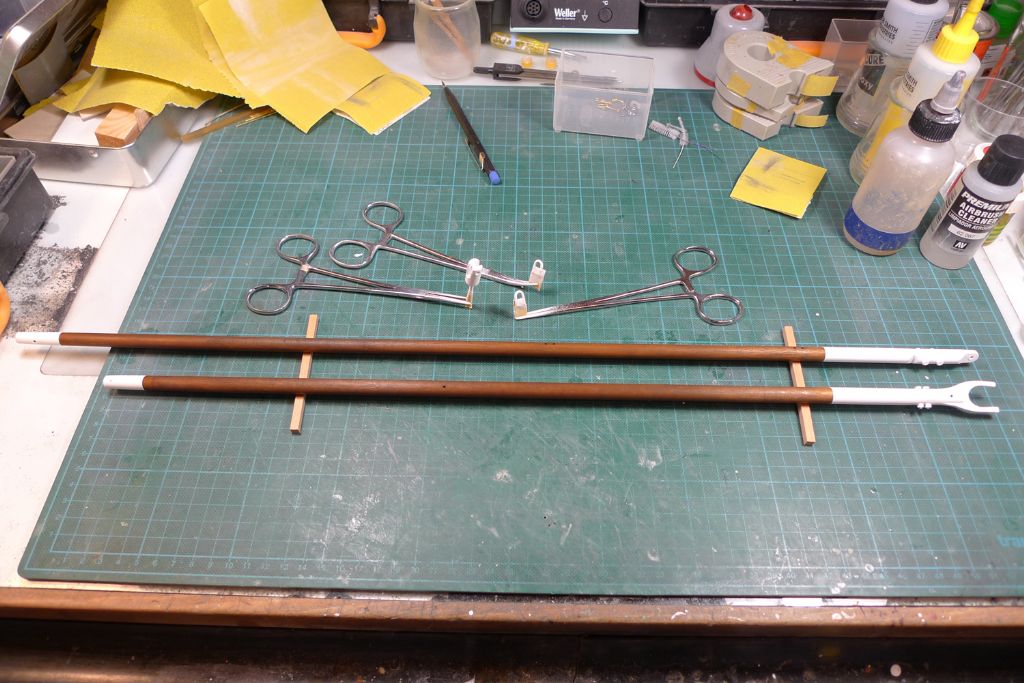
To be continued …
Mattias
Banjoman
@banjoman
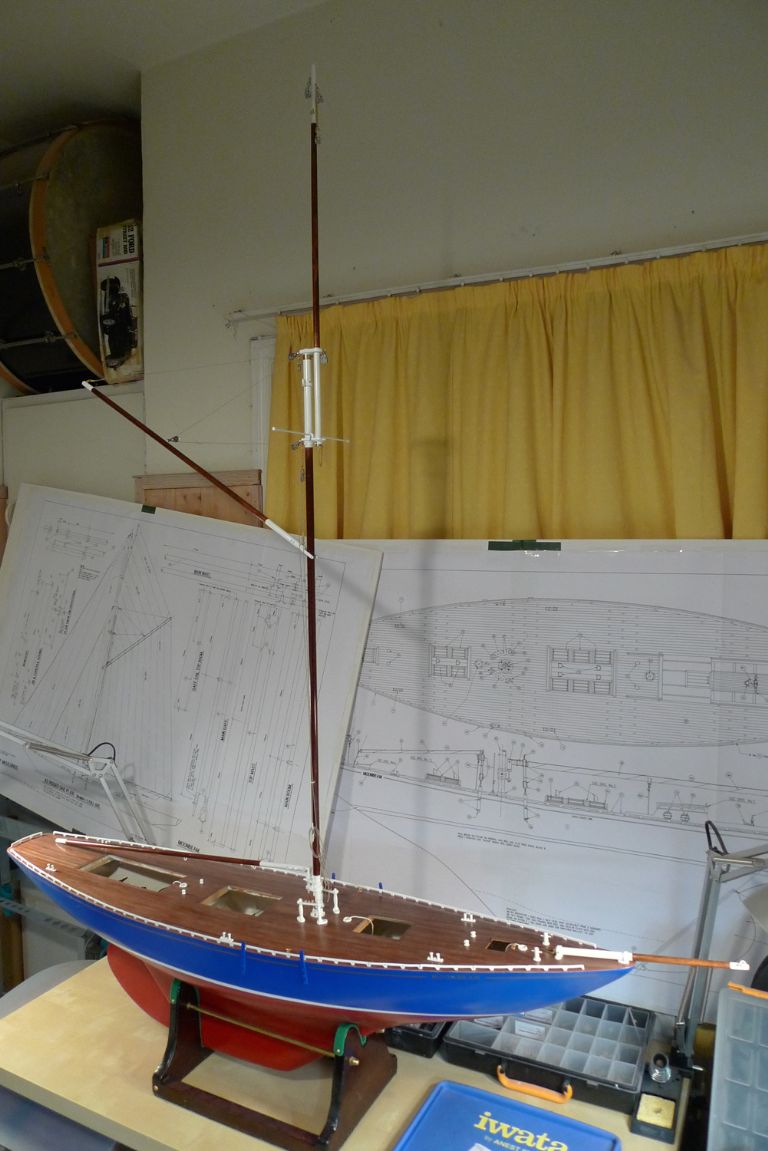
What build time I've been able to find through the week has mainly been spent on varnishing the boom and gaff …
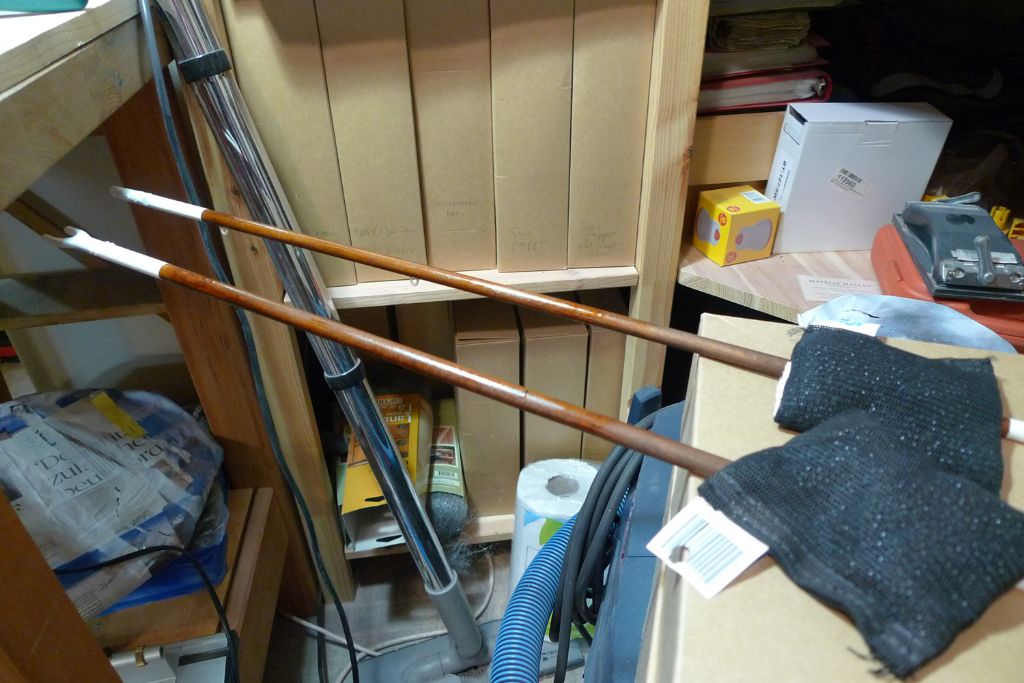
… one end at a time, until both had had six coats of varnish.
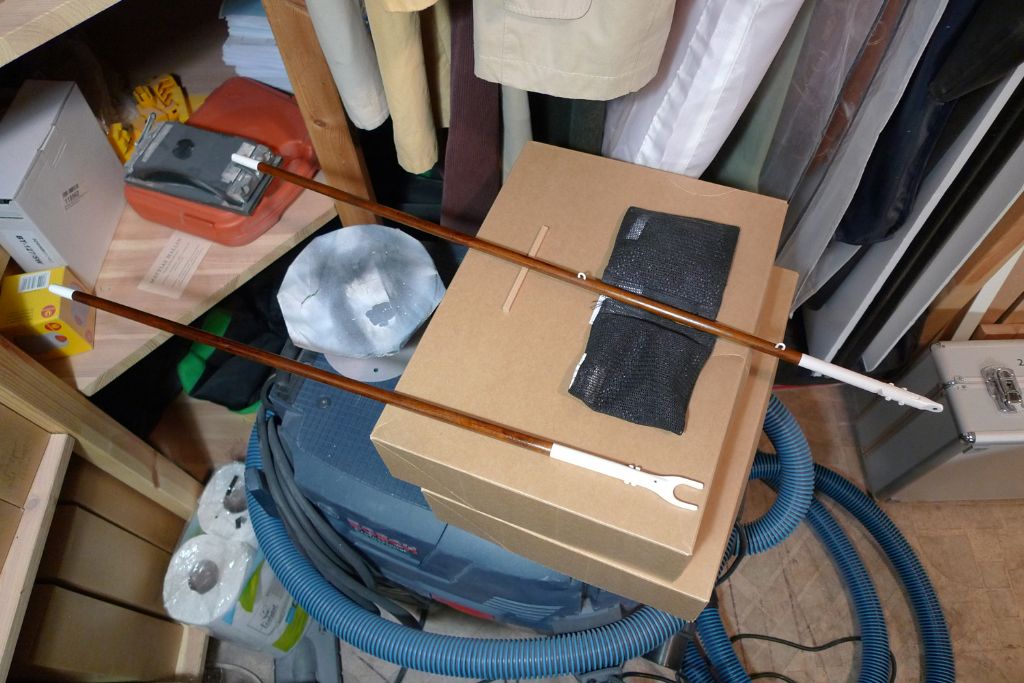
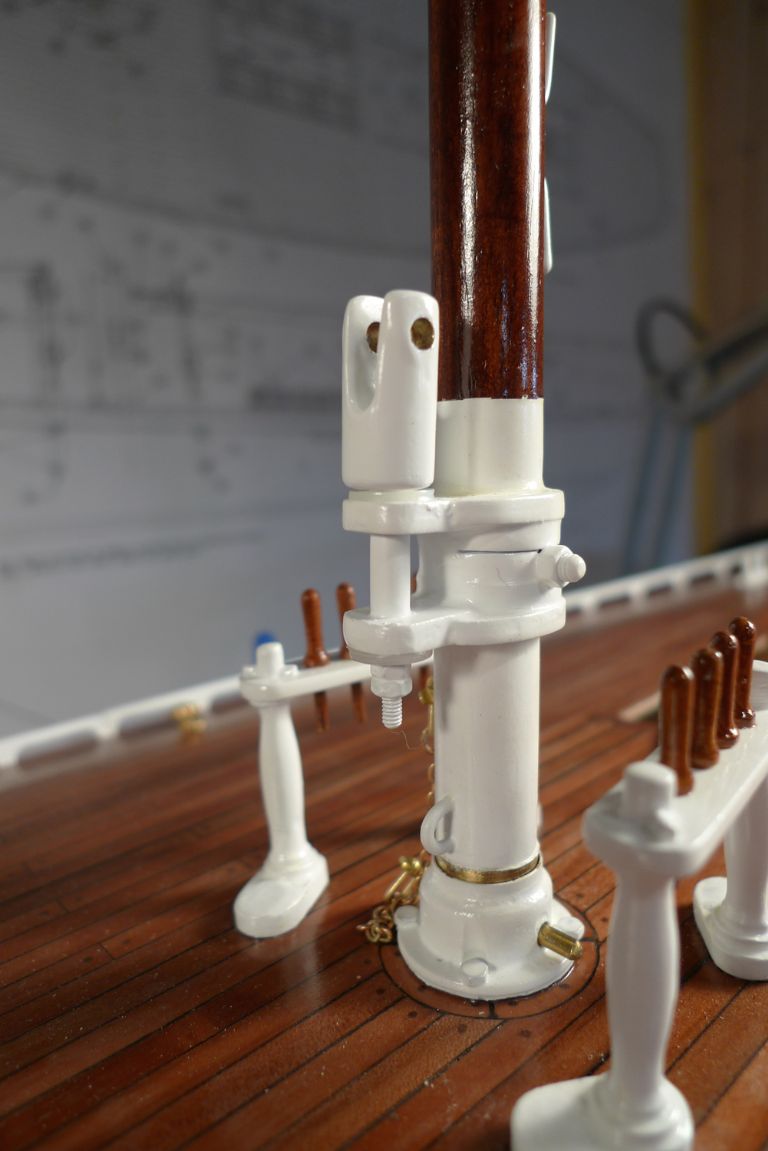
Inbetween, I also mounted the gooseneck swivel on the swivel plates, with nylon washers between the rotating surfaces and the plates …
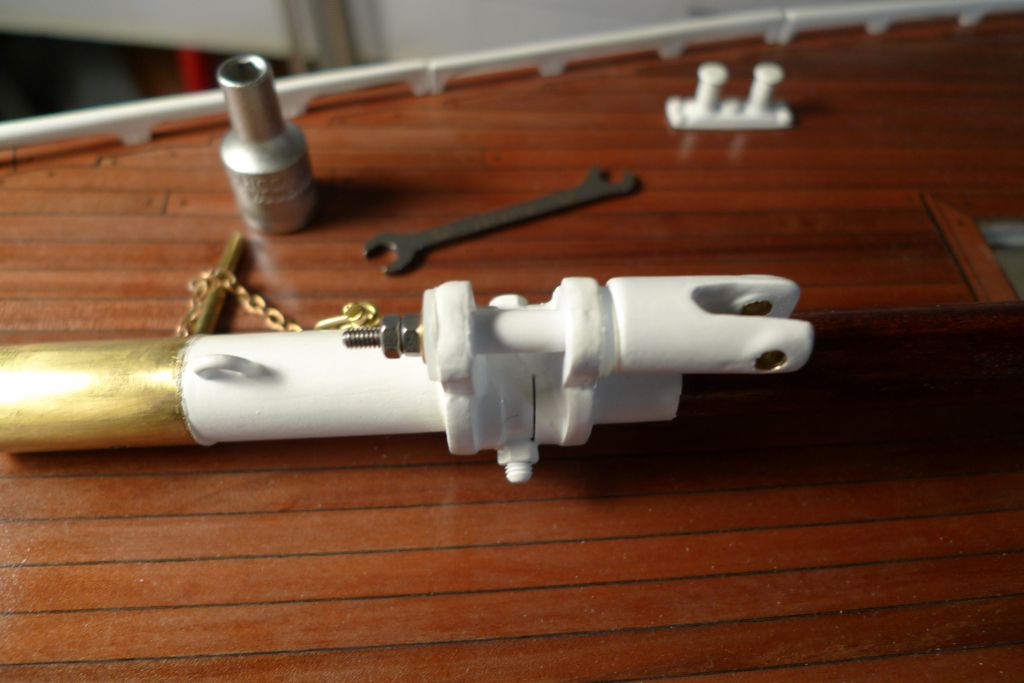
… and the locknuts, once tightened, painted white.
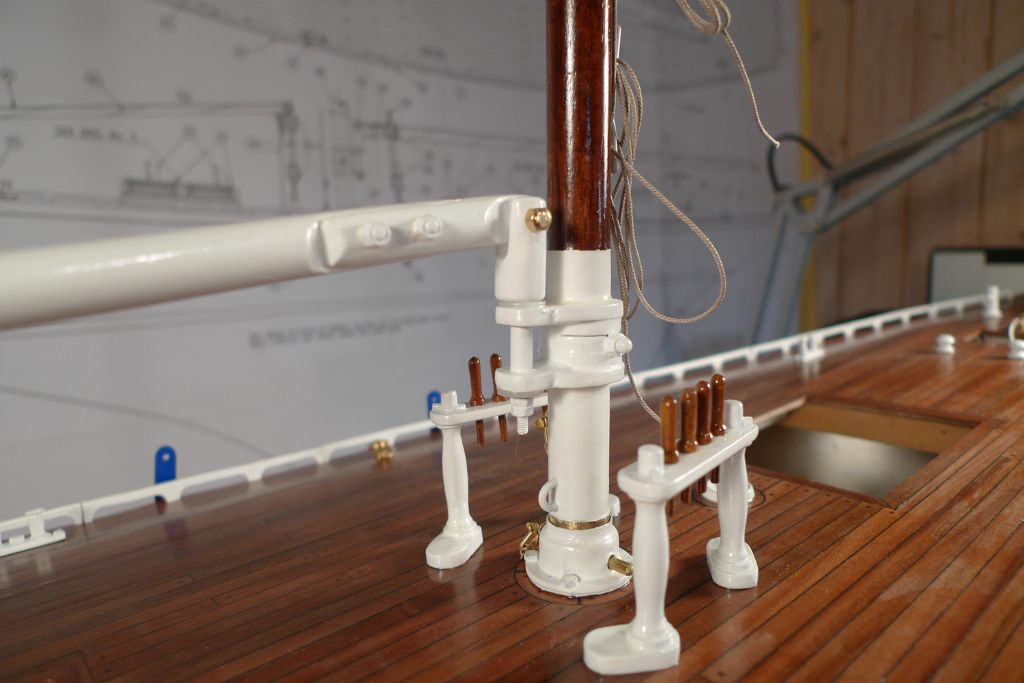
When the varnish had dried fully, the boom could be secured in place by the hinge bolt …
… after which the throat and peak halliards were temporarily attached to the gaff …
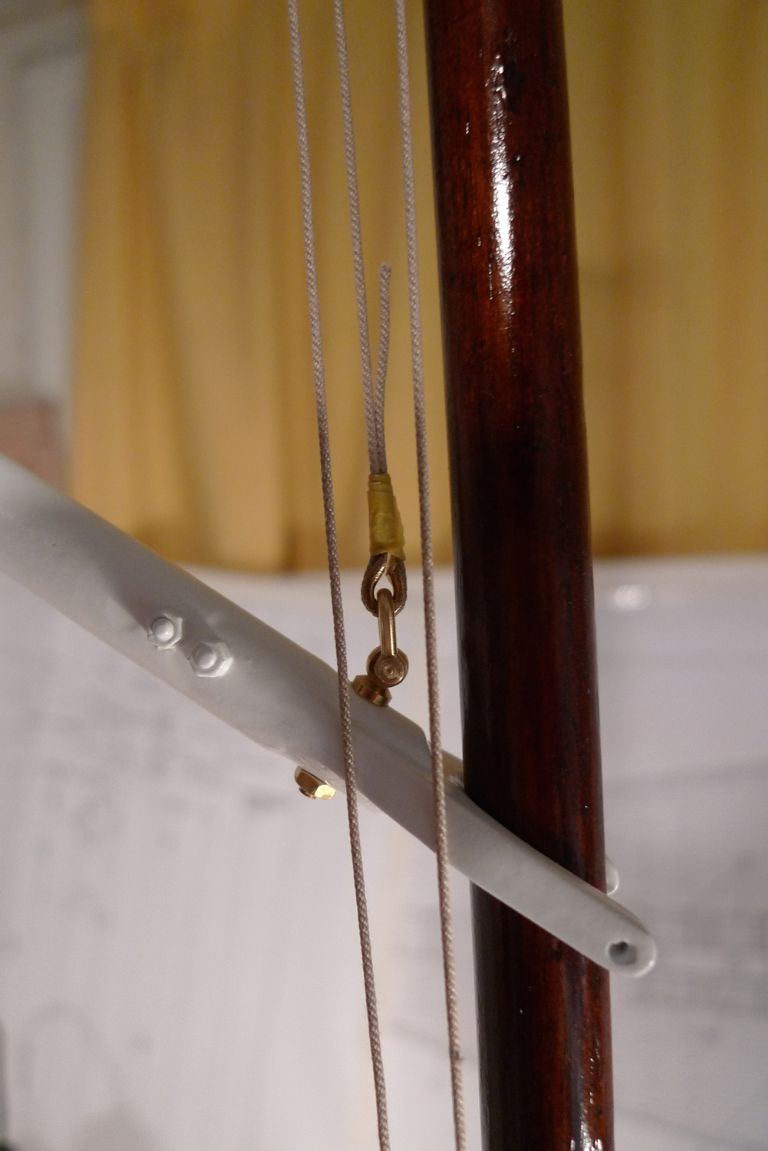
… so that it could be hoisted (roughly) into place.
There is no topping lift for the boom, as the sail will do the job of one while set, and – this being a model boat – there will never be any need to take down and make fast the mainsail (or any other sail for that matter) other than together with the whole mast and rigging for transport. For that purpose, however, a topping lift would be of no use, so there won't be one.
To be continued …
Mattias
Bob Abell 2
@bobabell2
Your Daz White fittings look excellent Banjo. in contrast with the brassware
Bob
Banjoman
@banjoman
Thank you very much, Bob!
And yes, I admit that I am rather please with the combination of gloss white, varnished wood and brass fittings …
Next up, it was time to get a start on the standing rigging, and more specifically the blocks that shall do the job of deadeyes for the shrouds. I don't find the white metal blocks that came with the kit very attractive,so I decided to replace them with some boxwood ones from Eskader in Stockholm that I found in my box of bits and bobs.
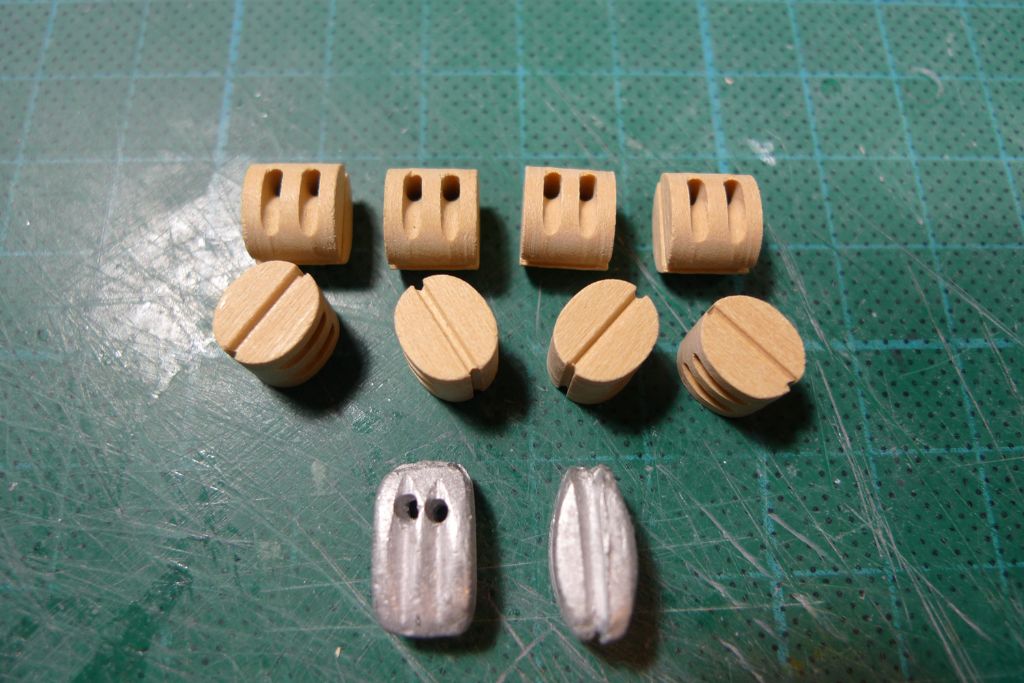
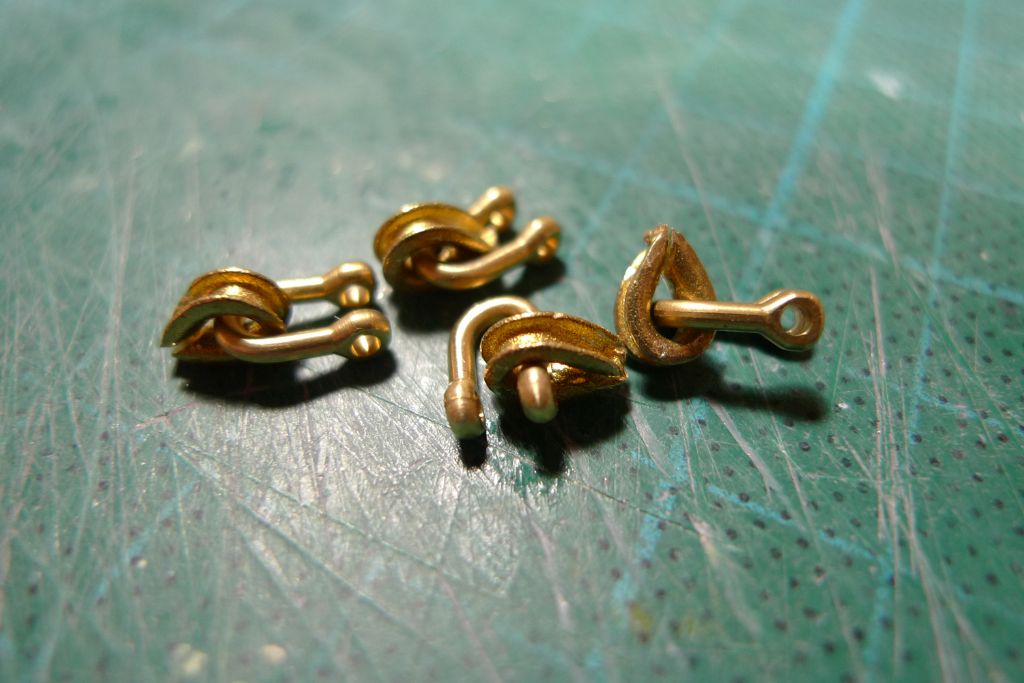
I also prepared four sets of shackles and thimbles – as usual, the thimbles had to have their ends sawn through so that they could be temporarily bent open enough that the shackle eyes would pass through.
I also prepared a small jig for holding a block and a thimble-and-shackle in position for stropping …
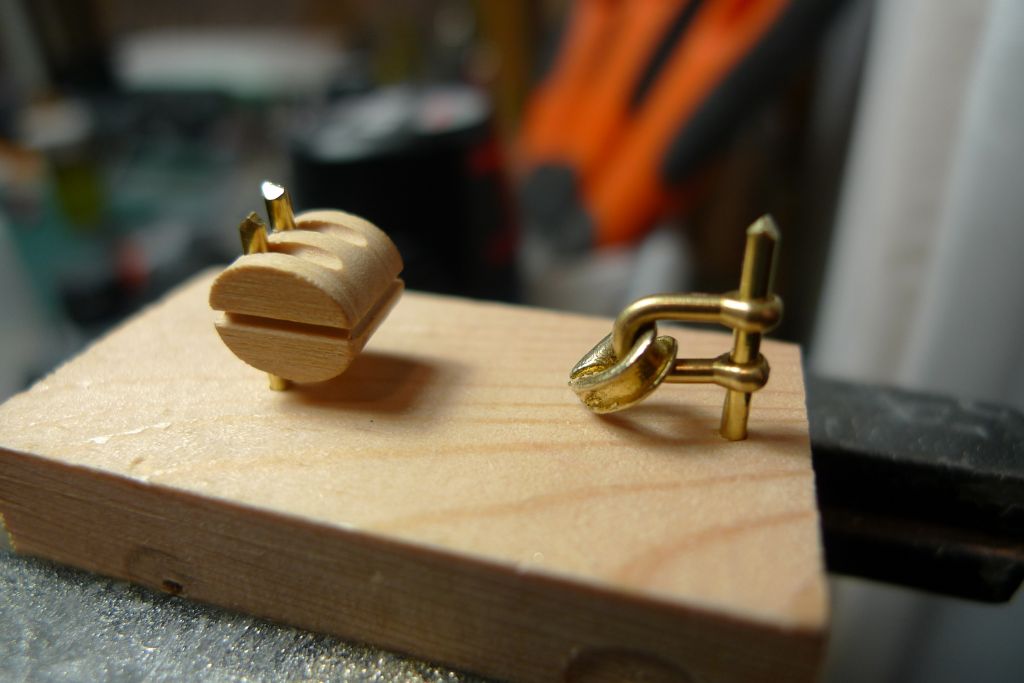
… but before that job could be taken in hand, the blocks were stained a dark oak colour …
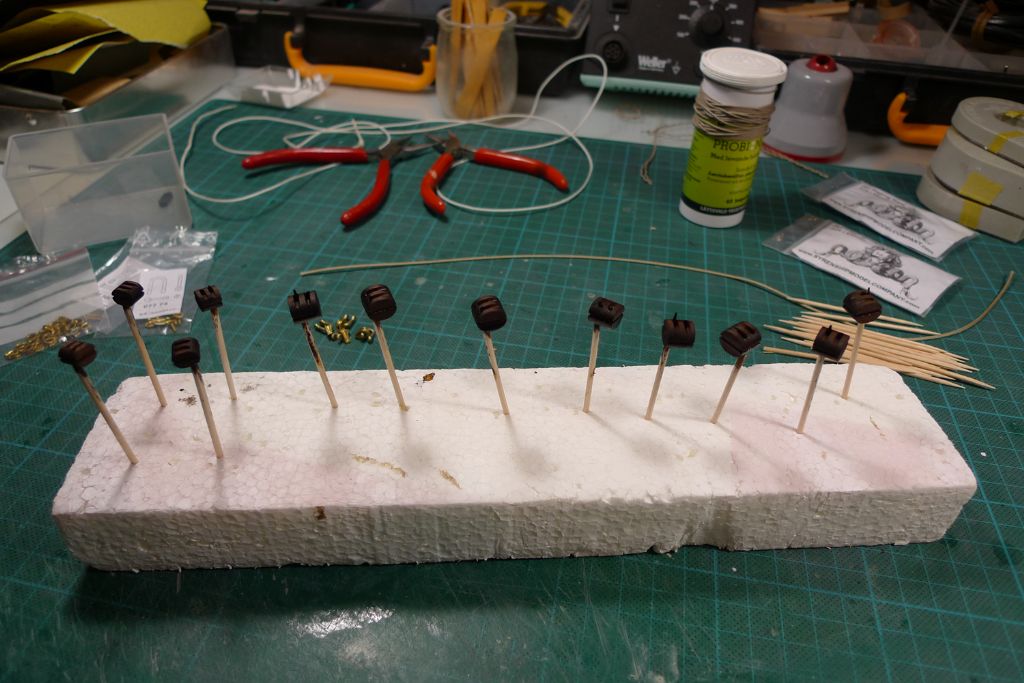
… and varnished.
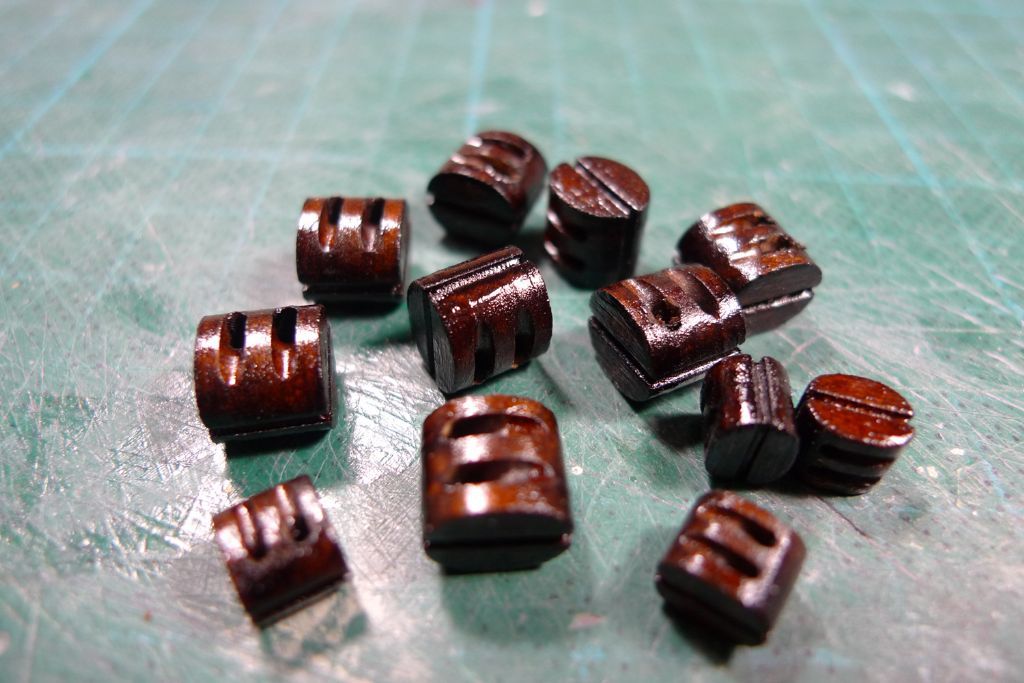
In the meantime I'd realised what I'm sure you have all already noticed three pictures up, namely that I'd set up the jig with the block the wrong way around, so I marked out the required difference of distance …
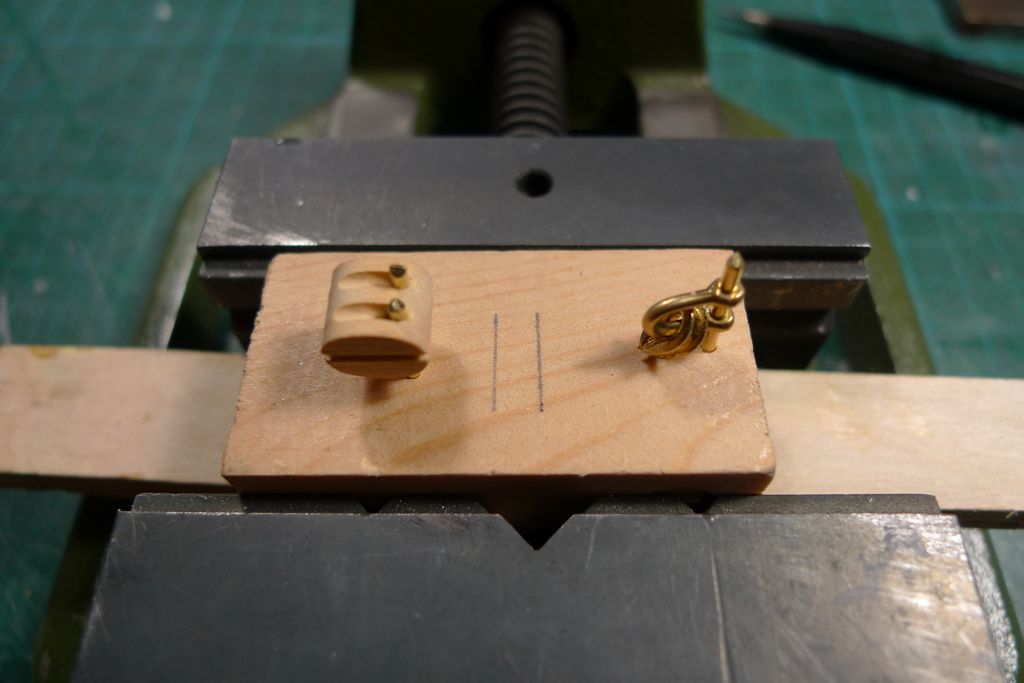
… and drilled two new holes for the brass rods to hold the block in position.
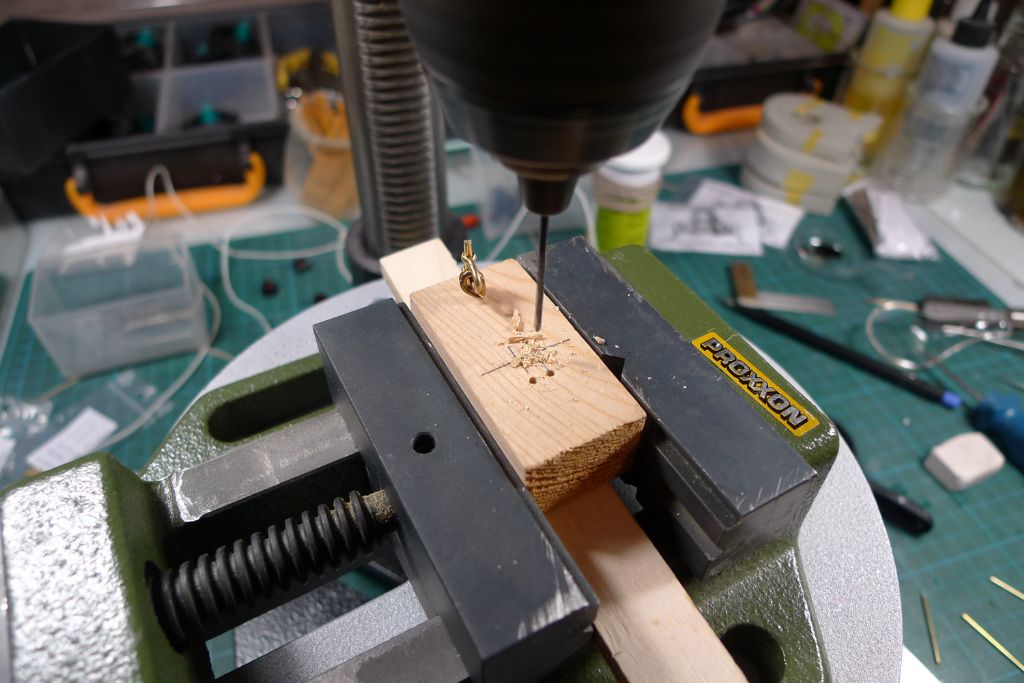
I then got a short length of the shroud rigging thread that came with the kit, and began by sewing the end together around the thimble …
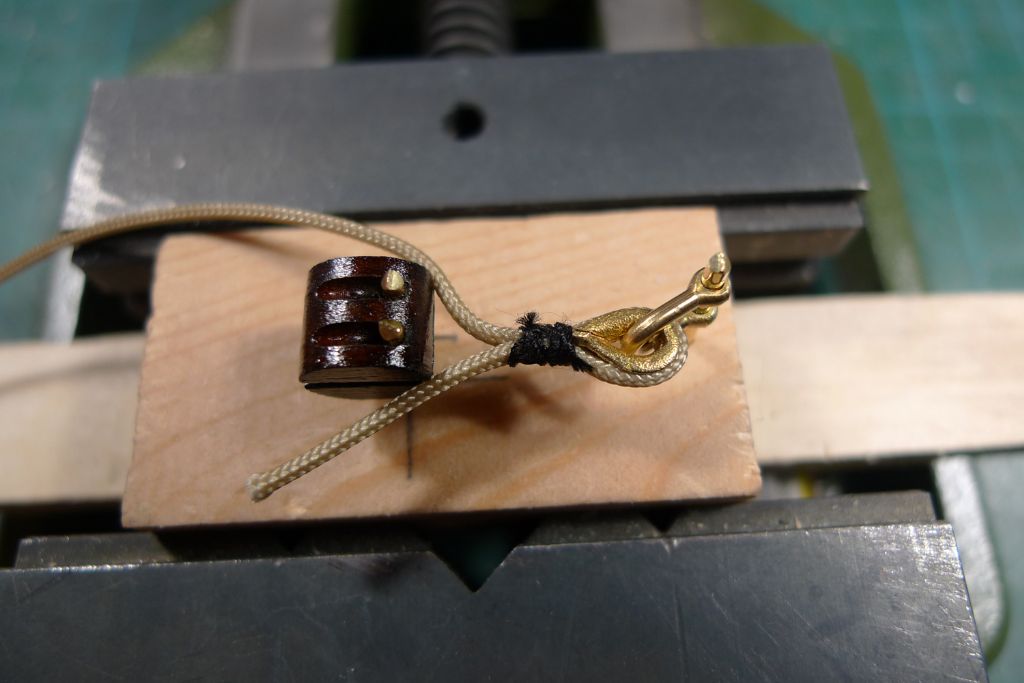
… before cutting off the excess, and repeating the process with the end of the bight that goes around the block.
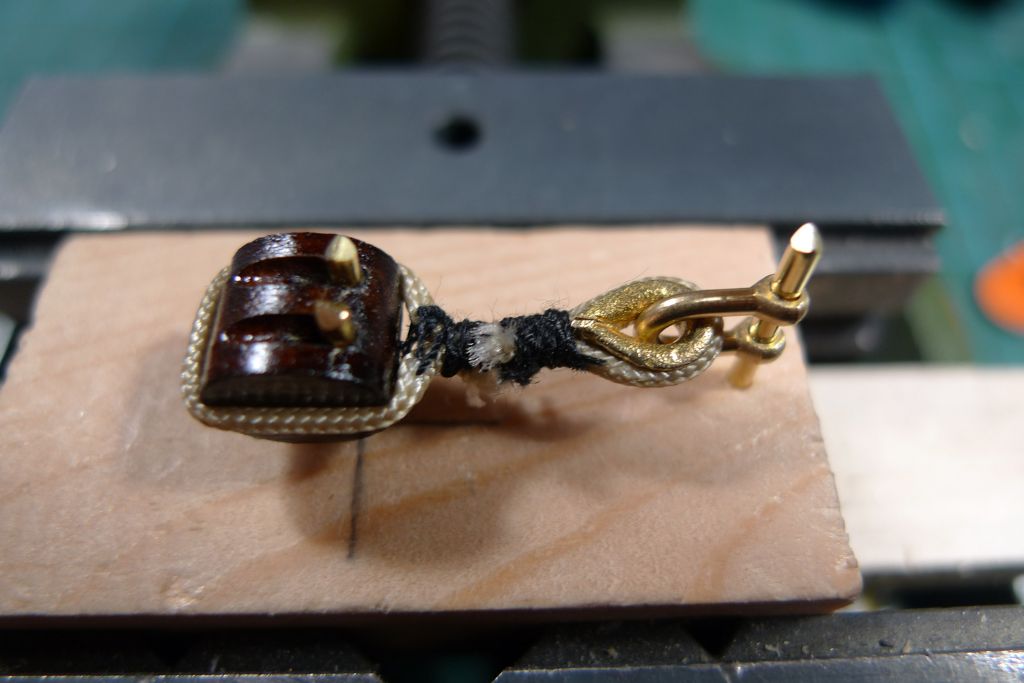
The ensemble was then moved to the tensioning jig (aka my jigsaw bow), and set up under tension so that the strop could be served.
Once I was happy with the result, it was further secured with a good dollop of thin CA glue, primarily to ensure against the knots of the tyings-off working loose, but also making the whole thing quite solid.
Obviously this method cannot produce as strong a strop as one would get with the real procedure, i.e. a closed, circular loop of rigging thread. I have on several occasions attempted to produce such strops the real way, i.e. by unraveling one strand from a rigging thread and then laying that strand around itself in a circle the same number of times as the original thread had strands, but so far these attempts have utterly failed.
Equally obviously this method would not have worked with the thread I'm using here anyway, as it is not laid but a woven, synthetic one, and I did rather prefer to have the strops made from the same thread that I will use for the shrouds, as I think it'll look neater and more coherent that way. But I shall persevere and hope one day to be able to learn how to make rope circles.
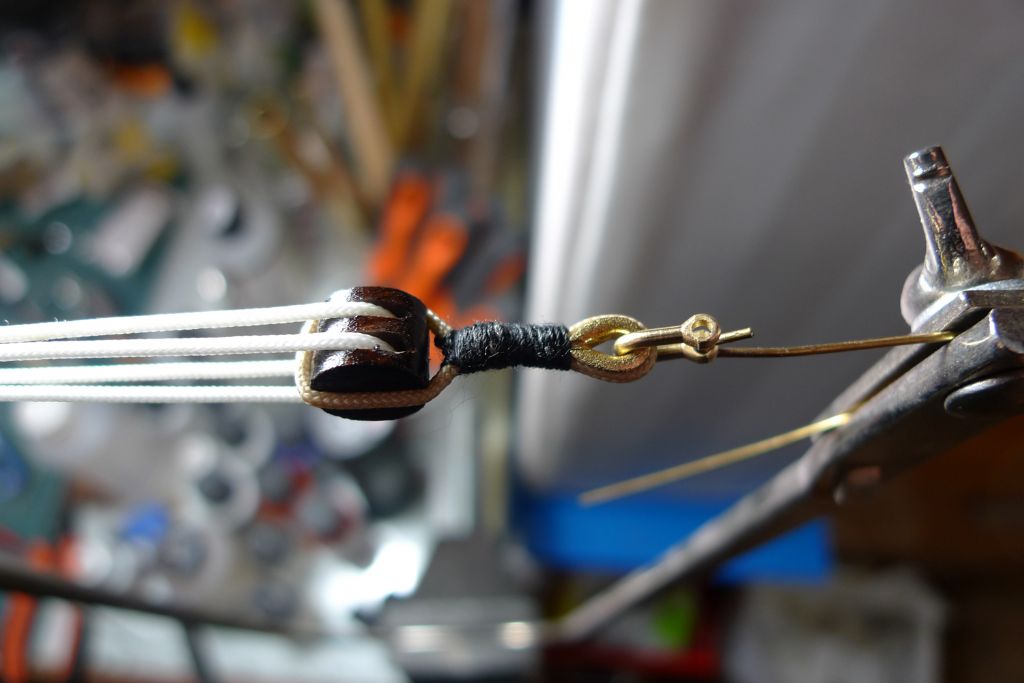
In any case, the stropping process was repeated until I had all four lower shroud-tensioning blocks, which were then set up to the shroud plates with the help of the shackles.
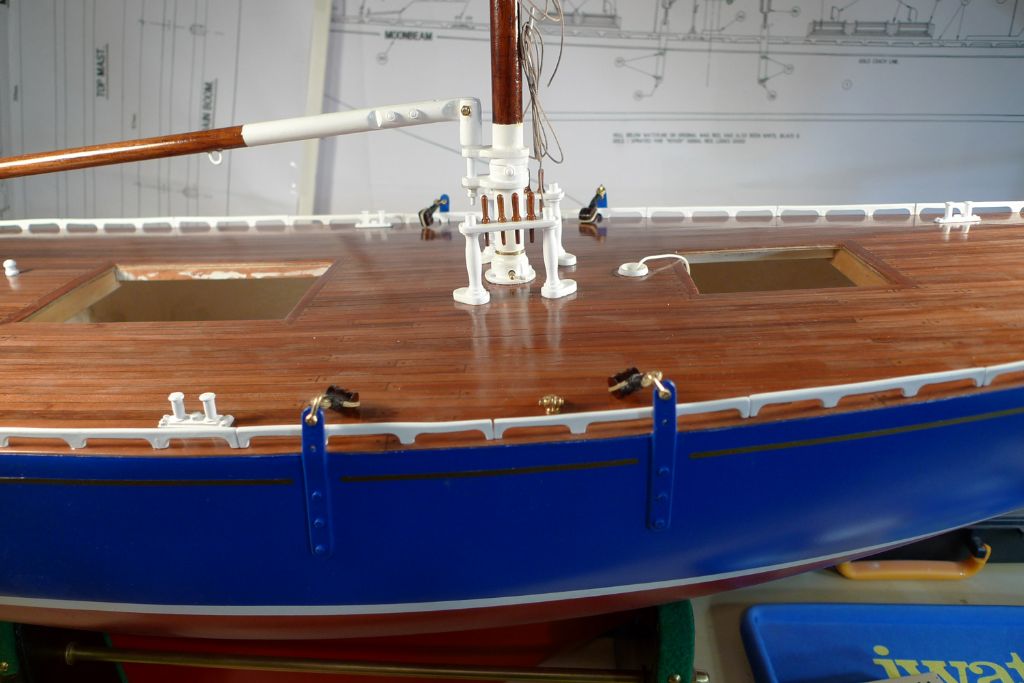
To be continued …
Mattias
Edited By Banjoman on 12/02/2017 20:40:02
Bob Abell 2
@bobabell2
Very nice fittings, Banjo
I like the multi sheave block…..They look very efficient and businesslike
Keep up the good work
Bob
Banjoman
@banjoman
Thank you very much, Bob
Yes, those blocks are rather nice, aren't they! As far as I know, they are only available (as single, souble or triple sheave) from Eskader (the Swedish word for squadron), a classic model shop in Stockholm, that has been in business continously since 1931, specialising in model ships, model trains and model steam (they have the Swedish agency for Stuart).
If ever you should find yourself in Stockholm, a visit to their (slightly poky and filled to the rafters) shop is absolutely recommended: **LINK**.
Their prices tend to be highish, but the offer is very good, the service is excellent and not least keeping a traditional store open and going in my view merits a premium.
Mattias
Bob Abell 2
@bobabell2
Looks a nice shoppe, Banjo
All in English too!
Here, up north, there are very few model shops still in business
The nearest to me now, is in Frodsham…..A 70 mile round trip, along the M56 motorway
Needless to say……..Car Parking is a pain!
Mail order is the order of the day……..Or the occasional Model Boat Exhibition
As a matter of fact, we`re going to the Manchester Model Engineering show this weekend
Love Live Steam Loco`s
Bob
Banjoman
@banjoman
Bob,
I know full well what you mean when you say that mail order is the order of the day, although I'm lucky enough to have three different model shops within a reasonable distance. One is even within walking distance of my home (!), and although that one mainkly caters for the plastic kit crowd, it has an excellent selection of paints and glues, the full (metric) assortment of Albion Alloy metals, a good selection of plasticard and also plenty of tools and other useful stuff; the two others, which are r/c oriented (one planes/helis and cars, the other the same plus boats) are within a 20 mile roundtrip (although alas in opposite directions), so not too far away really.
Actually, nothing is very far away here in Belgium: the two points furthest apart in a straight line are separated by about 175 miles.
That said, I too mainly send off for most of my specialist model boat fittings; the blocks, shackles and thimbles in my last set of photos for example were ordered from respectively Eskader in Sweden (the blocks), RB Model in Poland (the shackles) and Modelling Timbers on the Isle of Man (the thimbles).
Anyway:back to putting all those fittings to use!
As a first step toards setting up the main shrouds, I cut a 300 mm length of 1.5 mm brass rod into roughly equal lengths, fixed them together temporarily with some masking tape, and bent both sets of ends …
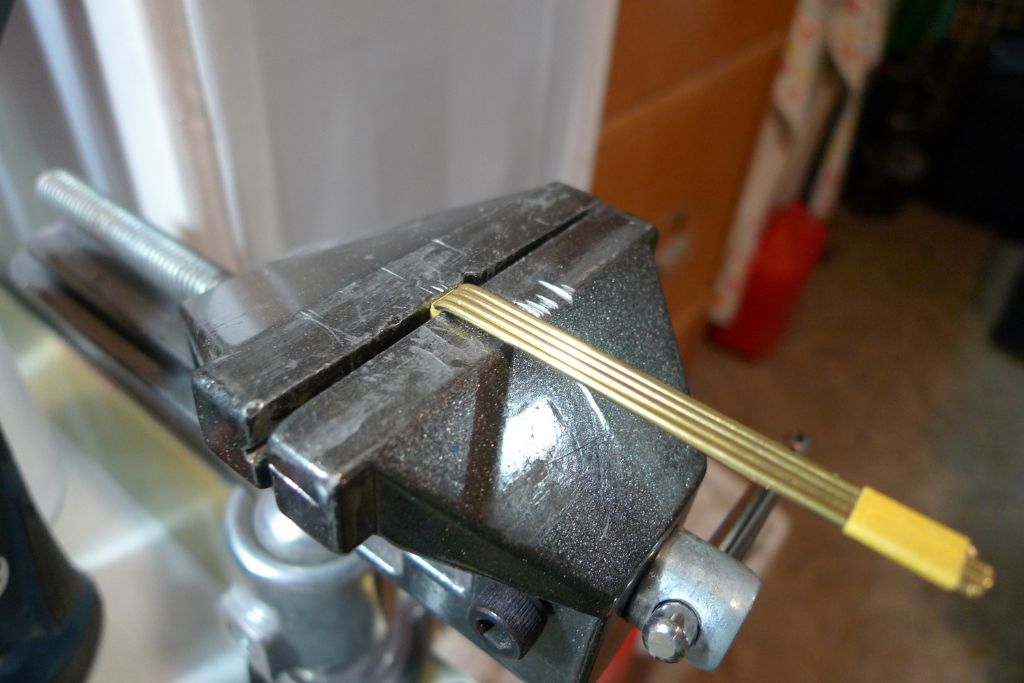
… to 90 degrees to create four distances with an approximate free length of 55 mm.
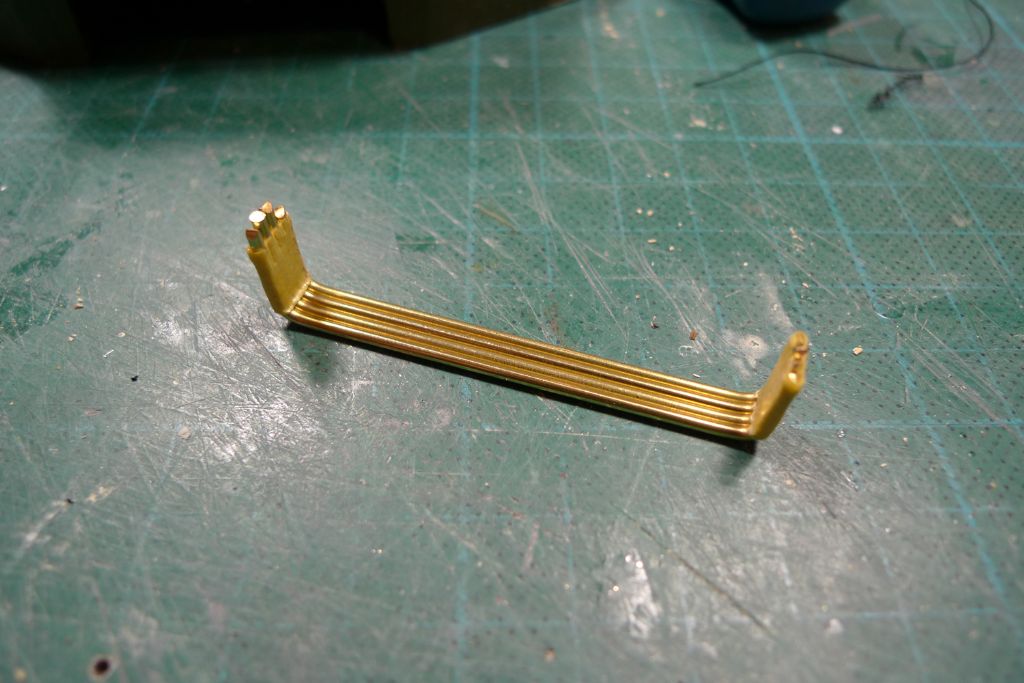
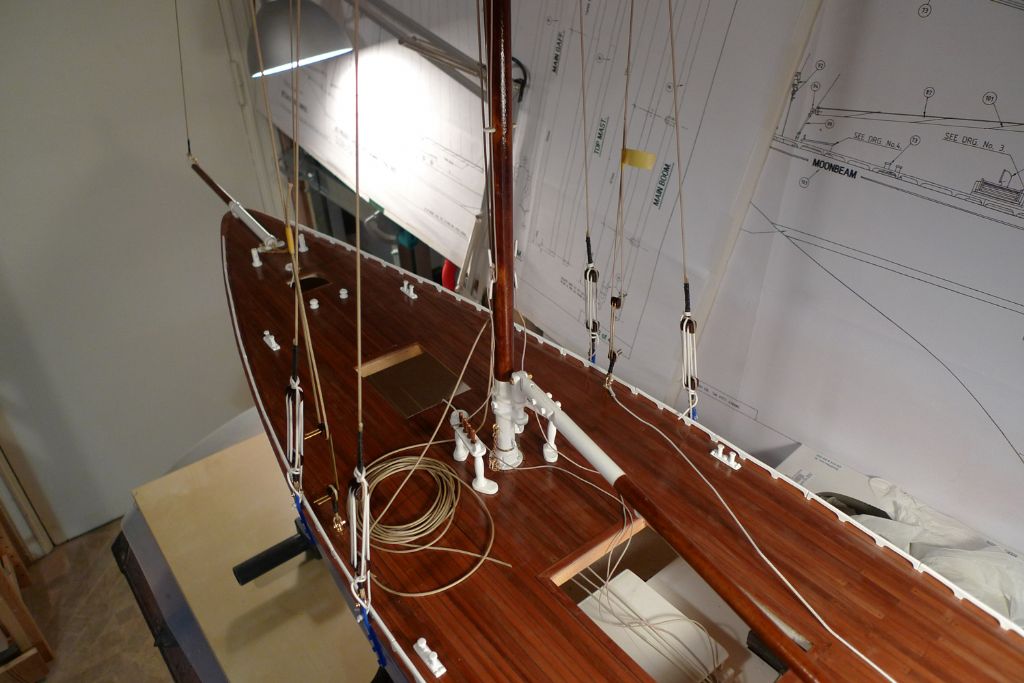
Next, I cut off two lengths of rigging cord for the port and starboard shrouds respectively. The port shrouds were temporarily set up and tied of to the lower blocks, just in order to provide some countertension to the mast for the work to be done on the starboard side.
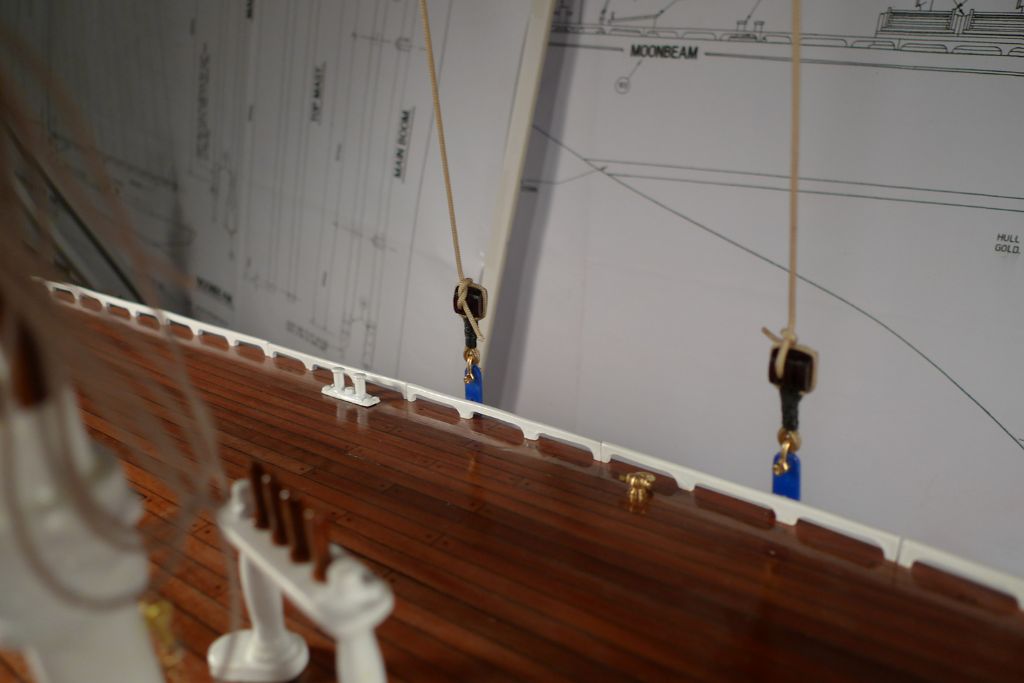
To starboard, I first looped the middle of the length of cord around the top slip bracket, and then sewed together the loop just below.
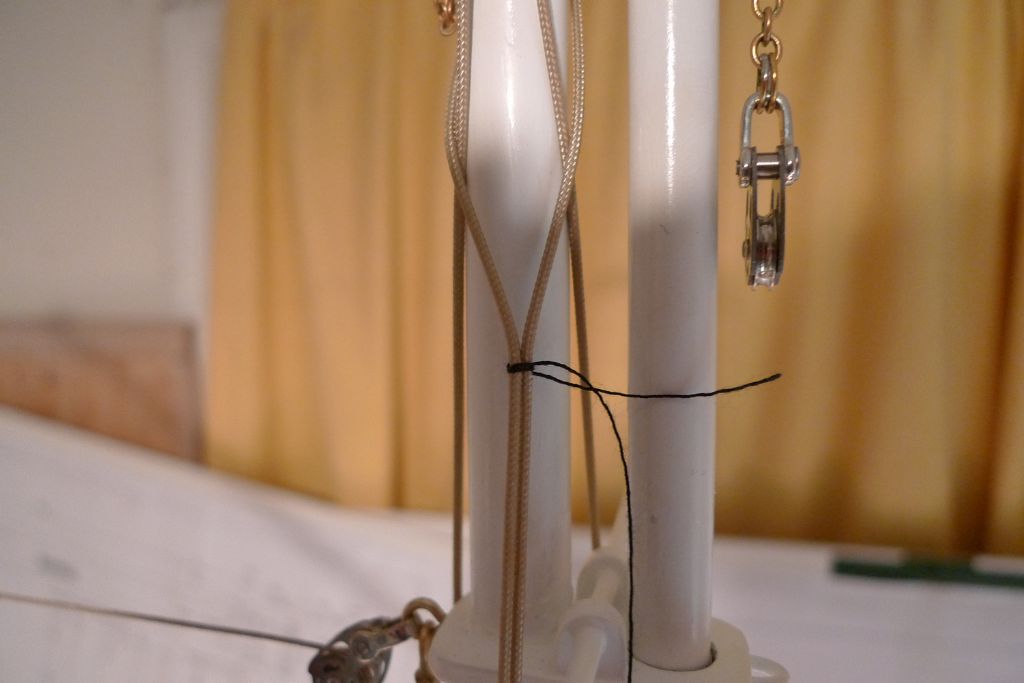
The two shrouds were then loosely stretched out and held straight against a toothpick through the spreader yard …
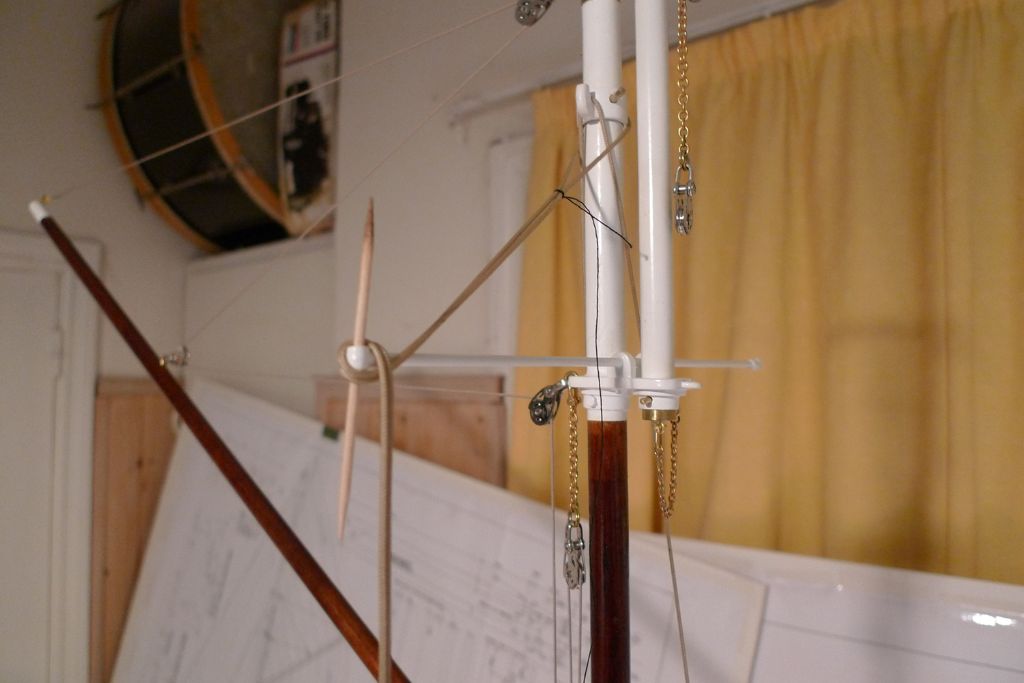
… to facilitate the parcelling of the loop closure point.
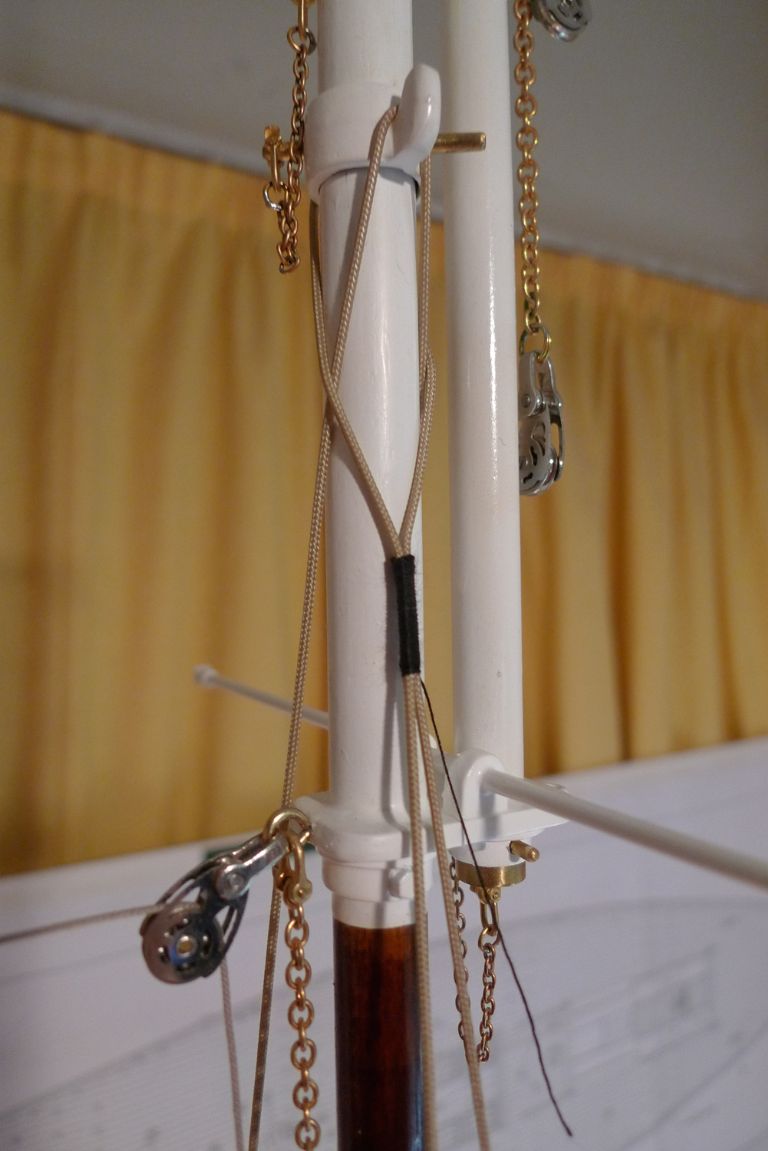
Next, the upper blocks were held in position with the help of the four brass rod distances, and the shroud ends loosely looped around the blocks …
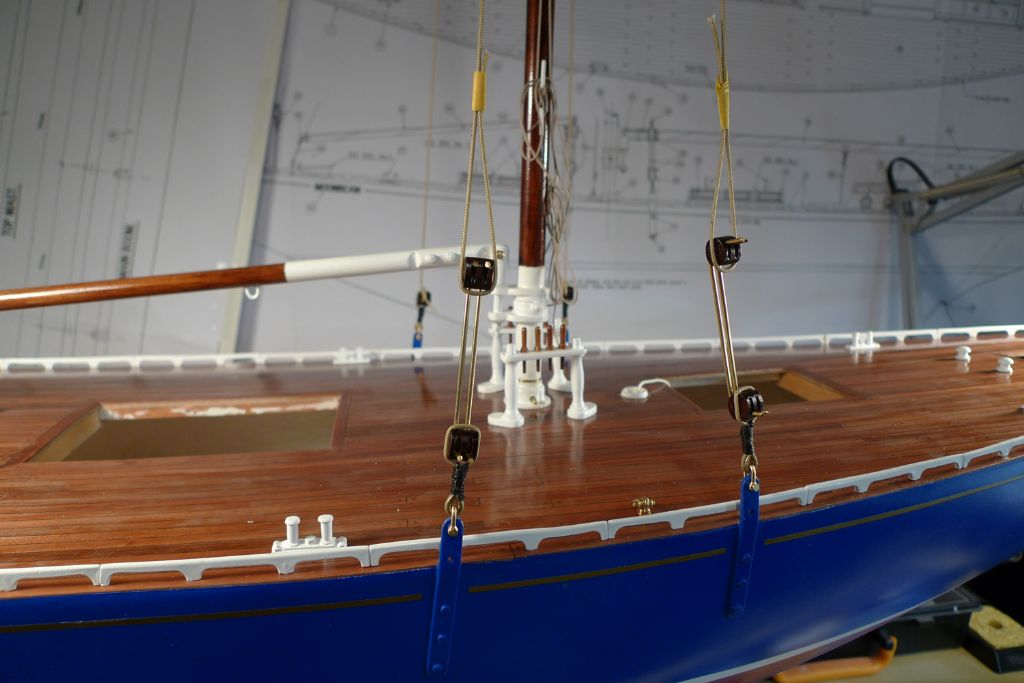
… to be stropped in place, and again parcelled.
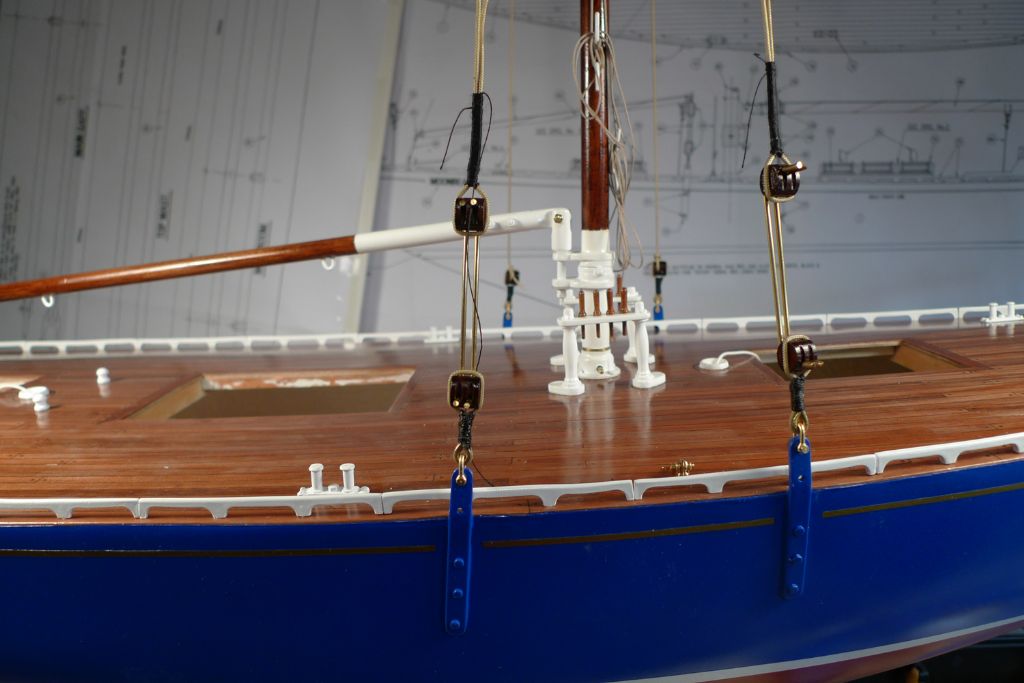
Before cutting of the ends of the parcelling thread, I shall properly secure the knots with some glue, but in the meantime I set up the tackles and tensioned the shrouds.
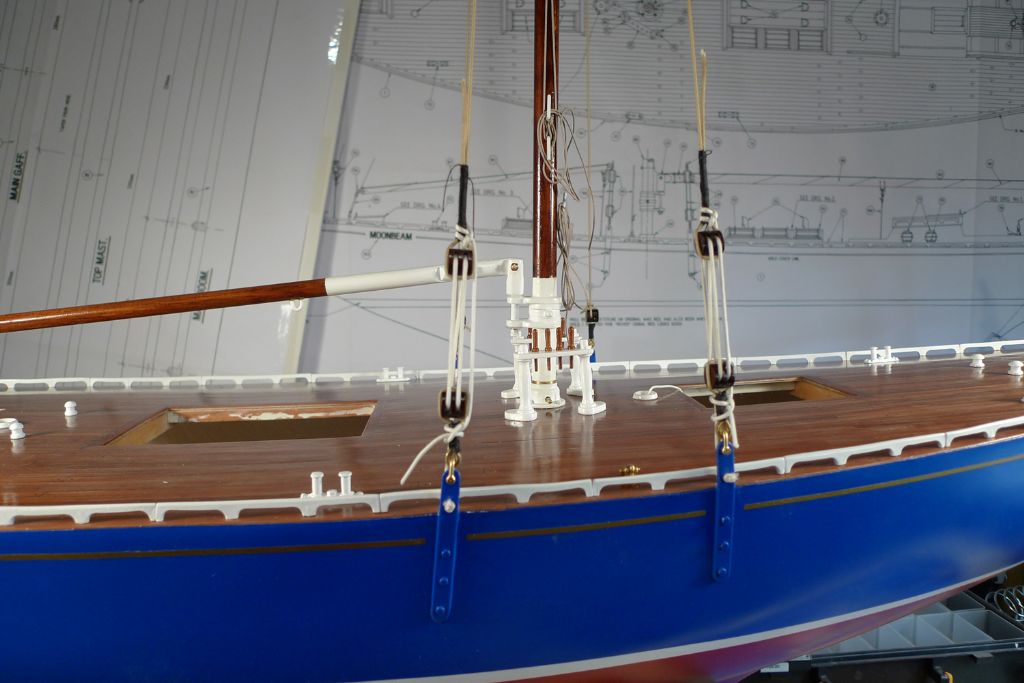
Next up will be the repeat process to port, and after that the fore- and jibstays, but right now this is where I'm at …
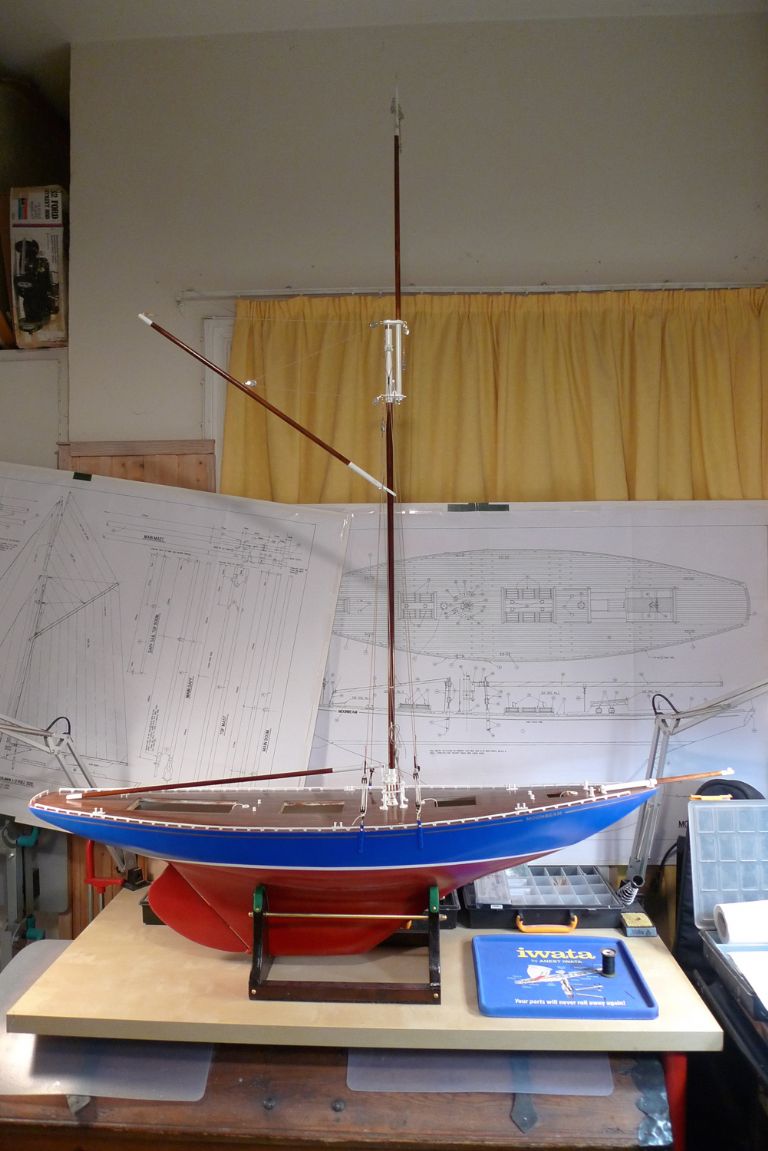
To be continued …
Mattias
Bob Abell 2
@bobabell2
I like the block and tackle tackle, Banjo
Very appropriate and impressive
Bob
Banjoman
@banjoman
Thank you very much, Bob!
Yes, I quite like the effect, too, although I'm not entirely convinced about the "appropriate" …
As a model of a model, i.e. a replica of an early 20th century pond yacht, I suspect that bowsies would have been more correct, while on a real yacht of similar vintage, I'm inclined to think that bottlescrews would have been used; see for example the second photo of the Fife yacht Moonbeam IV on this page: **LINK**
But never mind the woodblocks …  As you say, it looks nice, and as a method of setting up the shrouds, it works very well.
Again, build time has been a bit limited over the weekend — the weather was so nice that I got a few painting jobs done out on our back terrace instead — but I have now closed of the top loop of the port shrouds as well …
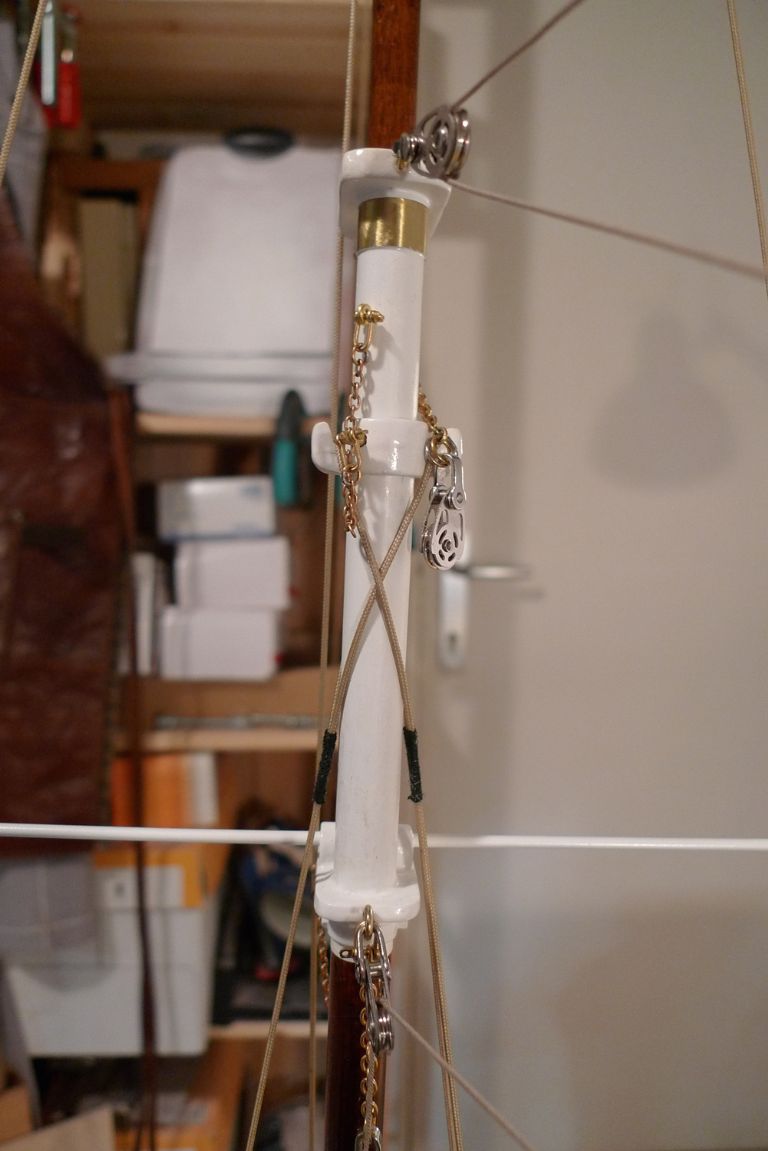
… and set up their tackles too.
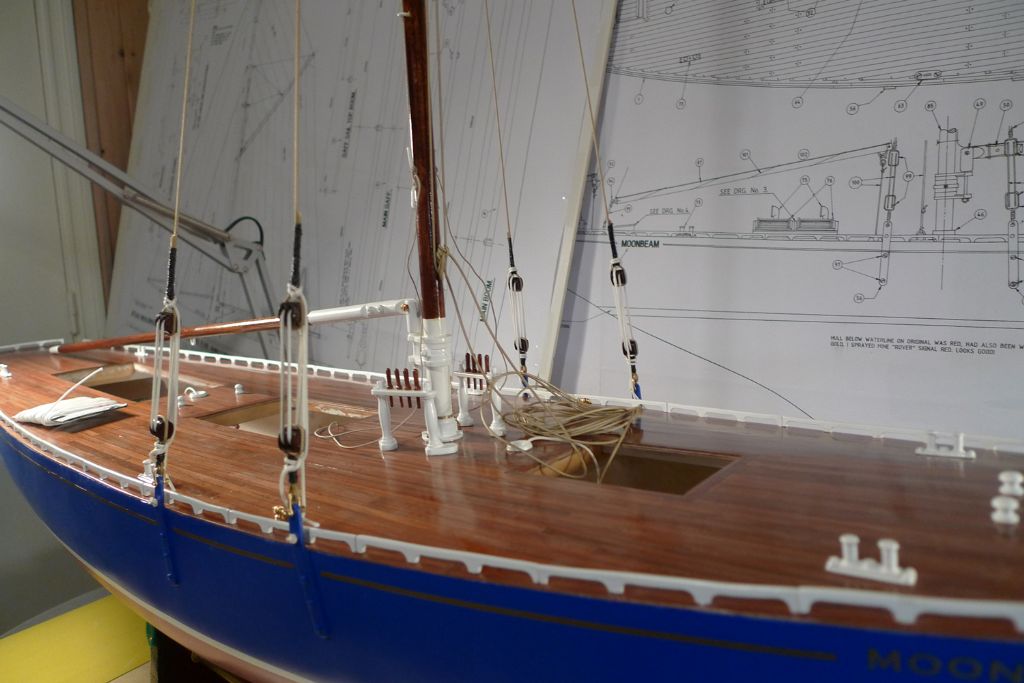
I have also added thimbles to the top ends of the two topmast shrouds …
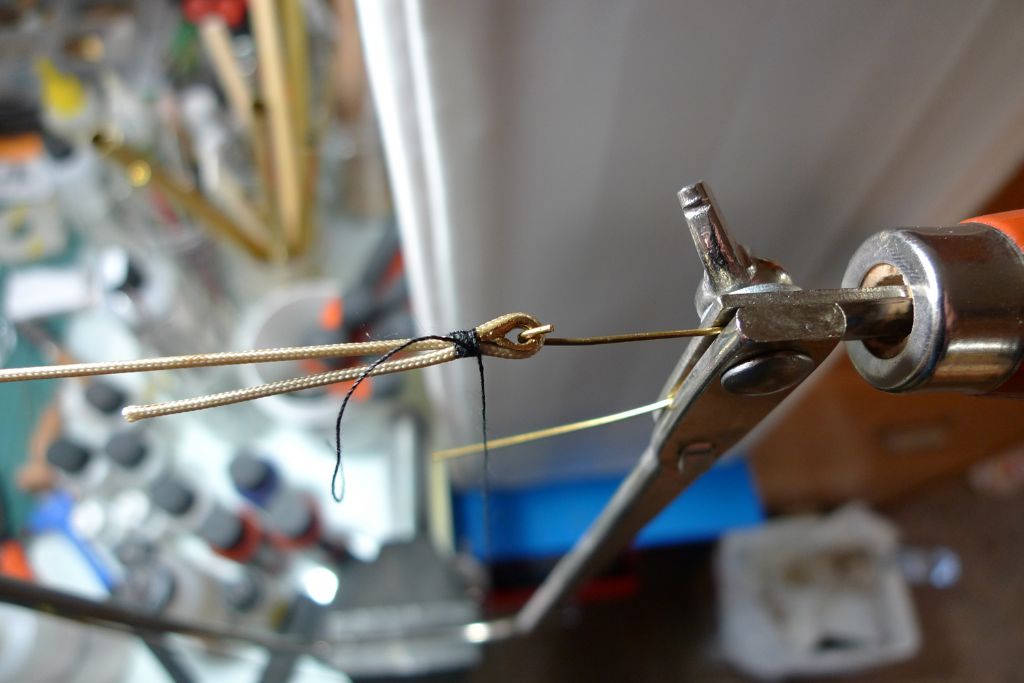
… and also to the fore and jib stays …
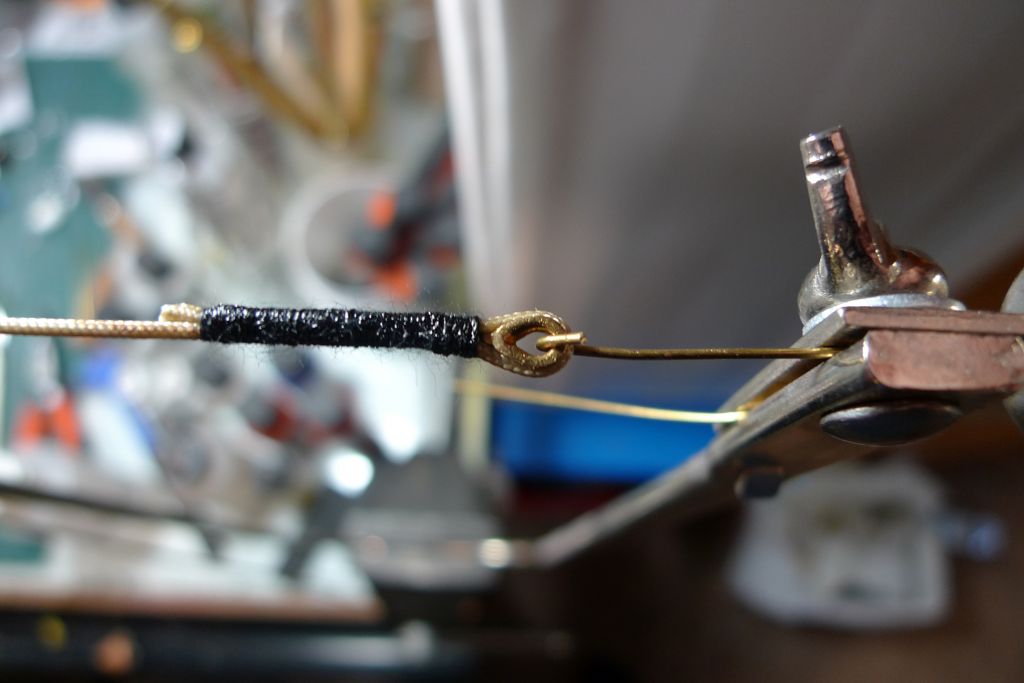
… shackled the topmast shrouds to the top of the topmast …
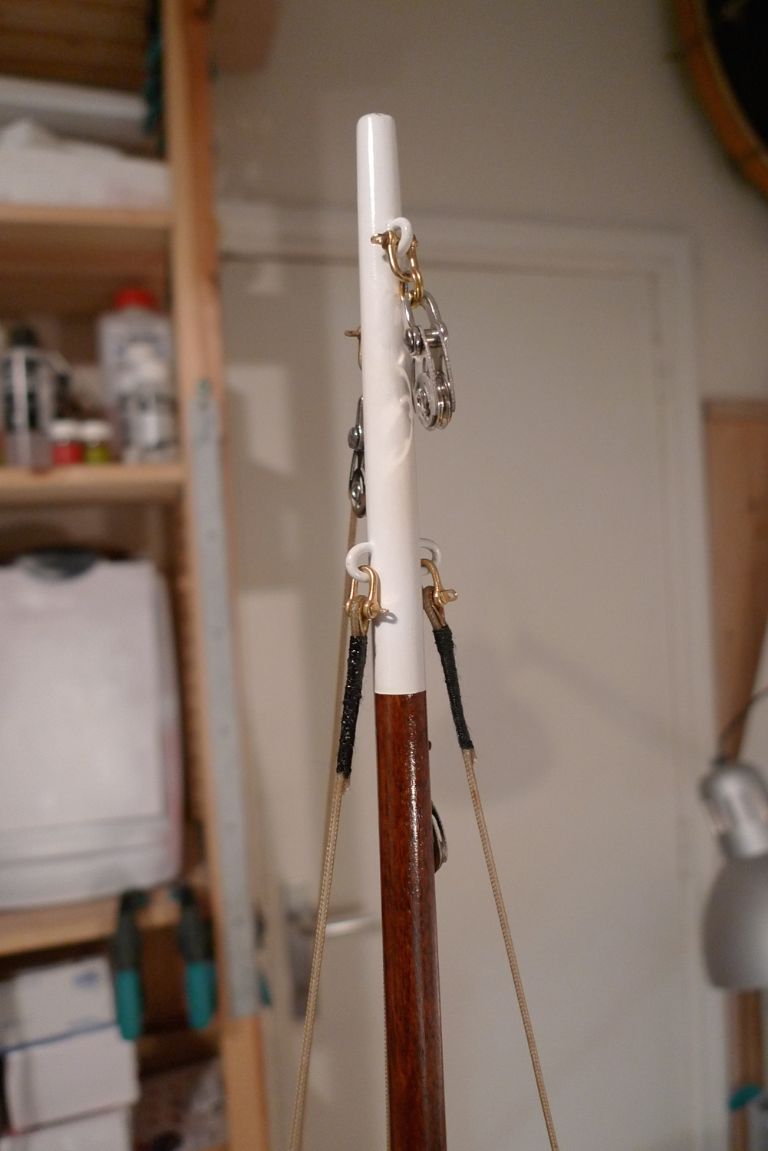
… and set up the stays. For these jobs, instead of getting on a ladder, I lifted the whole model down to the floor for easier access to the top of the mast …
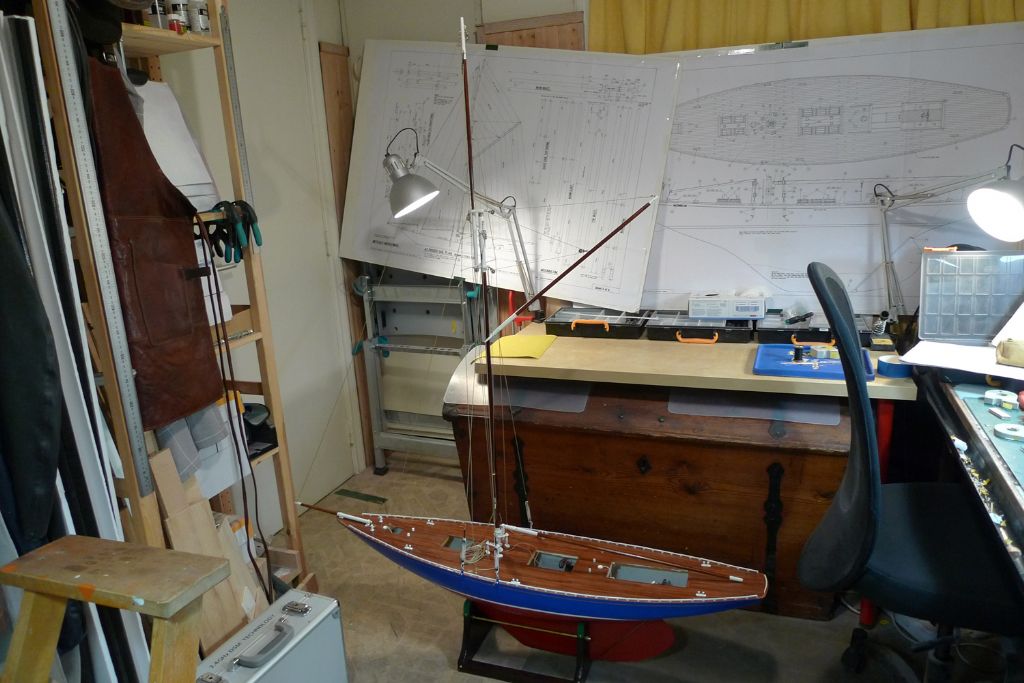
To be continued …
Mattias
Ray Wood 3
@raywood3
Hi Mattias
Brilliant work as usual from you, the eye for detail and finish exceptional, really like the reference to the Sex Pistols quote
Regards Ray

Rudy Why
@rudywhy43146
Hi Banjoman, Do you make your own ridding thimbles. Looks easy enough. But…
Rudy
Banjoman
@banjoman
Hello Rudy,
Good grief, no! I'm not even anywhere near being able to cast things in bronze!
No, these thimbles are store bought; as I said in one of my replies to Bob Abell above, I get them from Modelling Timbers on the Isle of Man (**LINK** – see about halfway down the page). This is the only place I've found them, and they really surpass most other model thimble types that I've seen: they look just right, and they work just right, too.
They come in three sizes, of which I am using the medium (6 mm long) ones here.
Mattias
Banjoman
@banjoman
Warmest thanks, Ray, for your much too kind words!
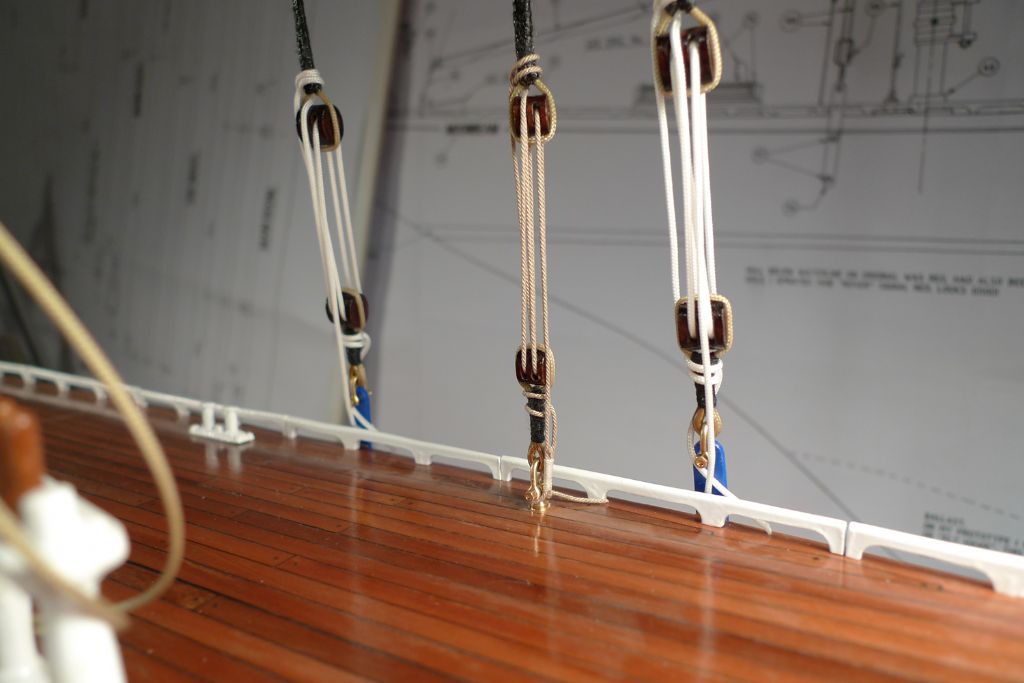
I have now also stropped the two lower blocks for the topmast shroud tackles; as can be seen I used slightly smaller ones for this job, primarily because I only had ten of the larger ones, and had already used eight for the main shrouds, but also to create a visual variation between the main and topmast shroud tackles.
I thus had to change the pins in the jig from 1.5 to 1.2 mm, to fit the slightly smaller holes in the smaller blocks, after which they were set up for the strops to be sewn together …
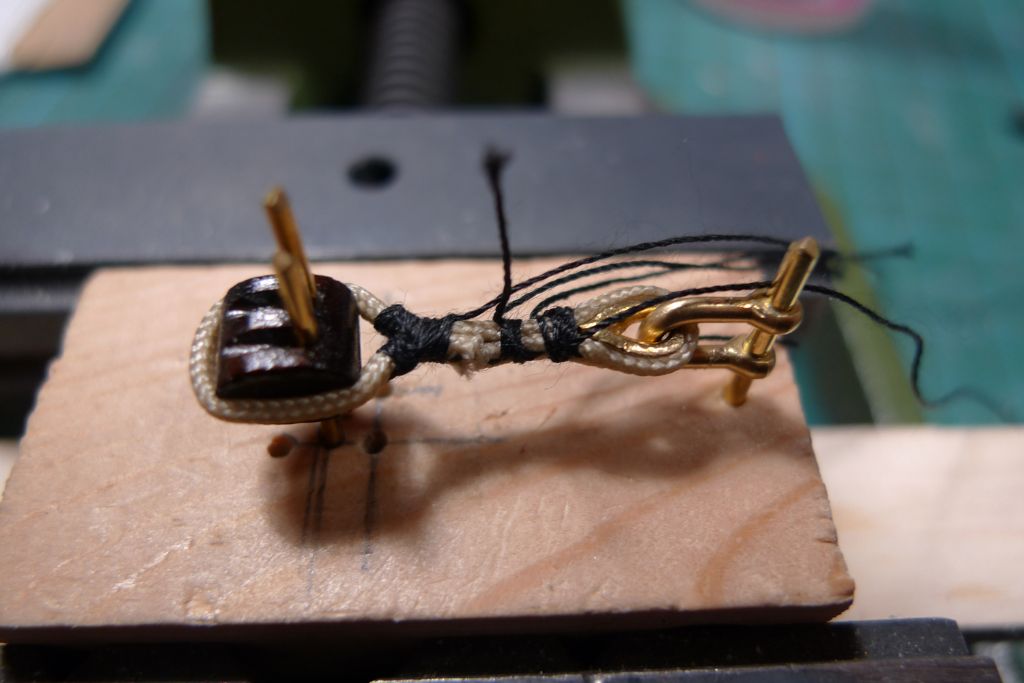
… and then tensioned in the jigsaw bow and seized.
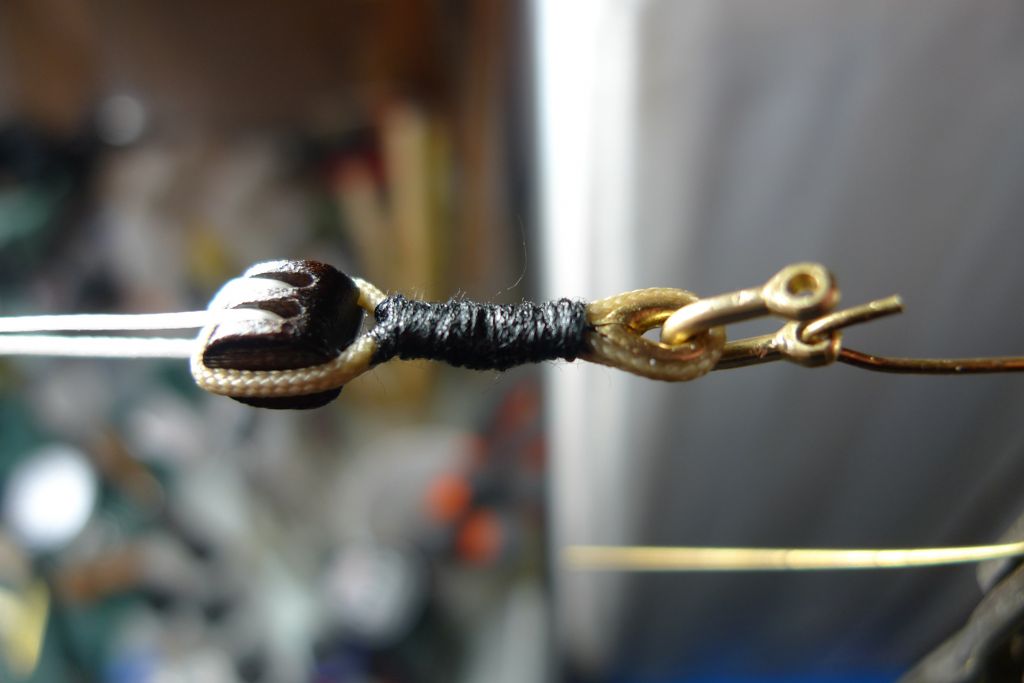
I also seized (un-thimbled) loops onto two lengths of 0.88 mm laid rope, and slipped these over the eyebolts set in the deck …
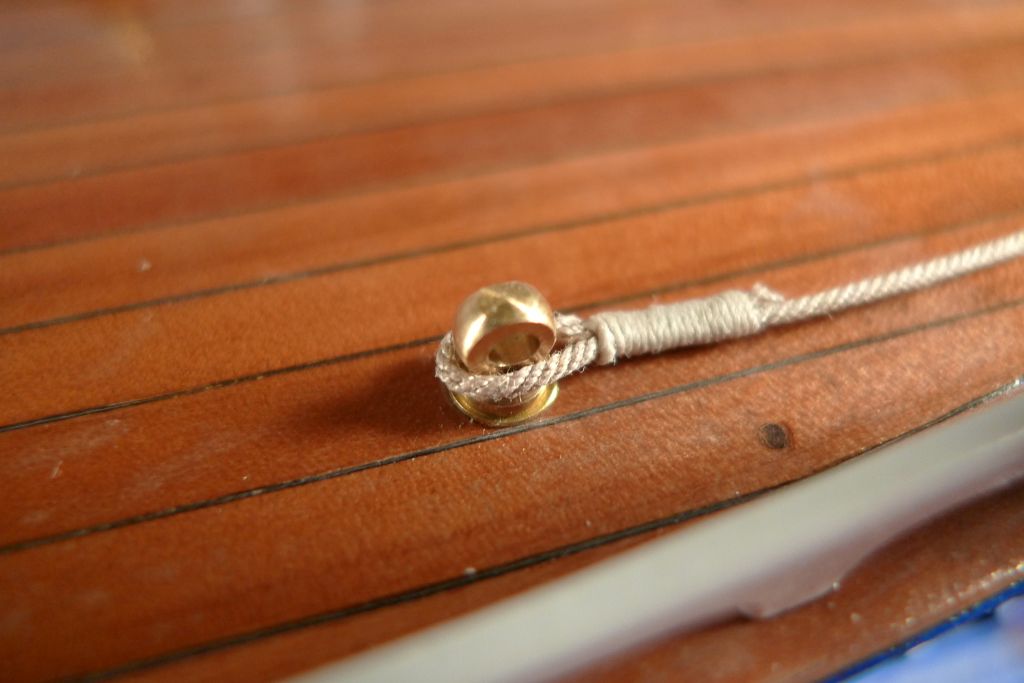
… to give the standing ends of the two tackles a strong purchase point.
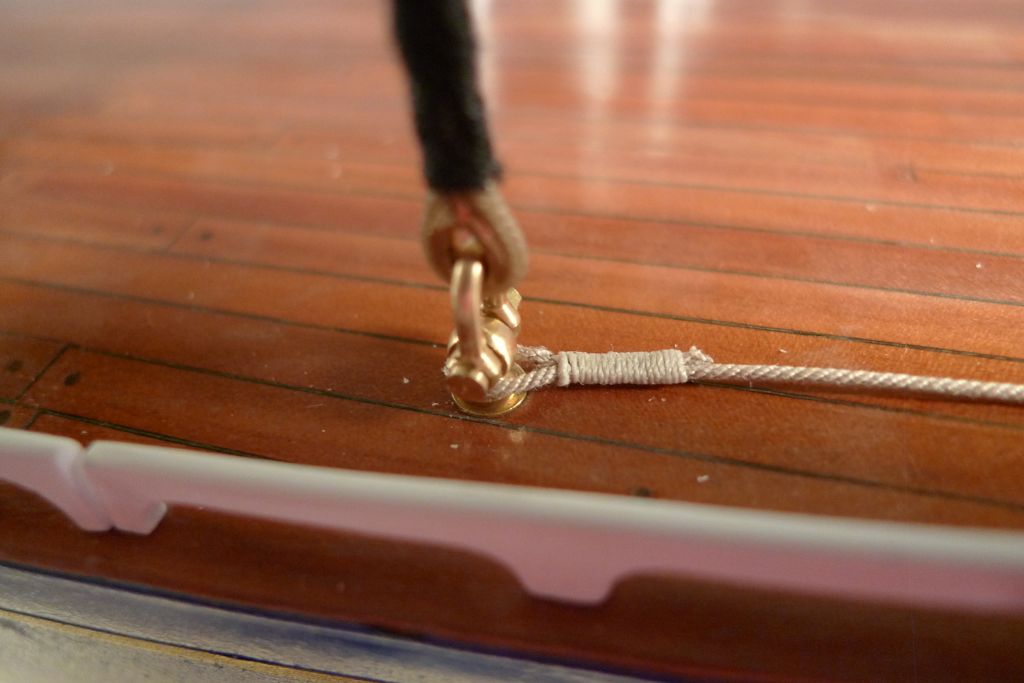
I then bent some 1.2 mm brass rod to form 50 mm (i.e. 5 mm shorter than for the main shrouds, again to create a visual variation) distances, set these up and looped the topmast shrouds around the upper tackle blocks …
… sewed the ends together …
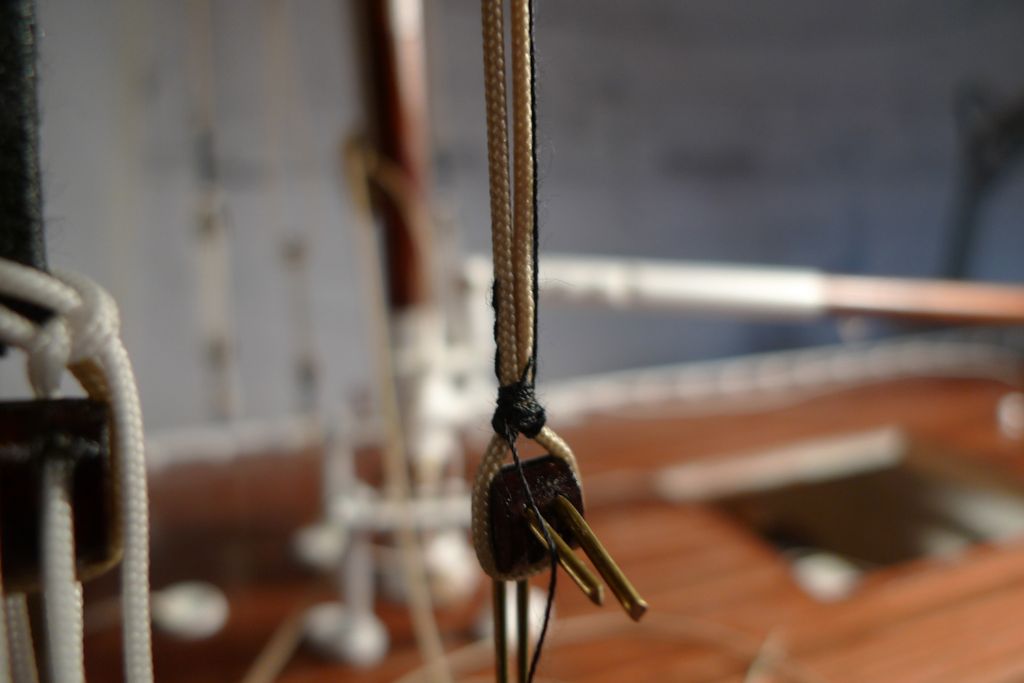
… and then seized them …
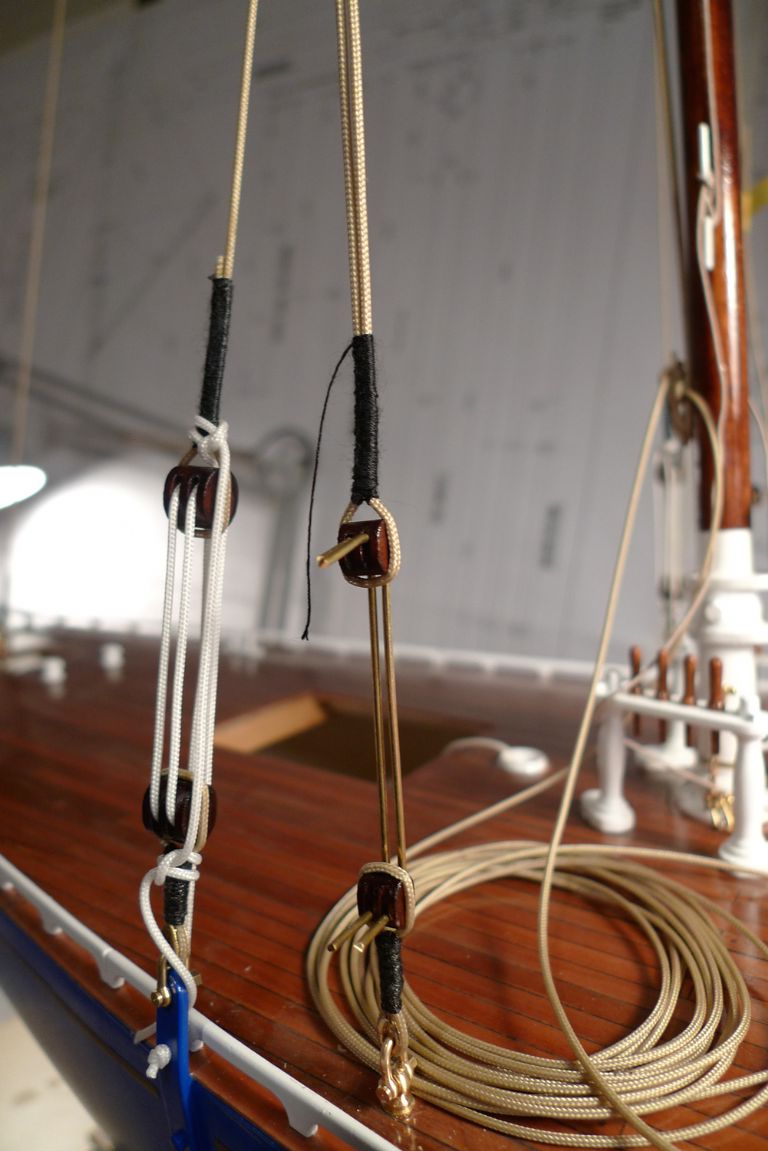
… after which the tackles were hauled tight and belayed.
With this, I think that the standing rigging is pretty much sorted. Next up will be the jib and foresail booms, then the various superstructures and finally the sails; in other words, I'm beginning to see the finishing line, and am hopeful that I shall be able to have her ready for the spring sailing season as planned …
To be continued …
Mattias
Edited By Banjoman on 21/02/2017 07:33:44
Edited By Banjoman on 21/02/2017 07:36:31
Banjoman
@banjoman
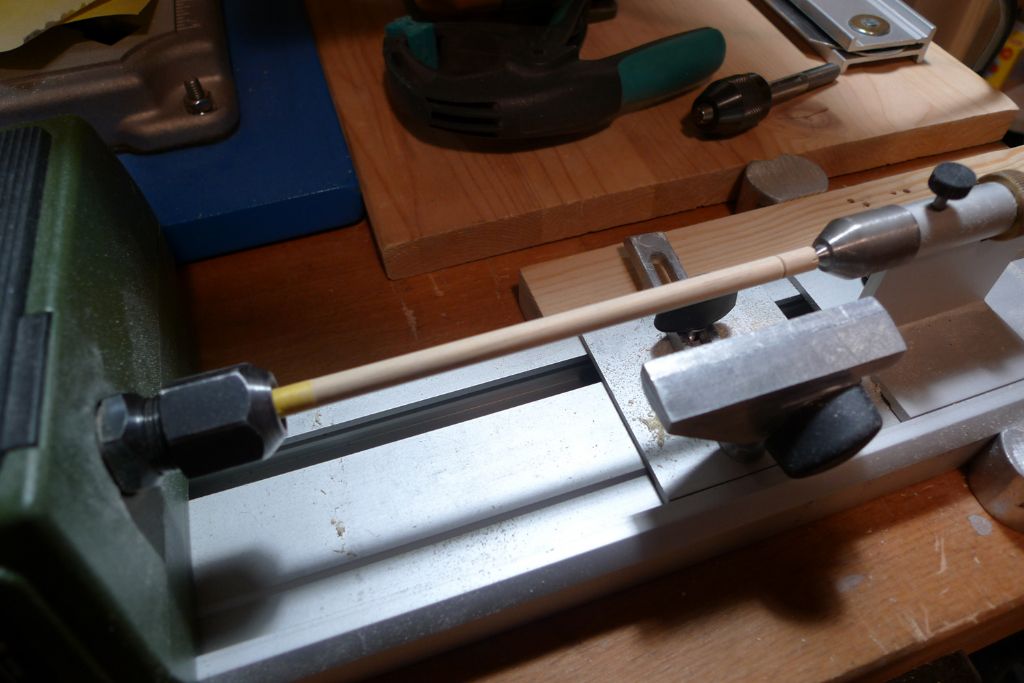
Today I cut off two lengths of 6 mm dowel blanks for the foresail and jib booms, and set them up in the micro lathe to sand them smooth and to give them a soft but discernible taper.
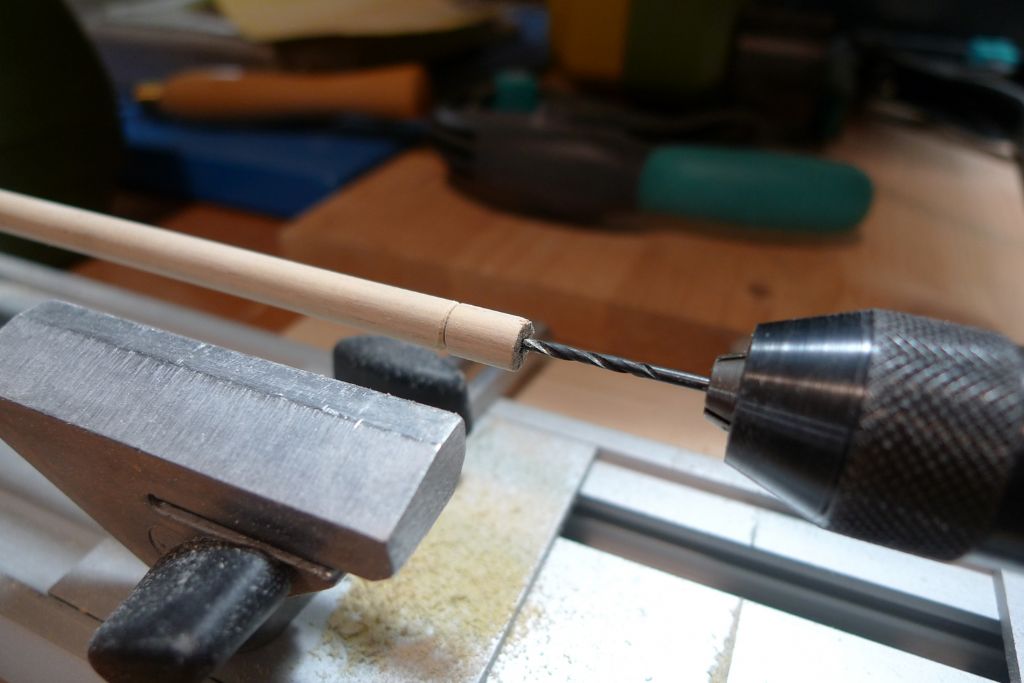
I also drilled a 1.6 mm hole into one end of each …
… and then tapped an M2 thread into those holes …
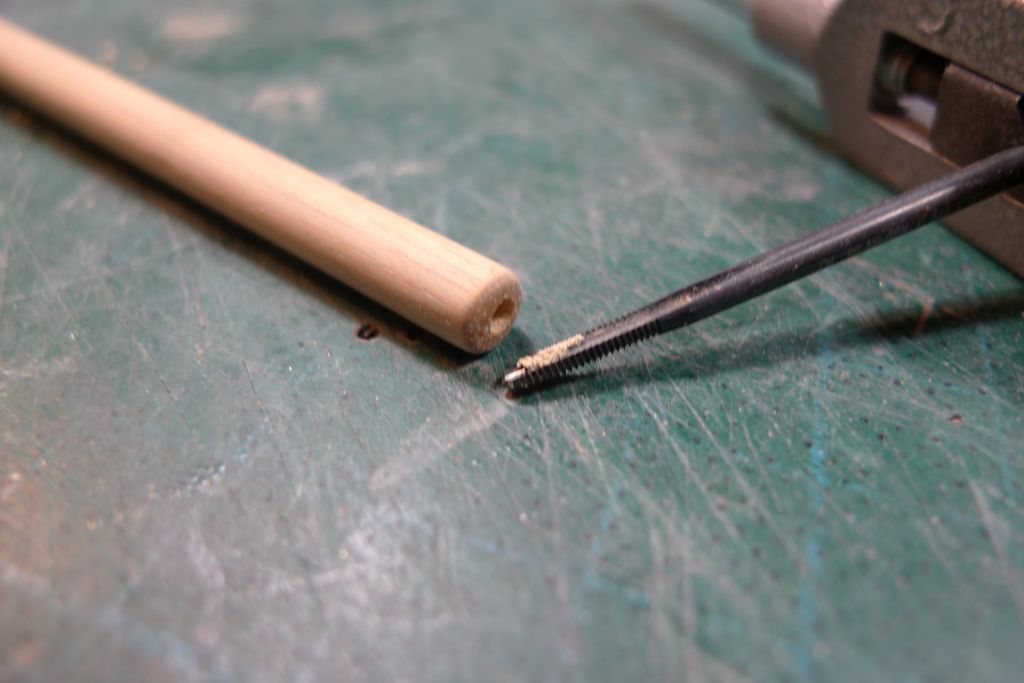
… so that the booms can be screwed on to the eyebolts that I have decided to use as hinges for these spars.
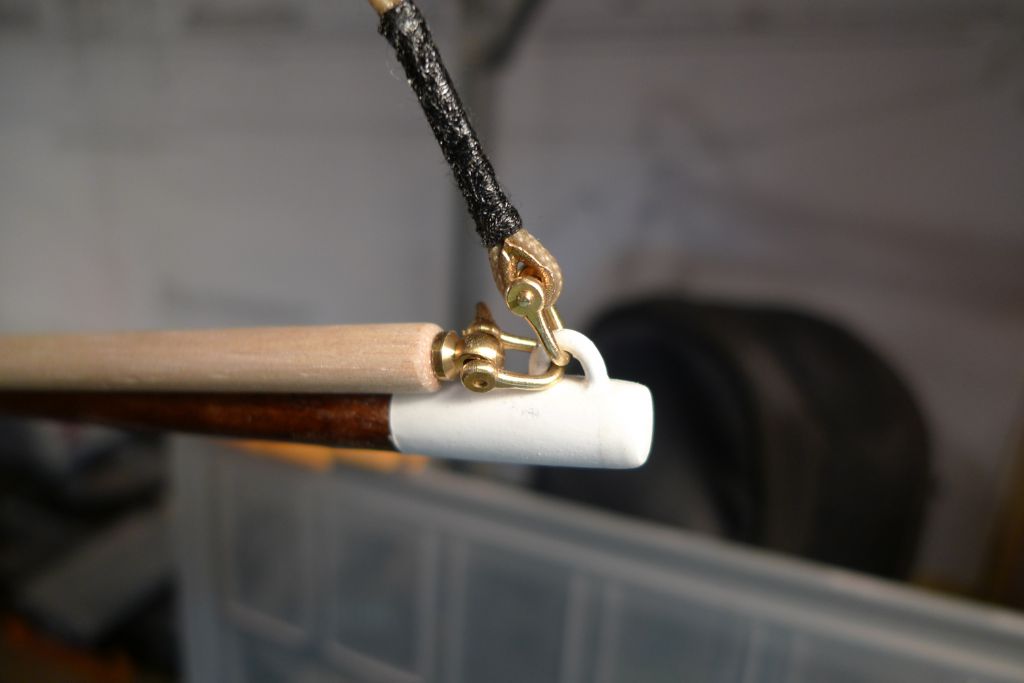
They still need to have the loops added for hooking on the sheets, and also the countersunken holes for the thread with whoch to fasten the sails, after which it'll be time to stain, paint and varnish them in the same was as the other spars have been done.
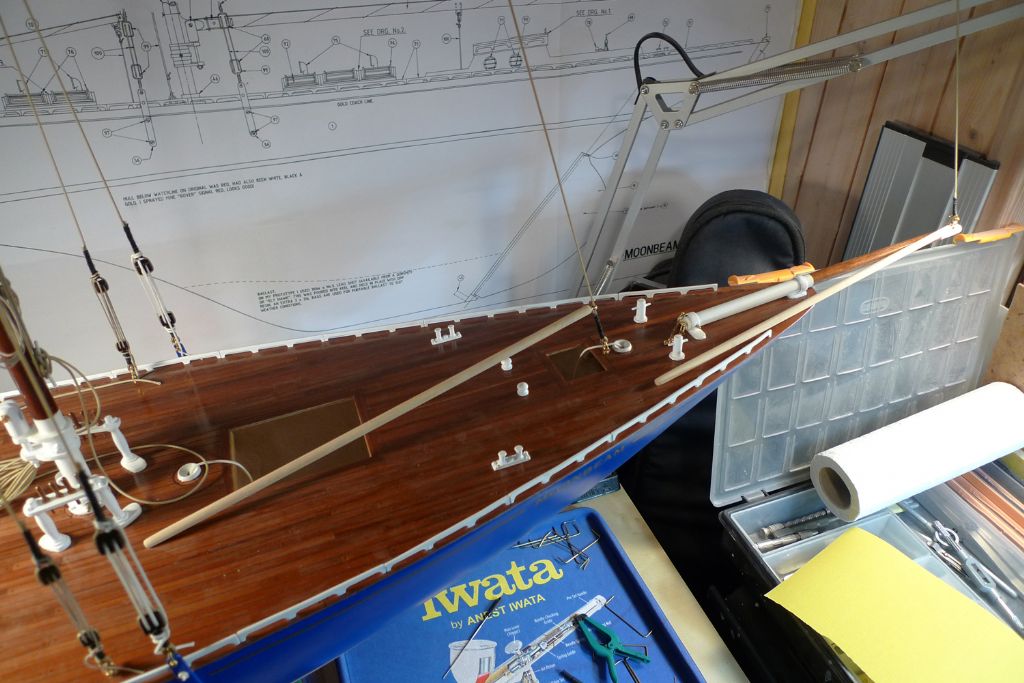
To be continued …
Mattias
Ray Wood 3
@raywood3
Hi Mattias
I'm probably teaching my granny to suck eggs ! but are you having adjustable outhauls on your jib & foresail booms and main boom to allow you get the best sail shape ? The only picture I have is the boom outhaul on my Laser which I'm still trying to sell
Best Regards Ray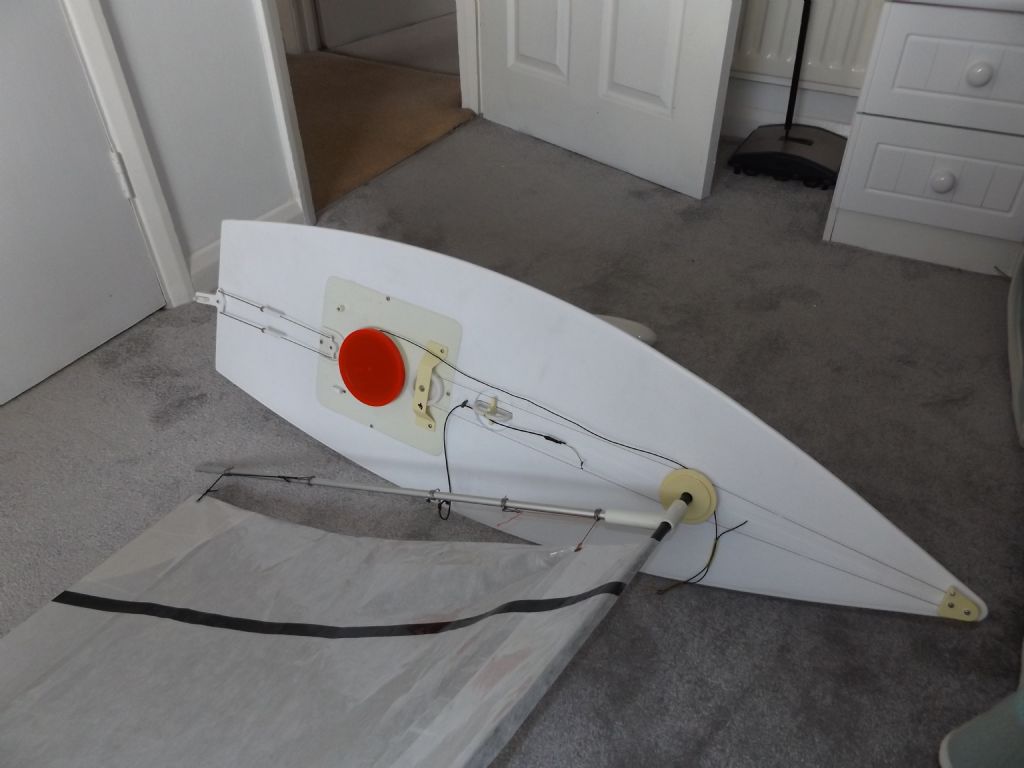
Banjoman
@banjoman
(sound of egg sucking suddenly stops)
Wha's tha' tha says, young Ray?
(sound of egg sucking resumes)
On a more serious note, the answer is no (the Banjoman says "no" ). I did think about it, but decided in the end not to bother; partially perhaps because it is not a feature foreseen in the instructions (although that in and of itself would not have stopped me from adding them), but mainly because I don't plan to race this boat in any way. My intentions from the start have rather been to take her for a lazy afternoon's potter about the pond on a not too windy day, or at least that's the image that I've had in front of me during the build.
As I don't intend to race her, I don't really think it'll matter all that much if the sails are not the most efficent shape, so I've decided to take my chances with a set-and-forget approach …
Mattias
Edited By Banjoman on 24/02/2017 07:32:56


 Banjoman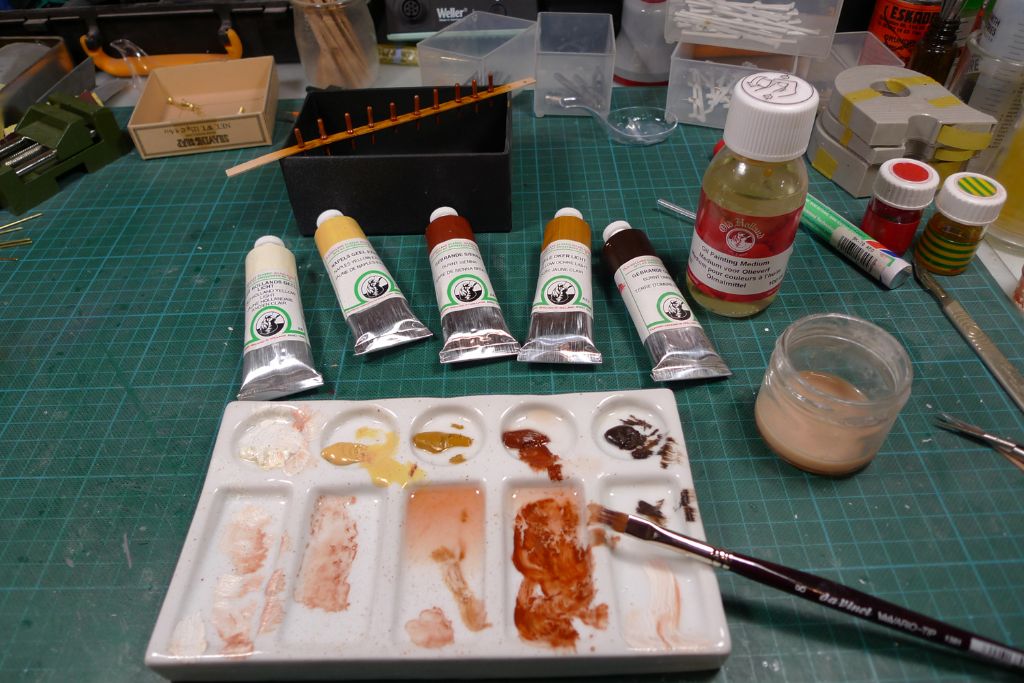
 Bob Abell 2
 Rudy Why
Tim Cooper in: Build Blogs
Queequeg Quint in: All things floating
 Richard Simpson
nighthaunt in: Beginners
 ashley needham
in: All things floating
ashley needham
in: All things floating
Gareth Jones in: Scratch build
 Alasdair Allan
in: All things floating
Alasdair Allan
in: All things floating
 Ray Wood 3
in: Scratch build
Ray Wood 3
in: Scratch build
Bob Abell 2 in: Scratch build
 Colin Bishop
Frag 74 in: Build Blogs
Stephen Garrad in: All things floating
 Chris Fellows
in: Build Blogs
Chris Fellows
in: Build Blogs
 Boiler Bri
Charles Oates in: Collectors’ corner
Dodgy Geezer 1
harry smith 1 in: Collectors’ corner
 Tim Rowe
Len Morris 2 in: Soapbox
 Tim Cooper
  Queequeg Quint
  nighthaunt
  Gareth Jones
  Bob Abell 2
  Frag 74
  Stephen Garrad
  Charles Oates
  Dodgy Geezer 1
 harry smith 1
  Len Morris 2