
Bowing plywood

Bowing plywood

Home Forums Scratch build Bowing plywood

  • This topic is empty.
Viewing 16 posts - 1 through 16 (of 16 total)
  • Author
    Posts
  • #58335
    David Marks 2
    Participant
      @davidmarks2

      I am building a UTE (Glynn Guest design) and made a lift off panel in the deck area to access all the usual gubbins located in the hull i.e batteries, servo et etc. the panel is made of good quality ply of 6mm thickness as the `plug' topped with a layer of 1.5mm. The panel was perfectly flat until it received three layers of dope to the upper surface as a a sealant followed by two coats of Halfords yellow primer/filler. Sadly the panel has now taken up the shape of a British Rail sandwich i.e. curling up at the edges. I can only assume this has been caused by the application if the dope…….Any suggestions to what has caused the problem.

      #7016
      David Marks 2
      Participant
        @davidmarks2
        #58336
        ashley needham
        Participant
          @ashleyneedham69188

          David. Its not called shrinking dope for nothing !!! New panel time I think. Dont use dope next time, I use sanding sealer, or simply dont seal at all, just use the spray, after all it is a primer/filler.

          Ashley

          #58338
          Colin Bishop
          Moderator
            @colinbishop34627

            Sounds like the problem is caused by treating one side only. If you apply the dope/sealer//filler/paint to both sides alternately it should stay flat.

            With dope or sanding sealer (I would agree with Ashley that the latter is better for this application) then you can treat both sides simultaneously by applying the sealer while holding the wood in a vertical position. Use a slightly bigger piece of wood initially and then cut the hatch to size after you have applied the coatings.

            Colin

            #58340
            Paul T
            Participant
              @pault84577

              David

              I put stiffening bars on the inside face of unsupported ply panels, for example to stiffen a 1.5mm ply I would add 2 or 3 pieces of 10 x 4mm stripwood with the 4mm edge glued to the ply (so the 10mm length is at right angles to the ply)

              This will prevent the ply from warping or twisting.

              Paul

              #58341
              Colin Bishop
              Moderator
                @colinbishop34627

                Paul's suggestion is very good one if you have space available as it effectively increases the thickness and rigidity of the hatch

                Colin

                #58342
                David Marks 2
                Participant
                  @davidmarks2

                  Thanks for the responses. I have used the same process before but not on such a large panel. I confirm that the `plug' i.e the piece that fits into the deck is 6mm ply and this was topped with the 1.5 ply which I made about 12 mm bigger (all round) to form a good seal. I would have thought this would have prevented the bowing.Changing the subject slightly, one of my jobs was the updating of test laboratories. Many included custom made `worktops' which were topped with a type of Formica. I questioned why the company undertaking the work covered the underside with Formica (or equivalent) as well as the upperside. To prevent bowing, distortion was the answer.

                  #58344
                  David Marks 2
                  Participant
                    @davidmarks2

                    Ashley – The dope I used was cellulose sanding sealer. The new supply is clearly marked as non-shrinking dope. both obtained from five star in Runcorn.

                    #58348
                    ashley needham
                    Participant
                      @ashleyneedham69188

                      David. I see…dope and sanding sealer are diferent things (as dope is normally a shrinking product) which is why i made the shrinking remark.

                      I am very suprised that material of this thickness bowed I must say.

                      I usually put stiffeners underneath things like hatches. So If you had room, for instance, for a hatch plug made from inch deep balsa, 1/4 inch thick, this would resist bowing much more than flat ply (as per pauls method..having just reread the posts !!!).

                      Ashley

                      Edited By ashley needham on 12/06/2015 08:42:42

                      #58352
                      Colin Bishop
                      Moderator
                        @colinbishop34627

                        Yes, one would expect ply of that thickness to be stable but on the other hand you are introducing a solvent to the top layer of the ply and the physical force introduced by the drying process should not be underestimated. After all, if it can happen to something like a thick worktop then 6mm isn't very much!

                        Colin

                        #58354
                        David Marks 2
                        Participant
                          @davidmarks2

                          I will make a new item and just treat the upper surface with the Halfords Primer/Sealer. As regards to Ashley's idea of using thickish balsa. For the present application there is insufficient space. Also I am not a great user of balsa as it does not fit in too well with my method of manufacture i.e I use a small milling machine for machining ply and Plasicard and balsa is too soft for "clamping down".

                          #58356
                          Colin Bishop
                          Moderator
                            @colinbishop34627

                            Probably still worth treating both sides, even if only with primer, on the belt & braces principle.

                            Colin

                            #58357
                            Dave Milbourn
                            Participant
                              @davemilbourn48782

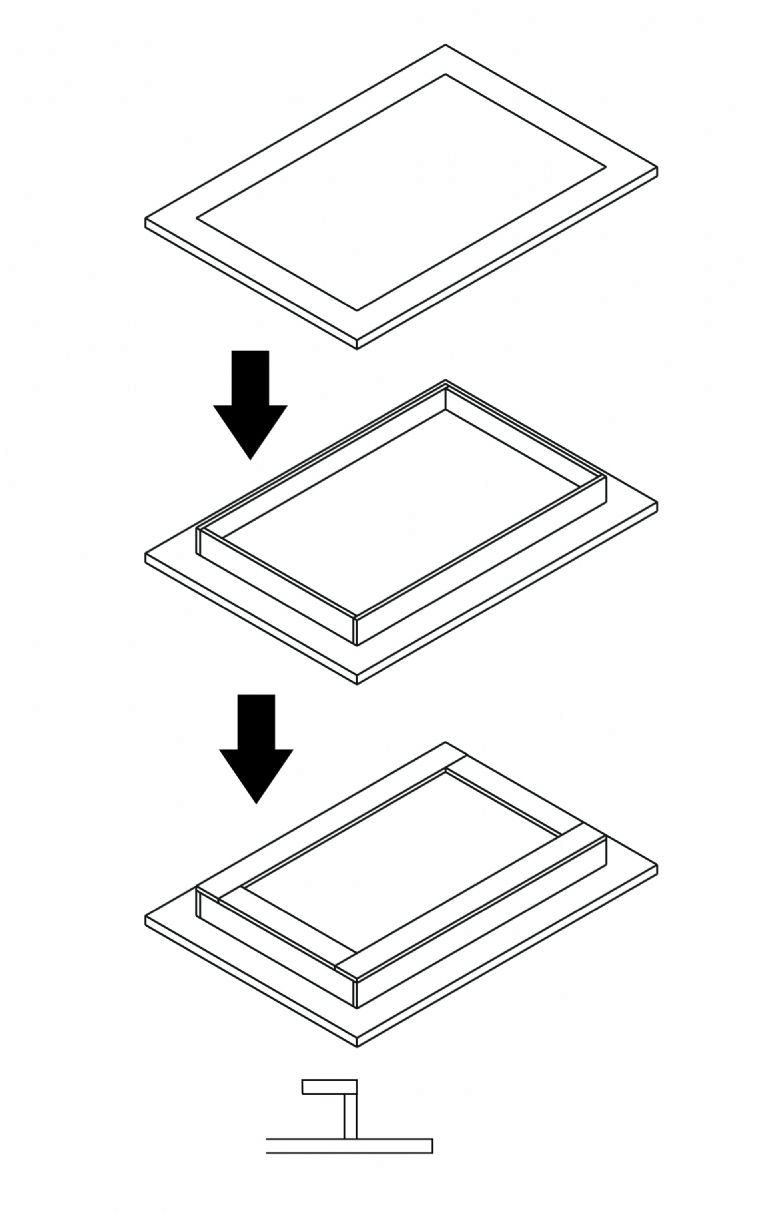
                              My suggestion would be to abandon the ply plug altogether and fabricate the hatch from 1.5mm styrene sheet with an L-section beam all around underneath, also made from 1.5mm styrene. When this has dried (weighted down flat while it does so….) you will be amazed at how strong and warp-resistant it is. Works for me (and Model Slipway).

                              Here's a drawing:

                              scratch hatch.jpg

                              Edited By Dave Milbourn on 13/06/2015 12:02:39

                              #58365
                              David Marks 2
                              Participant
                                @davidmarks2

                                Thank you both for the further information. I may try the styrene approach. Is the channel formed in that manner to reduce the amount of surface area which is glued or solvent welded? however, getting back to ply..what is the difference between conventional birch ply and lite ply? I need replenish my stock of ply.

                                #58368
                                Dave Milbourn
                                Participant
                                  @davemilbourn48782

                                  I don't understand your question about "the channel". The strips of styrene form an L section which is glued to the hatch to prevent it warping or twisting. If you glued one of the strips face down to the deck then it wouldn't form an L section any more; it would just be a flat beam and nothing like as strong.

                                  Liteply is a sandwich of three veneers of a relatively soft wood (I used to know its name but I've long since forgotten it) which are glued together with a pva-like adhesive. Contrary to popular myth is it NOT a layer of balsa with birch ply on each side. It was created to replace the cardboard used in childrens' jigsaws as it is much easier to die-cut and doesn't wear out the blades as much. It is also easy to cut with a heavy-duty modelling knife, sands easily, is light in weight but has a pronounced grain which needs a fair bit of sanding and filling. It isn't waterproof or even water resistant without treatment. If you submerged a piece in water it would come apart (de-laminate) very quickly.

                                  Birch ply is three or more veneers of birch (Finnish or Russian are the usual ones) which are glued together with a resin adhesive under great pressure. This makes it much stronger than liteply. It's also heavier, hard to cut with a knife and more difficult to bend. It does have a fine grain which makes it easier to finish, and it is generally WBP, or 'water and boil-proof'. This grade will not de-laminate in water.

                                  Hope this helps.

                                  #58379
                                  David Marks 2
                                  Participant
                                    @davidmarks2

                                    David – Firstly many thanks regarding the info on the plywood. I will stick with the Birch Ply.

                                    Regarding the styrene hatch cover. I was wondering if the horizontal part of the `L' was cemented to the underside of the cover (instead of the narrow edge of the styrene strip) would it cause distortion? However, giving it further thought, this would leave the vertical part of the `L' unsupported.

                                  Viewing 16 posts - 1 through 16 (of 16 total)
                                  • Please log in to reply to this topic. Registering is free and easy using the links on the menu at the top of this page.

                                  Code of conduct | Forum Help/FAQs

                                  Latest Replies

                                  Home Forums Scratch build Topics

                                  Viewing 25 topics - 1 through 25 (of 25 total)
                                  Viewing 25 topics - 1 through 25 (of 25 total)

                                  View full reply list.