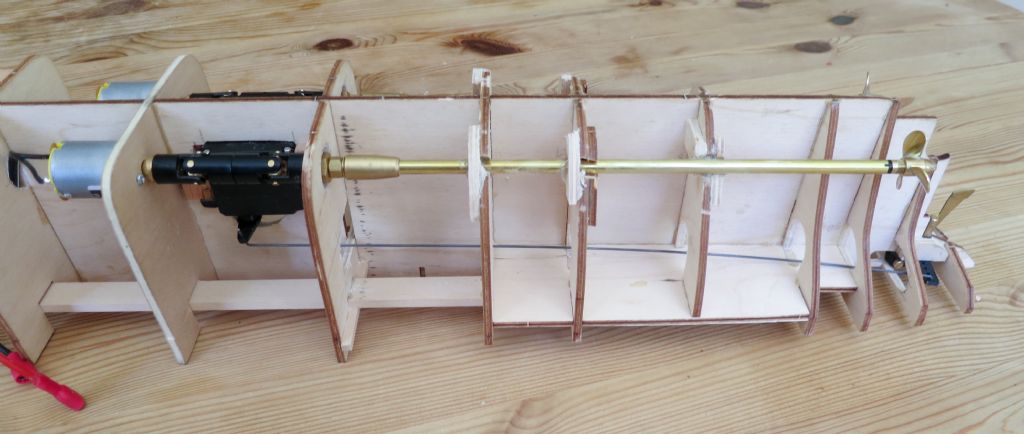

Mtroniks w-tail mixer/ESC set up.

Mtroniks w-tail mixer/ESC set up.

Home Forums R/C & Accessories Mtroniks w-tail mixer/ESC set up.

  • This topic is empty.
Viewing 13 posts - 1 through 13 (of 13 total)
  • Author
    Posts
  • #67186
    Jeremy
    Participant
      @jeremy15845

      I have just fried an Mtroniks Micro Marine Viper 10 during out of water testing on my Amati Titanic hull. Before frying the other one, I would appreciate advice on whether the set-up is appropriate.

      The motors are MFA 280 brushed 12-24 volt, current 0.3 amp at max efficiency. I plan to use 3 bladed 30mm diameter brass props, closest to the scale size of 28mm, although I could downsize to 25mm. Batteries are two 6 volt, 1 amp hour, SLA's wired in series.

      The Mtronics mixer was connected as follows. Input 1 to terminal 4 of the Planet T5 receiver. Input 2 to terminal 1. Outputs 1 and 2 to the two ESC's and output 3 to the servo. Output 4 was left blank. The red wire to the receiver was cut on one of the ESC's to avoid both trying to power the receiver.

      What confuses me even more is that, on my Riva model which does not use a mixer, the ESc's are connected to terminal 1 (not terminal 4) and this works. Trying this on the Titanic does not work.

      The Titanic set-up seemed to run OK forward or reverse, although the ESC's did get hot. Rudder left resulted in the relative motor speeds changing as needed. Rudder right seemed to stop both. I think the thermal overloads cut in more than once, making the red light on the receiver flash which would normally only happen if it is not bound with the transmitter (Planet T5 mode 1).

      I chose the micro ESC's because they are small (23g) and should handle 10 amps. I could fit the larger 15 or 20 amp units, both of which weigh 55 gms. Before I go any further, am I making some fundamental error?

      Sorry to be so long winded, but I though it better to supply all relevant information and I do need help!

      Jeremy

      #5435
      Jeremy
      Participant
        @jeremy15845
        #67190
        Dave Milbourn
        Participant
          @davemilbourn48782

          Jeremy

          I have no experience of the particular mixer unit used with those speed controllers, but I do know that those props are much too large for the motors you have used. That's probably why the ESCs are overheating.
          I would personally have used MFA 385LN motors. These are slightly larger than the 280 but have more than four times the torque on that voltage and would be capable of turning those props without melting anything. I have used this type of motor in my Sea Nymph and can recommend it – so has Tony Hadley (see the thread on his Guardsman build) **LINK**

          I would also have used an ACTion P94 Lite, but that's hardly a surprise to anyone who knows my modelling history! **LINK**

          Dave M

          #67195
          ashley needham
          Participant
            @ashleyneedham69188

            Jeremy. do you really need independent prop control?? One ESC would make life much easier! Perhaps a slight rudder enlargement may be warranted (if not already done) . I have found that simply interfering with the prop-wash on one or the other side at full lock to be a very effective way of gaining low speed control, if not "in the book"

            ​Ashley

            #67196
            Jeremy
            Participant
              @jeremy15845

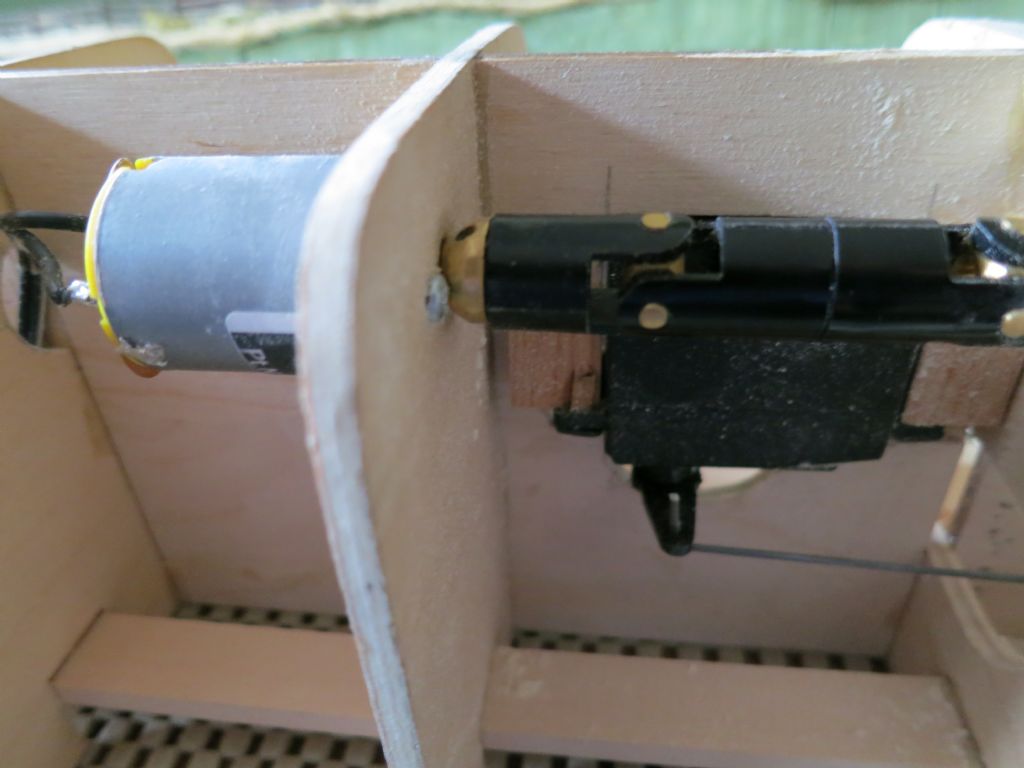
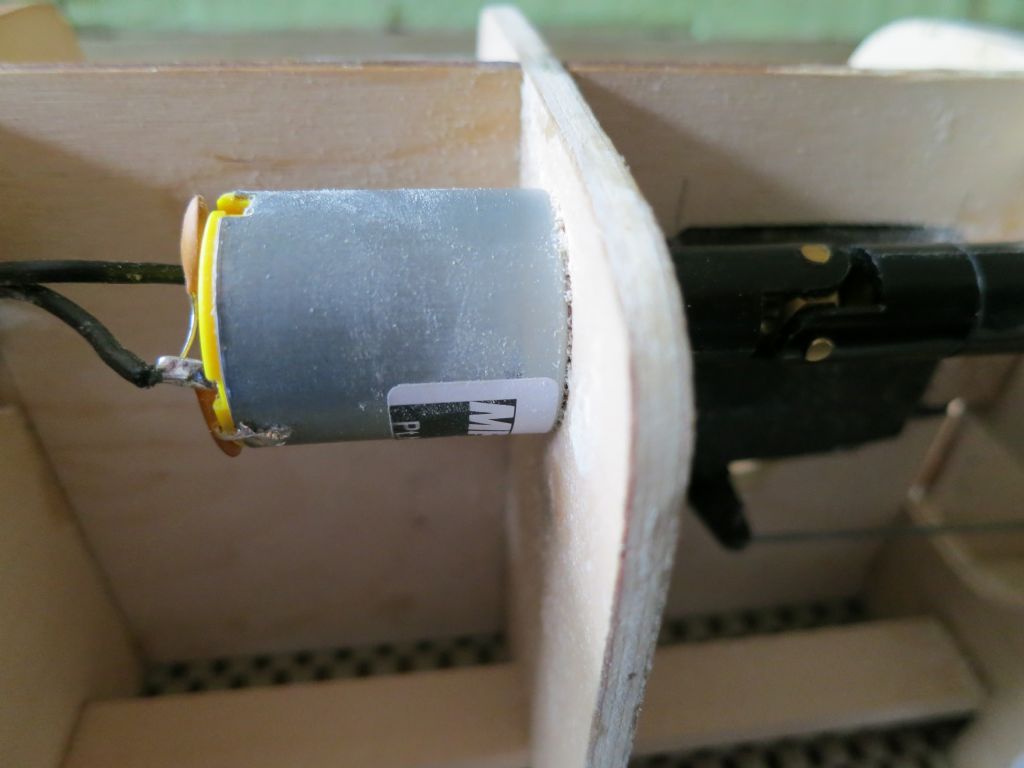
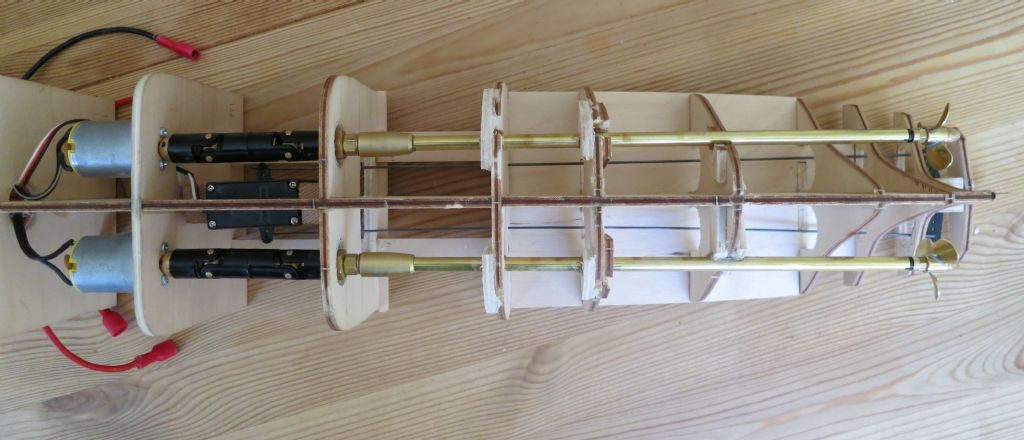
              img_1221.jpgDave – thanks for the advice. 280 motors were recommended in the RC conversion instructions for this model and, to be honest, I would prefer not to change them now unless they really won't work. They are screwed directly to the frame with only 5mm clearance from the bottom of the hull. I can easily go down to 25mm props but the ESC burned out without the props being in water. Being regretably ill-informed about all matters electrical, why would a small motor be more liable to melting an ESC than a larger one? I could go with the ACTP94 lite but would then need to find room for a battery pack for the receiver. To achieve the 12 volts required for the motors, I am using two 6 volt SLA's in series – there is a warning about using batteries in series in the P94 instructions on the basis that one can discharge into the other and lead to potential damage or even fire to the wiring. Could this cause me a problem?

              Jeremy

              Ashley – the scale rudder on this model is apparently far too small to have an effect without independent prop control, so I will have to try to make it work.

              Jeremy

              img_1220.jpg

              #67199
              Dave Milbourn
              Participant
                @davemilbourn48782

                Jeremy

                Some wrong ends of sticks are evident here. I'll try to sort them out for you:

                1. A small motor which is overloaded will draw more current than it can handle and thus overheat. This can also have the same effect on the speed controller. Too large a prop will overload a motor, as will a shaft which isn't running freely. I would check the latter if I were you; something isn't right there. The general rule of thumb for props, at least as far as brushed DC motors is concerned, is never to fit a prop whose diameter is larger than that of the motor case or which has more blades than the motor has poles. The 385LN is an exception in as much as it is specially wound to provide high torque at modest revs. It also has 5 poles on the armature. The 280 is a toy motor IMHO.

                2. The 385LN is 27.5mm in diameter whereas the 280 is 24.2mm. That means that there would still be clearance between the 385 and the hull, albeit only 1.65mm. A miss in my book is as good as a mile. Full details of both motors are available on the MFA Como website, under Miniature DC Motors **LINK**

                3. You can use a separate UBEC to power the receiver from the main battery. These are much smaller than a second battery pack e.g. **LINK**

                4. The P94 instructions (which I wrote) warn against using a separate battery for each pair of + and – leads. "Back-charging" is only a risk when you connect two batteries in parallel, not in series.

                Nuffink too clever there, was there?

                Dave M

                #67200
                Jeremy
                Participant
                  @jeremy15845

                  20160806-img_1199.jpgDave

                  OK then, I'll have to bite the bullet and try to fit larger motors. I looked at the MFA products sheet. Unless there are reasons to discount it, I think the 385 would be easier for me to fit than the 385LN. Its diameter is 27.5mm whereas the LN is 29mm. More significant for me is that the exposed spindle length is 11.5mm compared to 6mm which allows me to mount the motor one side of the 5mm thick frame with the coupling on the other. Torque is lower, but still three times the 280. However, the no-load speed is 11646 rpm, much higher than the 6300 of the 385LN. Given you comment about high torque at modest revs, is that a problem?

                  I have fitted the Raboesch water tight prop shafts, which are now virtually in-line with the double couplings. They are still a bit stiff but, as Raboesch say that no lubrication is neccessary and care should be taken if the shafts are removed from the tubes, I have left well alone. They run without vibration and I am hoping that running-in will free them up a bit over time without jeopardising the waterproof properties.

                  A you say Nuffink too clever in your explanations but still gold just for ignoramuses such as I. Thanks for taking the time.

                  Jeremy

                  20160806-img_1198.jpg

                  Edited By Jeremy on 19/08/2016 14:52:09

                  #67202
                  Dave Milbourn
                  Participant
                    @davemilbourn48782

                    With those stiff water-tight shafts I would go for the LN if 't were mine but, as I do remind people, the nicest thing about advice is that you can always say 'thanks' and then ignore it.

                    Perhaps you could reduce the speed of the standard 385 by reducing the voltage to say 7.2v?

                    DM

                    #67203
                    Jeremy
                    Participant
                      @jeremy15845

                      Dave

                      I've just checked the prop shafts again, disconnected from the couplings. One definitely turns more freely than the other. Both tubes were glued in place with absolutely no force applied. I hope beyond hope that I won't have to take one out again which, given that they were slid in laterally and anchored by fillets over the frames would not be easy. I could take the shaft out and lubricate it if required, although Raboesch clearly state that this is not neccessary.

                      Jeremy

                      #67204
                      Jeremy
                      Participant
                        @jeremy15845

                        Dave,

                        As I am using 6 volt SLA's, I am really stuck with 6 volts (one for each motor) or 12 volts (wired in series and feeding both motors). I could try both options and see. Anyway, you have convinced me to go for bigger motors.

                        Jeremy.

                        #67207
                        Malcolm Frary
                        Participant
                          @malcolmfrary95515

                          The ESC used should be quite capable of supplying 5A. The motors should not be drawing anything like that if the figures are to be believed, so something is amiss. Even more since it was during out of water testing when prop size is fairly unimportant and the only load is the prop shaft drag.

                          It might be a good idea in this case to install a fuse in the motor leads of about 5A (half what the ESC claims it can deliver). Better to blow a fuse and find out why that doing the same with an ESC which should have protected itself anyway. "Should".

                          I don't normally agree with fusing a single motor, but fuses are a lot cheaper than ESCs if the ESC can survive the current required to blow the fuse.

                          #67208
                          Kev.W
                          Participant
                            @kev-w

                            Just a thought, you say you are using a Planet T5, have you used the transmitter 'reverse' switches to change the direction of one of the motors? ………… as I know one of our club members did this & fried an esc, apparently it has something to do with back-feeding the current or something. (D.M. may know more about this, knowing his modelling history) smiley

                            Edited By Kip Woods on 19/08/2016 23:09:07

                            #67212
                            Jeremy
                            Participant
                              @jeremy15845

                              Using the reverse switch on the T5 is one of the few mistakes which I have not made!

                              My basic problem was to blindly follow the RC conversion instructions in using 280 size motors. I will now fit the MFA 385 motors which have 3 times the toque of the 280's and a stall current of 4.62 amps which should allow me to continue with the 10 amp micro ESC's.

                              Fortunately, I've encountered the problems before planking the hull after which it would be much more difficult to make the changes.

                            Viewing 13 posts - 1 through 13 (of 13 total)
                            • Please log in to reply to this topic. Registering is free and easy using the links on the menu at the top of this page.

                            Code of conduct | Forum Help/FAQs

                            Latest Replies

                            Home Forums R/C & Accessories Topics

                            Viewing 25 topics - 1 through 25 (of 25 total)
                            Viewing 25 topics - 1 through 25 (of 25 total)

                            View full reply list.