
Brushless Motor Drivelines and Couplings

Brushless Motor Drivelines and Couplings

Home Forums All things floating Brushless Motor Drivelines and Couplings

  • This topic is empty.
Viewing 19 posts - 1 through 19 (of 19 total)
  • Author
    Posts
  • #85035
    Colin Bishop
    Moderator
      @colinbishop34627

      The traditional fast launch model is becoming increasingly popular as are other models where the efficiency of brushless motors gives a performance hitherto unobtainable to mainstream modellers without the use of i/c power.

      However my builds of the SLEC Fairey Huntsman and Swordsman kits have thrown up a driveline issue which I can’t see any obvious solution to without spending a lot of money! I imagine the same will apply to other smaller models of the same type such as the re issued Aerokits and similar ranges.

      The preferred power plant these days is a combination of a small brushless motor combined with a 2S or 3S Lipo pack.

      Both my models are really noisy when revved up on the bench although the Huntsman in the water is a bit quieter. (The Swordsman has yet to get its feet wet). However much I check and adjust the driveline using a sleeve between shaft and motor it seems impossible to achieve a vibration free power delivery. I am using heavy duty couplings with rubber inserts as the HUCO type wouldn’t last more than a few minutes with the power these brushless motors put out. Even temporarily substituting a piece of silicone rubber doesn’t do much to bring down the noise levels and the thinnish piece I have available twists too much to be a practical alternative on an M4 shaft.

      Looking at it a bit more closely, I’m not sure you can expect more than an average result vibration wise. The coupling efficiency depends on the accuracy with which the rubber section is bonded to the ends and any error will be amplified by the high RPM of the motor. The plastic motor end mount allows for some flexing of the output shaft too, even when well screwed down. These little motors appear to be designed to have an aircraft prop directly attached to the shaft which of course makes couplings irrelevant. So I think we have to suffer the consequences when we try to link them up to a near foot long shaft with a big brass whirly thing on the end which probably introduces its own small intolerances. Precision engineering it ain’t!

      On my Swordsman the motor starts up a bit unevenly, smooths out at around one third throttle then there is a high vibration band which settles down to medium vibration at full speed (by which time the noise level has shot up with the RPM). So the unevenness is not consistent through the rev range.

      Dave Milbourn tells me that one of the people he sails with has removed the motor shaft and bolted the motor directly onto an elongated propshaft to give a rigid drive although the motor needs to be supported in the boat to absorb the thrust and stop it rotating of course. The motor I have does seem to have its shaft held in place with a bearing at the front and rear and a grubscrew securing it to the rotating case but I haven’t dared to dismantle it. It does have a 4mm shaft so should fit on a standard m4 model boat shaft plain end.

      I would be interested to hear people’s thoughts on this.

      Colin

      #4622
      Colin Bishop
      Moderator
        @colinbishop34627

        Some thoughts on problems.

        #85036
        Ray Wood 3
        Participant
          @raywood3

          Hi Colin,

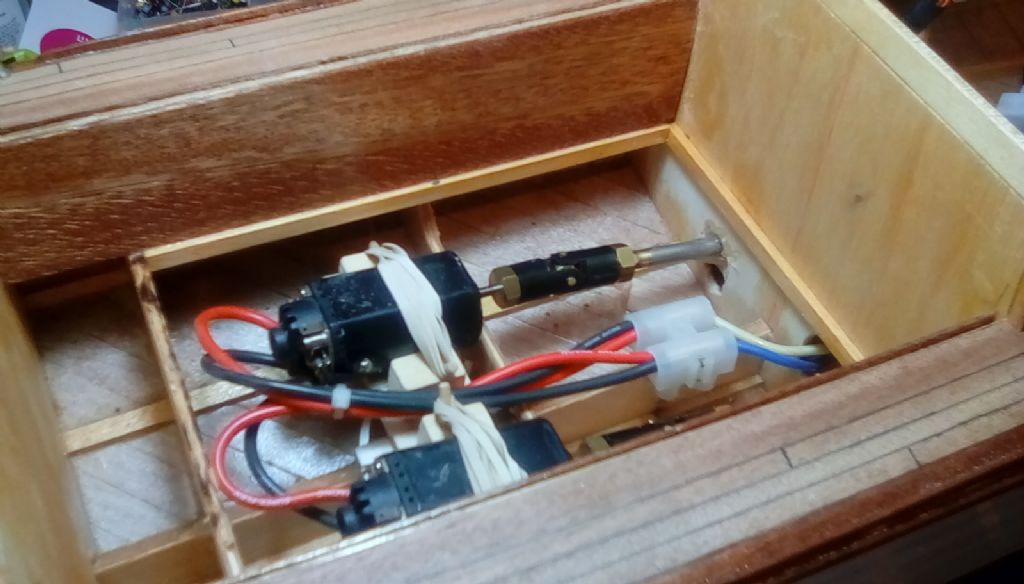
          This only an idea, as I haven't used brushless in a boat yet, the issue is occurring between 2 fixed points the stern shaft and the motor both fixed I assume with the motor bolted to the hull via fixed mount? My answer to this is flexible mounted motor, I use servo tape and rubber bands to keep the motor in place. Rubber engine mounts have been used for years for high performance ic boats , this allows for the inaccuracy of the the couplings.

          The noise generated by the vibration amplified in a plywood box ie the boat.

          This is a fairly powerful set up in White Marlin twin race 480's running on 3 cell 11.1 volt lipos, with flexible motor mounts 😀

          Regards & happy Christmas

          Rayimg_20191222_185223.jpg

          #85037
          Colin Bishop
          Moderator
            @colinbishop34627

            Ray,

            Yes, your method should work for a brushed motor but the brushless type put out an incredible amount of power for their size compared with the brushed type and at much higher revs.

            The Faireys are my first venture into brushless and the power difference over brushed is staggering as the increased RPM. It's just a different ball game.

            I still prefer brushed for my scale models though! Less exotic.

            Colin

            #85039
            Chris Fellows
            Participant
              @chrisfellows72943

              And for most boats where brushless are used they are outrunners i.e. the motor case turns!

              I'm only using brushless in my builds with a Huco coupling in the River Cruiser albeit a good quality Raboesch one and it's only a slow speed craft anyway and rubber couplings in the other faster boats. Of course they haven't seen water yet though!

              I'm also using Raboesh Maintenance free prop shafts (designed for high revs) with a ball-race at the motor end and given the substantial build of my boats aren't expecting to have any vibration issues on the water.

              Chris

              Edited By Chris Fellows on 22/12/2019 20:26:36

              #85040
              Ray Wood 3
              Participant
                @raywood3

                Hi All,

                Perhaps not a good example with my good old rubber bands method, it must be be possible to flexible mount a brushless motor mount on something to allow the motor to move slightly? Even a V12 Ferrari engine is rubber mounted, as are all our car engines. The IC boys are using bonded rubber mounts, even the rubber servo grommets allow isolated movement against high torque movement.

                Worth some experimentation I think 😀 I have got some brushless motors somewhere!

                Regards Ray

                #85041
                Colin Bishop
                Moderator
                  @colinbishop34627

                  Talking to Dave, it does seem to me that the two best options might be as follows:

                  1. If your motor has a 4mm shaft then remove it, order an extended M4 propshaft and fit the motot directly to it.

                  2. If the motor has a a 3.2mm shaft then get a rigid 3.2mm to 4mm coupling to connect shaft and motor.

                  In both cases the motor will need to be supported within the hull and ideally a ball race bearing should be introduced where the shaft exits the motor to balance the motor rear support.

                  Colin

                  #85042
                  Chris Fellows
                  Participant
                    @chrisfellows72943

                    Hi Ray

                    I think if you are going to mount the motor on flexible mounts then you would need to attach the motor to the prop shaft with either a solid coupling or a pair of Huco couplings otherwise the bearings (motor and shaft) will be put under load. If Huco they will need to be good quality to deal with the power and RPM.

                    Chris

                    #85043
                    Ray Wood 3
                    Participant
                      @raywood3

                      Hi Chris,

                      Yes the lack of accuracy of couplings is the issue some are fine, and some wrattle away noisily, luck of the draw really as you will find out when you run your boats 😀

                      Regards Ray

                      #85044
                      Chris Fellows
                      Participant
                        @chrisfellows72943

                        Colin – before deciding on using a conventional alloy motor mount I did consider mounting the motor as in an aircraft i.e. using the X shaped mount that came with the motor which screws to it and then to the bulkhead. In the end though I thought this would introduce other problems though in positioning the bulkhead and getting the angle right so ditched it.

                        Getting longer replacement shafts and support bearings also adds to the cost and complexity.

                        I've got one of Dave's Huntresses and don't have an issue with excessive vibration. It uses a metal/rubber coupling.

                        Chris

                        Edited By Chris Fellows on 22/12/2019 21:08:47

                        #85046
                        Peter Vinton
                        Participant
                          @petervinton69315

                          As Colin said above, I used a solid 3.2 to 4mm coupling in my 1:24 Fairey Swordfish. The motor (CF2822 1200KV) is small enough that I epoxied in the mount after doing up the coupling.

                          #85049
                          Charles Oates
                          Participant
                            @charlesoates31738

                            Hi Colin, I had a similar problem with my first brushless model, a lightweight vosper fire float. I partially cured the problem with a home made coupling using Hugo ends and silicon tubing between them. On my second brushless model, a RTTL , I used a 5 mm shaft instead of the 4mm used previously with a home made centre bearing, and the same home made coupling. This was pretty good from the start, but after I balanced the propeller it runs as sweet as silk. The motors in both are conventionally mounted except for a thin piece of neoprene between the mounting plate and the plywood base, something I've been doing for a very long time.

                            Charlie.

                            #85050
                            ashley needham
                            Participant
                              @ashleyneedham69188

                              Perhaps the old fashioned pegged type of coupling would be suitable? This would have sufficient solidity to transmit the awesome power of a tiny brushless, and would tolerate misalignment. As they consist of two separate parts, this halves the weight of rotating mass on both motor and shaft (if you see what I mean). A dab of silicone sealant would stop it rattling.

                              Other than that, a solid coupling gets my vote. I generally mount the motor first and then fiddle with the prop shaft before spotting in place with superglue..or the other way round if the shaft has no movement.

                              Colin. Did I give you a bit of the silicone tube I bought for u/j replacement last time you were at the pond? It has a really good grip on Huco brass splined ends and think it would manage ok. If not I will send you a bit!

                              Ashley

                              #85053
                              Chris E
                              Participant
                                @chrise

                                There are always pulleys/belts.

                                Never tried it but If replacing the motor shaft with an extended propshaft I have heard of modellers removing the top bearing from the propshaft to eliminate minor alignment issues. I guess this might be for short proshafts only!


                                Edited By Chris E 1 on 23/12/2019 11:16:53

                                Edited By Chris E 1 on 23/12/2019 11:43:59

                                #85057
                                Colin Bishop
                                Moderator
                                  @colinbishop34627

                                  Ashley, yes I still have the tube you kindly gave me but although I have lots of HUCO ends I don't have a couple of 4mm plain in stock. I have in fact ordered another ingegral rubber HD coupling from another supplier and I might hve a go with a solid coupling. Fortunately there is plenty of room in the hull to try a few different options.

                                  Thanks everyone for all the comments and suggestions which should educate us all.

                                  Colin

                                  #85185
                                  Colin Bishop
                                  Moderator
                                    @colinbishop34627

                                    The problem now seems to have been largely resolved with the arrival of an alternative rubber centre coupling which is much smoother. There is a slight vibration blip at around 25% revs but it smooths out above that and noise is reduced. Next step will be pond trials.

                                    Look like engineering tolerances may come into it. What is OK for a relatively low RPM setup can struggle at the speeds some of these brushless motors achieve.

                                    Colin

                                    #85190
                                    ashley needham
                                    Participant
                                      @ashleyneedham69188

                                      Sometimes it is worth simply trying different couplings (of the same sort) as I have had bad ones in the past. Also worth trying, different props.

                                      Ashley

                                      #85194
                                      Tim Cooper
                                      Participant
                                        @timcooper90034

                                        Colin

                                        I have used a rubber centred coupling for the brushless motor in my PT Boat and it works very well. I did make a plastic sleeve to keep it rigid when setting up, as recommended by DM.

                                        My Italeri Schnellboot has a rubber centred coupling on the brushless centre motor and Huco ends and tubing (kindly supplied by DM) on the 380 motors port / starboard motors. Seems ok on the bench but no water trials yet.

                                        My part built Huntsman also has a rubber centred coupling fitted.

                                        Tim

                                        #85199
                                        Colin Bishop
                                        Moderator
                                          @colinbishop34627

                                          Unless you can machine your own couplings, as someone on Mayhem has posted, you have to rely on the engineering of the commercial offerings and that can vary a bit. Any problems tend to show up at high revs.

                                          I doubt if I will build any more models of this type having now got a brace of Faireys so I can revert to the more conventional scale setups I am familiar with.

                                          Colin

                                        Viewing 19 posts - 1 through 19 (of 19 total)
                                        • Please log in to reply to this topic. Registering is free and easy using the links on the menu at the top of this page.

                                        Code of conduct | Forum Help/FAQs

                                        Latest Replies

                                        Home Forums All things floating Topics

                                        Viewing 25 topics - 1 through 25 (of 25 total)
                                        Viewing 25 topics - 1 through 25 (of 25 total)

                                        View full reply list.