
Brush or Brushless

Brush or Brushless

Home Forums R/C & Accessories Brush or Brushless

  • This topic is empty.
Viewing 16 posts - 1 through 16 (of 16 total)
  • Author
    Posts
  • #31081
    Ian Potts 1
    Participant
      @ianpotts1
      Hi Guys I’m back again with my ‘Slipway’ Tamar,
      I have fitted the Speed 600 ECO motors but am now having doubts as to if I should be going the ‘Brushless’ way.
      I have been getting differing views regarding the performance of the ECO motors with regards to the weight of the finished model.
      Have any of you experienced guys got a view on this?
      #5128
      Ian Potts 1
      Participant
        @ianpotts1
        #31082
        Ian Potts 1
        Participant
          @ianpotts1
          #31098
          Mark Beard 1
          Participant
            @markbeard1
            There is a good range of brushed motors with greater power than the Speed 600, so you don’t need to go brushless for extra power. If you intend to have your boat go haring about at high power on the plane for long periods, then you may wish to consider an in-runner which can be effectively cooled with water.
             
            All brushed motors produce their heat in the rotor, and that heat can only get out through the bearings. That’s no good for thermal management, except as a last-ditch attempt to avoid burning out an already over-loaded motor. Out-runner brushless motors produce their heat in the stationary core, which is even worse because nothing can be cooled. In-runners have their windings on the outside, which is stationary, so cooling the case is very effective at keeping the windings cool.
             
            The most critical factor in prop power and motor heating is the correct match between motor, gearbox, prop and hull. Many people try to run props that are too big, too fast. For example, if the full power prop speed in the water is less than half the full power speed out of the water, (if you have a musical ear, then if the motor pitch is more than an octave lower in the water than out) then you have overloaded your motor and are wasting a LOT of power as heat!
            #31100
            ashley needham
            Participant
              @ashleyneedham69188
              ian. As Billy says, there are more powerful brushed options, however if weight IS an issue, then brushless is the way to go as they are a lot lighter comparing size/power.
               
              The downside of this is that they are not cheap and you will also have to buy a brushless speed controller.
               
              The choice for brushless is also a bit bewildering, and you would need to match up the revs you require to the battery voltage as installed in order to choose a motor, and then match up the power requirement. An outrunner would probbably be the best choice and so the motor mounting arrangement would require considerable rework.
               
              Ashley
              #31102
              Colin Bishop
              Moderator
                @colinbishop34627
                If you are a Model Boayts subscriber you can see John Parker’s article on going brushless here:
                 
                Colin
                #31103
                Ian Potts 1
                Participant
                  @ianpotts1
                  Thanks for your input guys but as my budget is rather limited at the moment I am going to stick with what I have got. Apart from the extra cost I don’t feel like ripping out my motor mounts etc. to fit a larger motor and I think that brushless will have to wait for a future model. Ian
                  #31105
                  Mark Beard 1
                  Participant
                    @markbeard1
                    Done some calculations on this. The biggest unknown variable is whether the Speed 600 Eco is well-sized for the model. I just don’t know this, what do Model Slipway recommend? But assuming they are, then with 7.2V batteries and 30-35mm diameter high pitch props with no gear reduction, you should get a good scale speed of around 10-12 knots.
                     
                    Mark
                    #31109
                    Mark Beard 1
                    Participant
                      @markbeard1
                      Er, I have some corrections to declare: I used the spreadsheet to check out my own model and got ridiculous figures!  Also in hindsight the reference I found to the speed of 12 knots is wrong. The Tamar class speed is listed on Wikipedia as 25 knots, which is rather more useful for a life boat.
                       
                      I do believe you will need some gear reduction between the motor and prop shaft. So before settling on your existing motor mounting arrangement, please consider if you want to include this.  If not, all is not lost if you are prepared to rewind your motors and do without the gearboxes.
                       
                      If you use 30mm standard pitch props with Speed 600 Eco motors at 7.2 volts, then with 3:1 reduction gear you should get around 3 metres/sec which is 25 knots scale speed. If you want a little extra in hand for emergencies, (per Ashley’s wise counsel), then go for 2:1 which should give you something like 4.5 metres/sec which is a fast 36 knots scale.
                       
                      30mm props geared down may seem small for a boat of this size. From the list of examples given in the Construction Special issue of MBM, it seems to me that many modellers tend to over-prop their boats. The risk of using too big a prop is that the motor runs at a highly inefficient operating point, getting too hot and wasting battery power without moving the boat any faster. A smaller prop lets the motor run faster, at a more efficient operating point. Also, for scale use, many of these motors which are designed for racing models, simply run way too fast, and do need gearing down.
                       
                      If you want some calculations, I’m happy to post them here or PM them to you for checking.
                       
                      Mark

                      Edited By Billysugger on 22/06/2011 18:40:18

                      #31110
                      Ian Potts 1
                      Participant
                        @ianpotts1
                        Mark, I really appreciate the advice given. Model Slipway do recommend the ECO 600 motors and they also provide 3 blade nylon propellers at 40mm dia.
                        As I have already fitted the motor mounts I will be faced with a considerable rework if I fit gear reduction but I suppose if it is really necessary I must bite the bullet.
                        I would appreciate any calculations that would assist .
                        Ian
                        #31116
                        Mark Beard 1
                        Participant
                          @markbeard1
                          Okay Ian, here’s my tutorial, I hope you’re ready for this! I worked in a motor manufacturing company for 12 years, so I got to know a bit about these little beasties. I must declare that I’m far more expert in motors than models, but with that caveat I’ll try to apply what I know to this situation.
                           
                          Servo motor theory is fairly straightforward and motor performance is very predictable from a few basic parameters. Fortunately, Graupner publish the relevant parameters, so using Excel I have run up a model which predicts motor performance over the range of torque loading values. The results are shown below.
                           
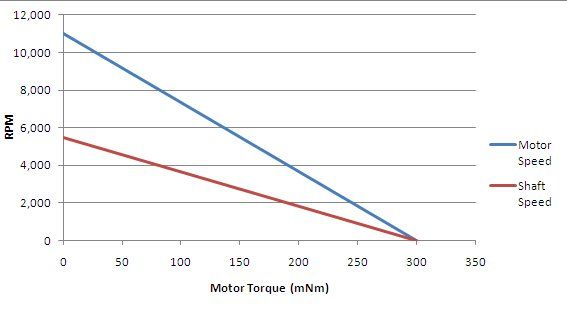
                          All these curves are for the Graupner Speed 600 Eco motor running at 7.2 Volts, with a 2:1 gearbox between motor and prop shaft. (The gearbox only affects the prop shaft speed, all other curves would be the same if the gearbox was removed or had a different ratio).
                           
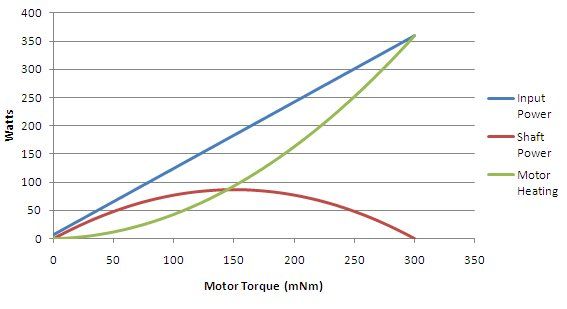
                          The power curve shows input electrical power, output shaft power and the difference – power lost in heating the motor – against loading torque. (The reason we use torque is because that is directly proportional to motor current, and the constant of proportionality relates electrical work to mechanical work).
                           
                          The important thing about the power curves is that the output shaft power is maximum at precisely half the maximum torque, which is also half the no-load speed. At every other output power, there are two torque-speed combinations to get that output power: one faster than the peak power point (lower torque) and one slower than the peak power point (higher torque). That last sentence is very important in understanding the performance of motors, if it didn’t sink in please go back and read it again as it key to the conclusions I reach.
                           
                          So, for every model performance point, there is a low-torque solution and a high-torque solution. By looking at the input power and heating power curves, you will see that we always want to operate at the lower torque solution. If we don’t, we get the same shaft power but at a lower speed (see speed curve below), and we also waste a lot more heat in the motor.
                           
                          For example, at 200mNm of torque we get 77 watts of shaft power and lose 160 watts in heating the motor. However if we use a smaller prop and operate at 100mNm of torque, we still get 77 watts of shaft power but now only lose 45 watts in motor heating. The first solution is on the wrong side of the power curve, the second is on the right side.


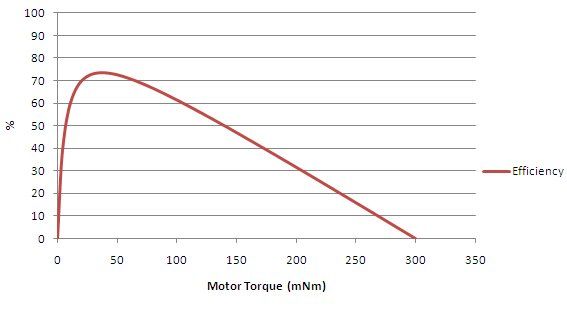
                          The efficiency curve shows how efficiency varies with torque. Maximum efficiency is always at a low torque value, in this case just one sixth of the maximum available torque. This curve shape corresponds with the idea above that of the two available torque-speed solutions for model performance, the more efficient is always the lower torque solution.
                           
                          The speed curve shows the motor speed as it changes with loading torque. This is a simple curve, showing that speed reduces linearly as torque increases. Ultimately, at maximum torque, the motor stalls and the speed becomes zero. The zero torque point is called the no-load speed. So you can make a graph like this simply by drawing a line with a ruler between the no-load speed and the maximum torque.
                           
                          Some things to note about these curves:
                           
                          1. The peak power point is always at half the maximum torque, and half the no-load speed.
                           
                          2. If your model operates at a shaft speed faster than half the no-load motor speed, then you are operating at a lower torque than the peak power point, and are operating at the higher efficiency of the two possible operating torques.
                           
                          3. If your model operates at a shaft speed greater than half the no-load motor speed, then you are operating at a higher torque than the peak power point, and are operating at a lower efficiency. In this case, using a smaller prop to operate at a higher speed, and a lower torque, is always more efficient, gives a higher performance, heats the motor less, and makes the battery last longer.
                           
                          If you’re musical, there is a simple way to tell if your model is operating in the right side of the power curve: life the model from the water, run the motors briefly at ful throttle and listen to the note the motor or gearing makes. Then put it back in the water (a pond please, not a bathroom test tank) and run the model at full throttle. If the note on the pond is no more than an octave below the no-load note, then the running speed in more than half the no-load speed and you are operating on the right side of the curve. If not, you need a smaller prop or greater gear reduction to get the same (or better) performance with less heating and
                          #31117
                          Mark Beard 1
                          Participant
                            @markbeard1
                            Oh no, I did go on too much: here’s the rest…
                             
                            get the same (or better) performance with less heating and longer battery life.

                            Right: now to your model. I have absolutely no idea what power is required to move your hull through the water as what speed, so I have to take it from Model Slipway that a pair of Speed 600 Eco motors provides the right power.

                            I know that racers want to operate at peak power for a short time, but am assuming that scale modellers want to run for quite a while around the pond, showing off their handy work (I know I do). So we want to run at a greater efficiency than peak power, but probably at a better performance than peak efficiency. I’ve chosen half way up the torque curve to the peak power point as the best scale operating point. That’s 25% of peak torque and 75% of no-load speed.

                            (For the musical scale model tuners out there, that means operating on the pond three full notes below the no-load note.)

                            At the best scale speed we’re operating at 75% of peak power and 92% of maximum efficiency, so that’s a good place to be in my opinion. At that point the motor is running at 75% of 11,000 rpm = 8,250 rpm.

                            I put all my figures into one giant Excel spreadsheet and fiddled until I got reasonable values, so I won’t derive them here (message me with an email address if you want the spreadsheet). But here’s how the values I chose pan out.

                            With a 2:1 gearbox, the prop is turning at 4125 rpm.

                            With a 30mm prop, the circumference is pi x 30 = 94mm. Multiplying by 4125 rpm, gives a prop tip speed of 396,000 mm per minute, which is 396 metres per min. Dividing by 60 gives 6.6 metres/sec. Having analysed the Raboesch recommended max prop speeds, they equate to a max tip speed of 18 m/s, so 6.6 m/s will be well within acceptable limits.

                            So now to calculate boat speed. Again we are relying on Model Slipway’s advice here. But if the Speed 600 Eco is operating at a reasonable efficiency, and the power is well matched to the hull, then the prop slip must be less than 30%. I have taken 30% as a conservative value.

                            A standard prop has a 1:1 pitch ratio, which means that if the prop circumference is 94mm then it moves the water 94mm in one revolution. That makes the sums easier. If the prop slip is 30% then the boat moves 70% of the prop pitch per revolution, which is 66mm. 66mm at 4125 rpm gives a forward speed of 272,250mm per minute wich is 272 metres per minute. Dividing by 60 gives Multiplying by 60 gives 4.5 metres per second. If you can imagine your Tamar moving 14 feet every second, that’s a fair lick for a scale model I’d say! Multiplying 272 by 60 gives metres per hour, and dividing by 1820 gives nautical miles per hour, which is knots. Doing this sum gives a model speed of 9 knots. To adjust for scale, we multiply by the square root of scale (root 16 = 4) which gives 36 knots.

                            The prototype runs at 25 knots, so 36 knots scale speed is rather fast. But you don’t have to run flat out, and as Ashley Needham wisely points out, it is better to have a little extra in hand for getting out of trouble.

                            So that’s how I arrive at my performance expectations. Hope I haven’t gone on too much. Given the amount of research and knowledge scale modellers have of their subject, and since apart from modelling motor performance all this involves just multiplication and division, I’m hoping some of this will rub off on the community.

                            I’m sitting outside with my laptop at 10:30pm in front of a chiminea, burning logs and sipping a wee dram, so although I trust my thinking I know I make mistakes with the numbers. So if anyone has the inclination to check my numbers and let me know either way, I’d appreciate that.

                            (I hope you don’t need aspirin too much)

                            #31118
                            Dave Milbourn
                            Participant
                              @davemilbourn48782
                              Ian
                              Lawrie White is one of the most experienced and well-respected scale modellers and kit manufacturers in the UK, if not the world. If he recommends those motors then it’s not done lightly. As I think I’ve said in the past, stick to the supplied props and don’t use more than 8.4v and you’ll be fine.
                              Brushless motors require special speed controllers and water-cooling. They also draw a heck of a lot more current than 600 ECOs so you’d need high-capacity LiPo cells and a special charger and a voltage monitor etc etc. You stated that you are on a limited budget – do the maths, then multiply by two for a twin installation. Scary stuff, huh?
                              Dave M
                              #31122
                              Ian Potts 1
                              Participant
                                @ianpotts1
                                Mark, Wow that was some tutorial, I really appreciate your input (you should have been a teacher). It has clarified a lot and I now understand much more about motors and output etc. I shall save this so I can refer to it again.
                                 
                                Dave, thank you for your comment, it is just that with all the other (well meaning) advice I have been getting I just wanted to be sure that I was doing the correct thing with this model.
                                 
                                Ian
                                #31128
                                Mark Beard 1
                                Participant
                                  @markbeard1
                                  Okay, okay. Time to eat humble pie!
                                   
                                  I stand by all my motor calculations but have found an error in the boat speeds. There was a pi where there shouldn’t have been one, so all the speeds were out by a factor of three. In the notes above, the error is in the fourth paragraph from the end. For a 1:1 pitch ratio, the water moves one diameter not one circumference.
                                   
                                  Reworking the problem using pitch ratio referred to diameter shows that using direct drive with 1:1 40mm props moves the boat at 30 knots scale speed – which looks just right to me.
                                   
                                  Apologies for leading anyone astray. A number of lessons to be learned:
                                   
                                  1. Check, re-check, wait till the morning and check again before publishing!
                                   
                                  2. Dave you’re absolutely right, whipper snappers should respect world renowned wisdom.
                                   
                                  3. Now calculations truly support the excellent choice of this motor-prop-hull combination by Model Slipway, perhaps we are a step closer to my goal that the rest of us are able to predict model performance with motor choice before building the motors in. (Poor attempt to recover dignity there).
                                  #31130
                                  Ian Potts 1
                                  Participant
                                    @ianpotts1
                                    Hey mark, we are all human and make cockups now and then, thanks for the correction.
                                    It was still quite a tutorial though.
                                     
                                    Cheers,
                                     
                                    Ian
                                  Viewing 16 posts - 1 through 16 (of 16 total)
                                  • Please log in to reply to this topic. Registering is free and easy using the links on the menu at the top of this page.

                                  Code of conduct | Forum Help/FAQs

                                  Latest Replies

                                  Home Forums R/C & Accessories Topics

                                  Viewing 25 topics - 1 through 25 (of 25 total)
                                  Viewing 25 topics - 1 through 25 (of 25 total)

                                  View full reply list.