
From the Dining Table

From the Dining Table

Home Forums All things floating From the Dining Table

  • This topic is empty.
Viewing 24 posts - 1 through 24 (of 24 total)
  • Author
    Posts
  • #76239
    Peter Crow
    Participant
      @petercrow25030

      Hi, guys. Is there room for another in the Model Boats seamen’s mess? I am a retired 63 year-old returning to modelling after some 45 years away piloting a desk and pushing a pen in the meantime (in addition to the usual domestic offices). My, how things have changed!

      As a laddie, my main interests lay with aircraft and AFVs although I built a good number of the models in the Airfix catalogue through the 1960s in all categories. I later moved into modifying kits and some elementary scratch-building.

      My second childhood has found me developing an interest in boats, and in particular WWII British warships. In 2014 I decided to dabble in some boat modelling in a small way whilst doing mega research into the multifarious techniques demanded of the scratch-builder.

      By late 2015 I had considered that I had learned enough to try putting a radio controlled model together. You can learn only so much by reading; it was time to see if I had any of the basic skills, given that my eyesight and manual dexterity were nothing like they were when I last wielded a modelling knife. What had come with age, though, was patience to see a project through (just!).

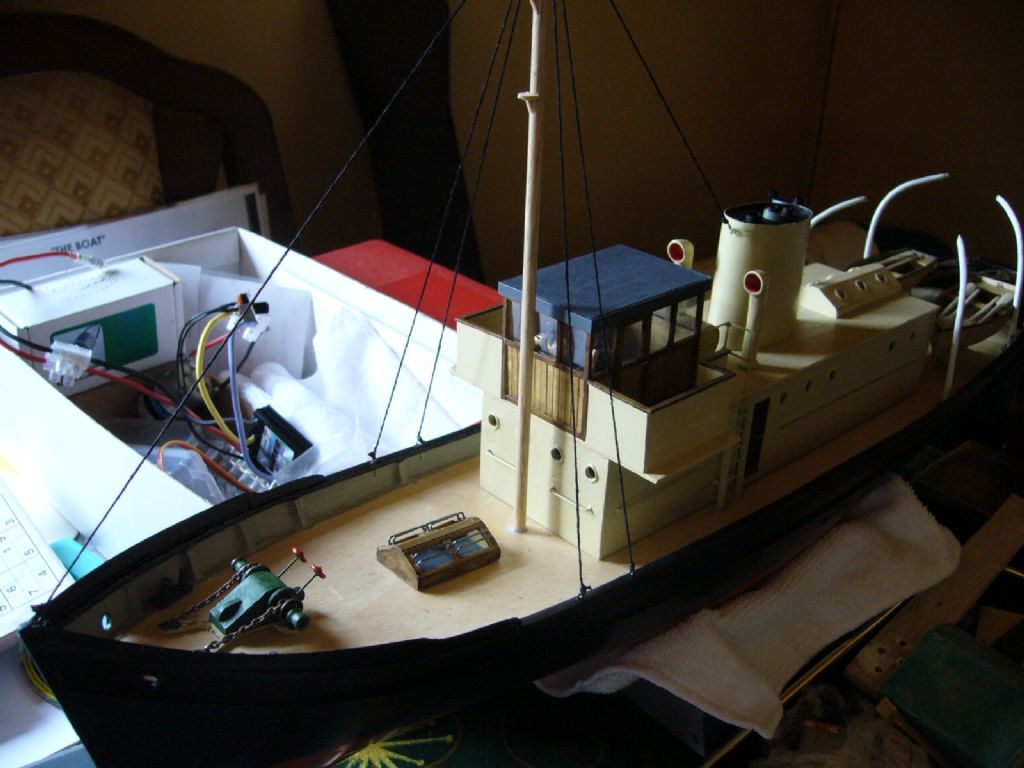
      Early 2016 saw boat number 1 take to the water. A random plan off the web with freelance superstructure and fittings (any resemblance to Graham Buckton’s THV Vigia is purely in passing!), it is 23 inches long plank on frame and powered by an MFA 280/5 motor driving a 40mm prop on a 6V 1.2Ah SLA battery.

      p1030572.jpg

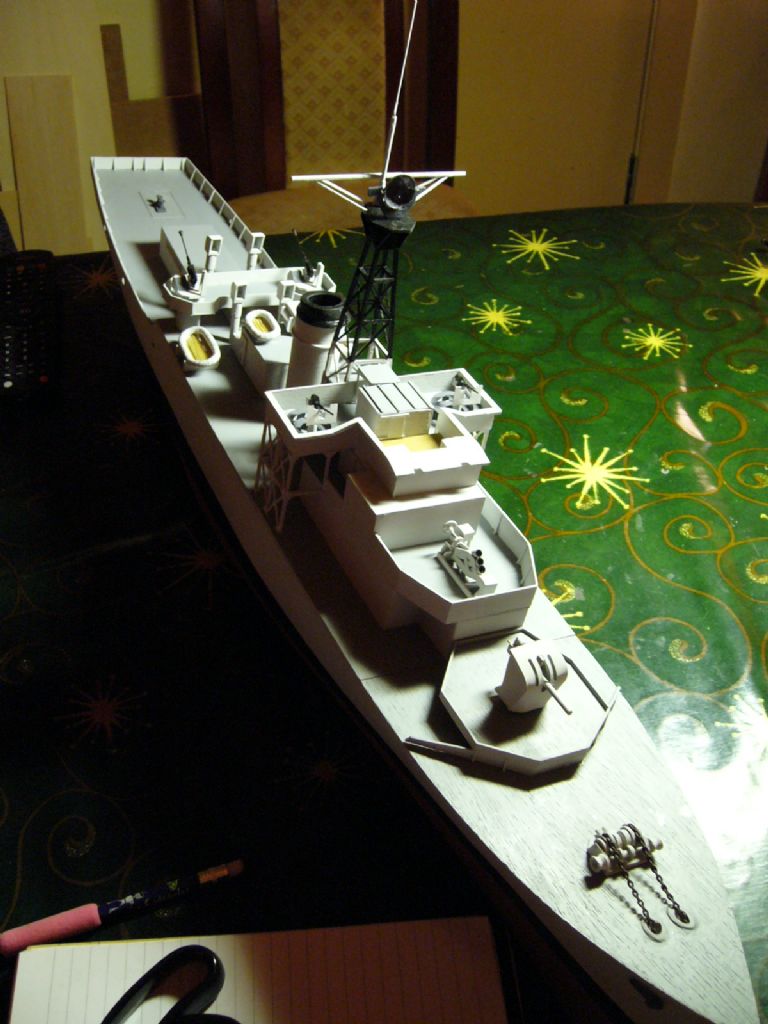
      Boat number 2 was already forming itself in my head as I was building number 1. I wanted to build a warship this time but felt daunted by making the fittings involved. I liked the lines of the Castle class corvette and it was relatively lightly armed. Again, I found some plans on the internet, did as much research as I could, and ended up with a plank on frame hull of 31inches (just under 1/96 scale), powered by an Mtroniks Power 400 motor. Provision was made for it to carry 2x 6volt SLA batteries or an 8.4volt NiMH pack, driving a 40mm screw. At 6volts, the performance is probably close to the scale speed of 16.5 knots; 8.4 makes it look like a fleet destroyer; at 12 volts it would just about catch an Eboat!

      Again, apart from the electrics and drive train, all is scratch-built. If it’s short on detail, that it is because it is very much a test bed for things that I have learned. I don’t see myself producing museum quality stuff (that’s a laugh!) just to have bits knocked off at the pond side or in transit.

      p1040030.jpg

      This model has been on the water throughout 2017.

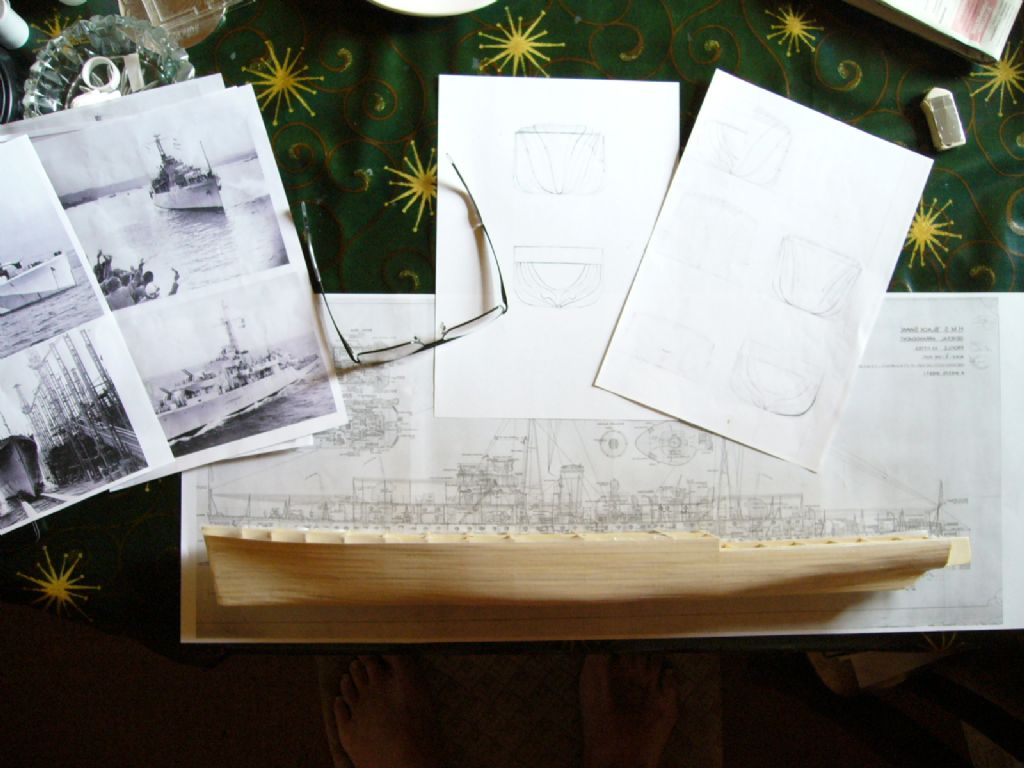
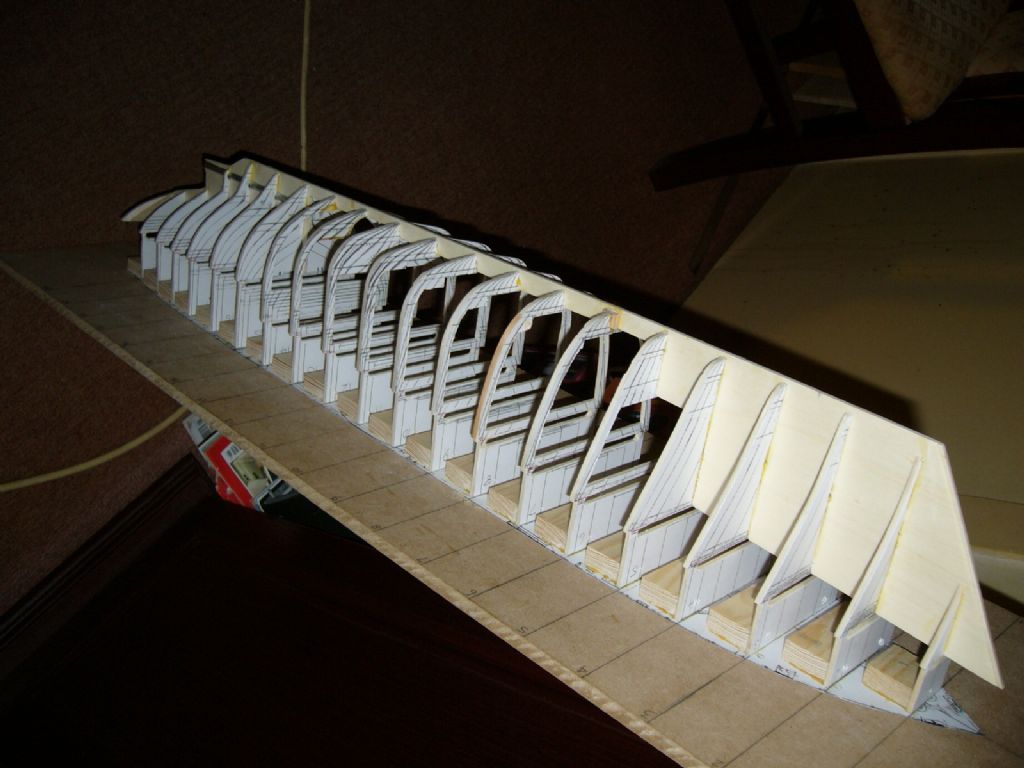
      For my next experience in the discovery learning process, I became interested in the Black Swan/ Modified Black Swan class sloops. Time to “up the ante” on the fittings front and to attempt twin screws. As of March 2018 this is as far as the build has progressed:-

      p1040306.jpg

      Living in a flat,I do not have working space beyond my side of the dining table, so I am greatly restricted in the size to which I can build. This model is to the size of the John Lambert plans which accompanied his article in MMI December 2003 and which I obtained through Sarik Hobbies. It is 27 inches long which works out at a scale of about 1/133.

      After all of this rambling, I am coming close to the point of this post (sighs of relief all round!). I am fitting it out with a pair of MFA RE170 motors rated up to 3volts, with a 6volt 1.2Ah SLA battery for power. I had naively thought that with an ESC for each motor run in parallel I could “do a Glynn Guest” (Earnshaw, issues February and March 2016 of Model Boats) and run them on V-tail from my transmitter.

      Problem is that I’ve only encountered ESCs that require an input in excess of 3volts (and of course there’s BEC to consider). In the short term, I propose wiring the motors in series from one ESC. I appreciate that I will not have individual motor control, but there are enough other “what if” factors to overcome such as; will it float?; will it be stable enough? etc, etc. Assuming that it eventually does become a water-borne proposition can anyone suggest speed controllers for my intended set-up? I suppose that an alternative would be to replace the RE170s with small 6volt motors but I don’t know what sort of endurance 1.2Ah would have. (I don’t think that the hull displacement will support a heavier battery)

      I’m aware that there have been other threads on the subject of multiple motor control but haven’t come across one that fits my circumstances (if indeed my circumstances can be fitted!).

      Cheers, Peter

      #4479
      Peter Crow
      Participant
        @petercrow25030

        Introduction and multiple motor control

        #76240
        Chris Fellows
        Participant
          @chrisfellows72943

          Welcome Peter

          Your manual dexterity and eyesight looks alright to me!

          Interested to see how the Black Swan progresses.

          Chris

          #76241
          Cookie
          Participant
            @cookie15923

            Hello Peter , Have a look on the Action Electronics web site ,Dave Millbourn did a stack of drawings of loads motor configurations and how to wire them up , these drawings are drawn for the novice to understand and can be viewed on the site..

            Regards Dave

            #76244
            ashley needham
            Participant
              @ashleyneedham69188

              Welcome to the forum Peter.

              ​I see you are making excellent progress and attempting a plank on frame build…good stuff.

              I might suggest swapping to Nimh Batteries, and using motors that will run on 6V specifically. I like the speed 280`s myself but there are other out there. The weight saving on a Nimh can be made up by the slightly larger motors.

              ​An M`Tronics Viper ESC is a small device and will provide a BEC facility for the receiver. Both motors can be run off the one ESC by connecting them in Parallel and not series. Nimh batteries can come very small and I have a pair of 1700 mAhr 6 cell 2/3A size packs which I use for the flying boats.

              ​The thing about an SLA is, although in theory there is 1.2Ahr to use, it is not all useable, as flattening the battery dead will shorten its life and in any event the voltage will fall off rapidly once (probably) only half discharged. generally speaking , a Nimh will deliver most of its supposed capacity and not be harmed by discharging fully, although the voltage drops suddenly at the end so coming ashore when a loss of speed is noticed is a good idea.

              However, read Mr Milbourne's site first for the the initive answer to all this!!

              ​Ashley

              #76245
              Peter Crow
              Participant
                @petercrow25030

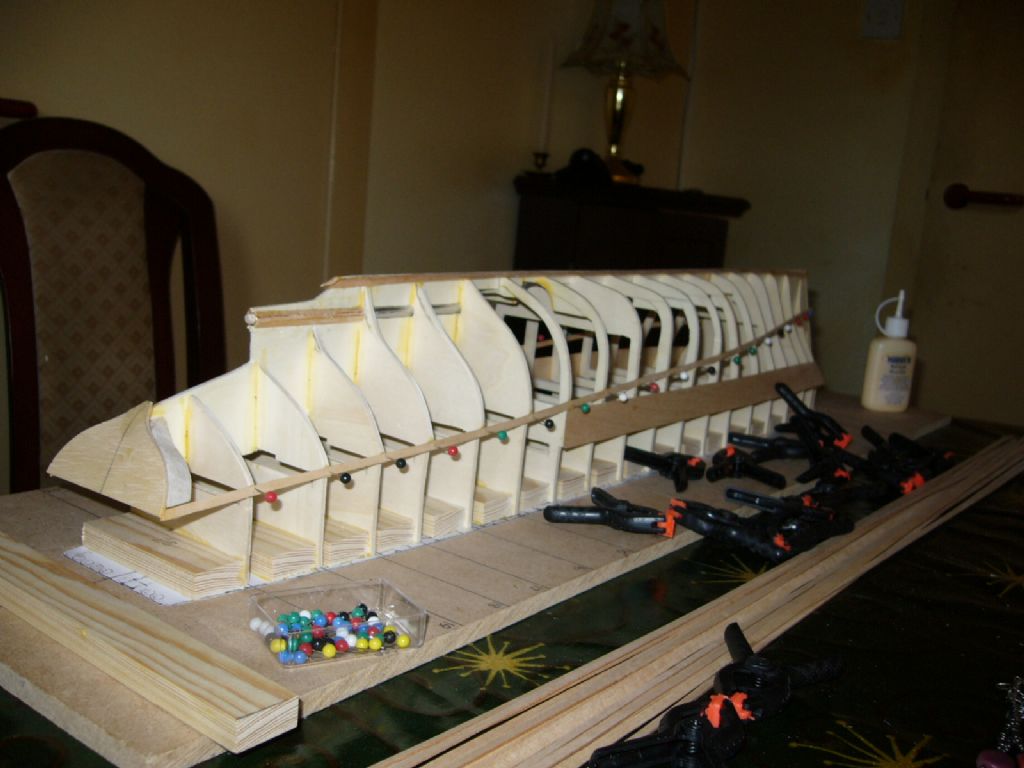
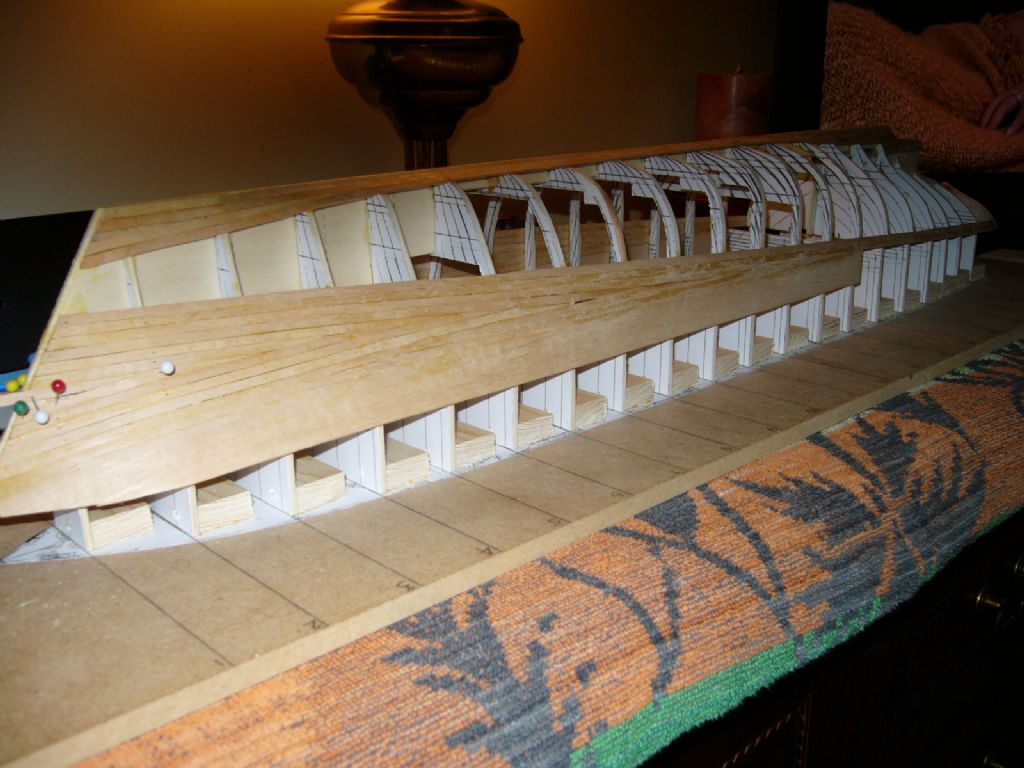
                Thanks for the welcome Chris. I’ll post progress (such as it may be!) on the Black Swan from time to time in my album. For the next few days it’ll be a case of finalising the alignment of the stern tubes and fairing off the frames with my trusty “bendy stick” (a 4mm wide strip of 1/32 inch basswood which will ultimately be used for planking) and a sand paper-wrapped batten until all flows smoothly. Then the planking can begin.

                Dave, thanks for your response. I’m aware of DM’s extensive and extremely informative inputs on matters electronic on this forum and MBM. My main problem is having settled for the time being on using 3volt motors. Can the output of a commercial 6-12volt ESC be regulated to operate within a band up to 3volts. I’ve read with interest articles about miniature installations using the “guts” of continuous rotation servos as ESCs, and other ploys, but my knowledge of electronics via Higher Physics goes back to 1971 and predates the modern era. As I said originally, it might be simpler for me to go down the line of giving up on the RE170s and running with small 6volt motors instead.

                #76246
                Peter Crow
                Participant
                  @petercrow25030

                  Hi, Ashley. Thanks for your reply. It crossed over with my previous post in which you can see that I am considering ditching the 3volt motors. I was referring to series connection in relation to running these motors from a 6volt supply.

                  Thanks for the additional perspective on SLA vs NiMH. I was thinking of the old adage that ballast should be useful weight when deciding on SLAs.

                  I think at the end of the day that simplicity of installation and operation will win through! I was leading myself down a blind alley and it has been of immense value to put my thoughts down on “paper” and to be guided back to the straight and narrow!

                  #76247
                  Colin Bishop
                  Moderator
                    @colinbishop34627

                    Running motors in series brings its own problems as if they are not perfectly matched one will tend to gobble up more than half the power and they will run at different speeds.

                    Colin

                    #76248
                    Dave Milbourn
                    Participant
                      @davemilbourn48782

                      Peter

                      I remember something like this cropping up elsewhere. At that time I tested a Hitec Minima 6 micro-receiver with a P68a speed controller and found that they would work OK down to 3 volts, but not much lower. The P68a doesn't need BEC as it connects to the receiver and also the motor i.e. the power travels from the one battery through the receiver to the speed controller and thence to the motor along the same three-wire lead as the signal to the speed controller. Two 68's can be run through a P82 Micro-Mixer to give twin-motor mixing. I would use a single LiPo cell (3.7v) for power; SLA's are good for weighting things down while they dry but I wouldn't put one in a model – certainly not one this size – unless you require it for ballast.

                      Dave M

                      #76249
                      Francis Macnaughton
                      Participant
                        @francismacnaughton39461

                        Hi Peter,

                        Was it my article in May 2017 MB you are referring to when mentioning continuous rotation servos? I promise you there is no particular need to apply a specialist knowledge of physics to get this to work – if you have any questions about using them fire away. I would certainly consider using a couple of the units I described in your latest project – what size props are you using?

                        More to the point, a 1/133 scale Black Swan is going to need to come out at around 550 grams total weight for scale displacement while a 1.2 Ah SLA would take 290 grams of that leaving very little scope for the hull, superstructure etc let alone motors, shafts and RC. Ashley's advice on going for NiMHs is definitely worth following. In many ways a Black Swan at 1/133 is fairly similar in size and weight to the 1/200 HMS Abdiel I describe in the current edition of MB and you will see there how I had a fair bit of bother with stability before going for a bolt on bulb keel. Your planked hull would allow ballast for stability to be sited a low as possible which will help but it is always worth giving yourself as much margin as possible and RE 170s are quite heavy so smaller motors might be adviseable – scale top speed would be about 2.8 feet per second which shouldn't need a huge amount of power.

                        Francis

                        #76250
                        Colin Bishop
                        Moderator
                          @colinbishop34627

                          Dave's suggestion using the P68a ESCs with a P82 is a very good one. I have two small models fitted with this setup and the mixer gives excellent handling capability. I didn't use a LiPo battery though, just a 4 cell NiMh pack which powers everything. I used AA sizecells weighing around 118g for 2500ma capacity but a smaller lower capacity pack would weigh even less.

                          Obviously a LiPo would weigh even less again but at 3.7v it ismaybe a bit marginal to power the RX perhaps?

                          Colin

                          #76251
                          Dave Milbourn
                          Participant
                            @davemilbourn48782

                            Hitec rate the receiver as 4.8v to 8.4v but I'm sure I got down to 3v with one. It would, as you say, be a bit marginal on range if nothing else.

                            DM

                            #76252
                            Peter Crow
                            Participant
                              @petercrow25030

                              Wow! A veritable plethora of wisdom and expertise, and all at one’s fingertips.

                              Thanks gents. It is also an able demonstration that there is more than one way to skin the proverbial cat.

                              Colin- I read your first post concerning series connection, stood up from my computer, stepped out into the hallway and, in John Cleese fashion, banged my head on the wall several times. I had known this but it had been lost in the volume of info that model boat building entails. Thanks for the timely reminder.

                              Dave- I’d decided in my own mind that I had it all sorted after Ashley’s post. Now I’m only confident in my indecision. I’m very grateful to you for your input. (ps- that last sentence could be taken as being sarcastic; it’s not!)

                              Francis- Thanks for reminding me of your Lucky XI harbour tug conversion. It’s at times like these that I wish that I’d started compiling a cross-referenced index of subject headings published in Model Boats since I bought my first issue. It was Abdiel that was to the forefront of my mind together with some kind of blurred memory of having read several plastic kit conversions. I had not considered the Lucky XI approach for motive power. Yet more for me to think about! Thanks also for your invitation to ask any questions; I will take you up on that when I’ve caught up with some refresher reading.

                              Edited By Peter Crow on 14/03/2018 16:33:29

                              Edited By Peter Crow on 14/03/2018 16:51:35

                              #76255
                              ashley needham
                              Participant
                                @ashleyneedham69188

                                Peter . You COULD always do as Colin likes to, and use a pulley/rubber band drive, so you could then use ONE motor instead of two to drive the shafts. This would cut down weight and this can also result in quite a smooth transmission.

                                ​Nimh packs can be made up in different configurations as well, so for instance you could get a 4/5/6 pack made joined end-end as a long stick. This may enable you to distribute the weight of the pack along the centreline assisting stability, and keeping the apparent battery height very low.

                                ​Ashley

                                #76261
                                Byron Rees…(Ron)
                                Participant
                                  @byronrees-ron

                                  Hi All,

                                  Most boaters who plan to run motors at 3v Max run into the problem of powering the R/C equipment which invariably requires minimum 4.8v. , and if you follow Ashleys recommendation and use NiMh batteries, the weight saving over SLA's is massive.

                                  Most of us seem to forget that while the main power to motors is to be 3v, which can be achieved in various ways including those little step down voltage regulaters so you can run a separate feed of 4.8v or so to power the R/C. The reduction in battery weight will also allow a separate R/C battery pack of 4.8v to be carried doing away with need for BEC.

                                  An NiMh or Lipo battery of considerable capacity, like 3.8 Amp/H weighs much less than the SLA. I tend to use the Lipo setup where, providing you are not expecting a high current usage, Centre Tapping via the Balance plug can supply 3.7 volts to two separate motors and the mains leads 7.4v for the ESCs. Care needs to be exercised here, but the system, carefully assembled and monitored onboard with those little 'Gizmos' to tell you battery state in use works very well and has been tested extensively in Plastic Magic projects.

                                  I'll just wait now for the cries of Consternation and Horror!!!

                                  Cheers….Ron.

                                  #76262
                                  Dave Milbourn
                                  Participant
                                    @davemilbourn48782

                                    Peter

                                    As a caveat, do make sure that your receiver will accept 8.4v before you adopt Ron's suggestion. A fully-charged 2S LiPo is nearer to 8.25v than 7.4v. Certainly the absolute maximum that the ACTion P68 ESCs will accept is 5.5v.

                                    If you do adopt a separate 4-cell battery pack for the receiver then you could use two of the slightly larger P79 ESCs; these are relay-based and can switch a motor supply down as low as 2v. They will also work with the P82 as a conventional motor mixer. Whatever method you adopt it looks like ditching the SLA battery is universally recommended.

                                    DM

                                    #76267
                                    Peter Crow
                                    Participant
                                      @petercrow25030

                                      No cries of consternation and horror from me, Ron. Welcome to the party!

                                      I have made a decision, and Dave M is quite right; the SLA is well and truly ditched. As to the rest, I think that I will book into a retreat and spend some time in isolated meditation and contemplation! Seriously, I think that I am beginning to see my way forward with this project, with more than enough information to ring the changes for my next as my learning experience progresses.

                                      As an aside, I digress slightly (actually it could a bit of a shaggy dog story, so better put the kettle on!). Francis made mention of the need to consider scale displacement in deciding how best to equip and fit out a model. His approach is quite properly based on mathematical principles. I have already addressed this issue with this model, although my approach was rather more empirical.

                                      Having decided on a Black Swan, the obvious first steps were to amass as much pictorial and other material as possible and to procure plans. What a godsend is the internet for research (used with discernment). My stash of reference tools got off to a running start and continues to pile up as I rove through the ether.

                                      Plans, however, are quite another subject. I am a Scot. It’s best to state that right away given our national reputation for thrift. My projects up till now have been based on downloaded freebies. Nothing was forthcoming for the Swan. I was going to have to pay!

                                      It became clear that plans were available at some expense, but entirely disproportionate to the use I was going to make of them. I could pay as much or more for the plans than the model would cost at the end of the day. I was not building for a commission or for museum quality, but for my own satisfaction. I did not need copies of the builders’ original drawings (although I would love to have seen a set!).

                                      Then I discovered that MMI had published drawings. My problem was that I did not strike right away. By the time I decided to put in an order Traplet had closed the doors of its shop.

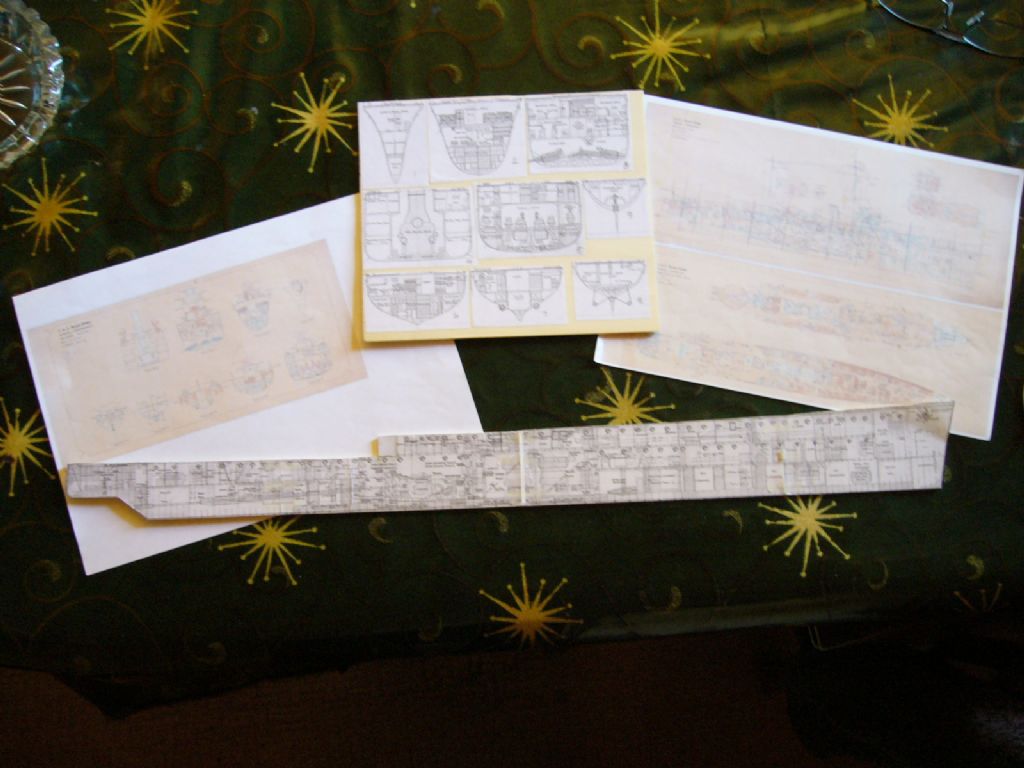
                                      Searches under “Images” for plans showed some held by the National Maritime Museum. I clicked on the images and copied them in to a Publisher document. I had side elevation and plan views as well as 9 sections, all of fairly poor definition (quite rightly so – they’re not going to let high quality images be pirated, are they?). All I had to do was to draw the missing sections and I could build a model!! It shouldn’t be too hard to fill in the blanks should it?

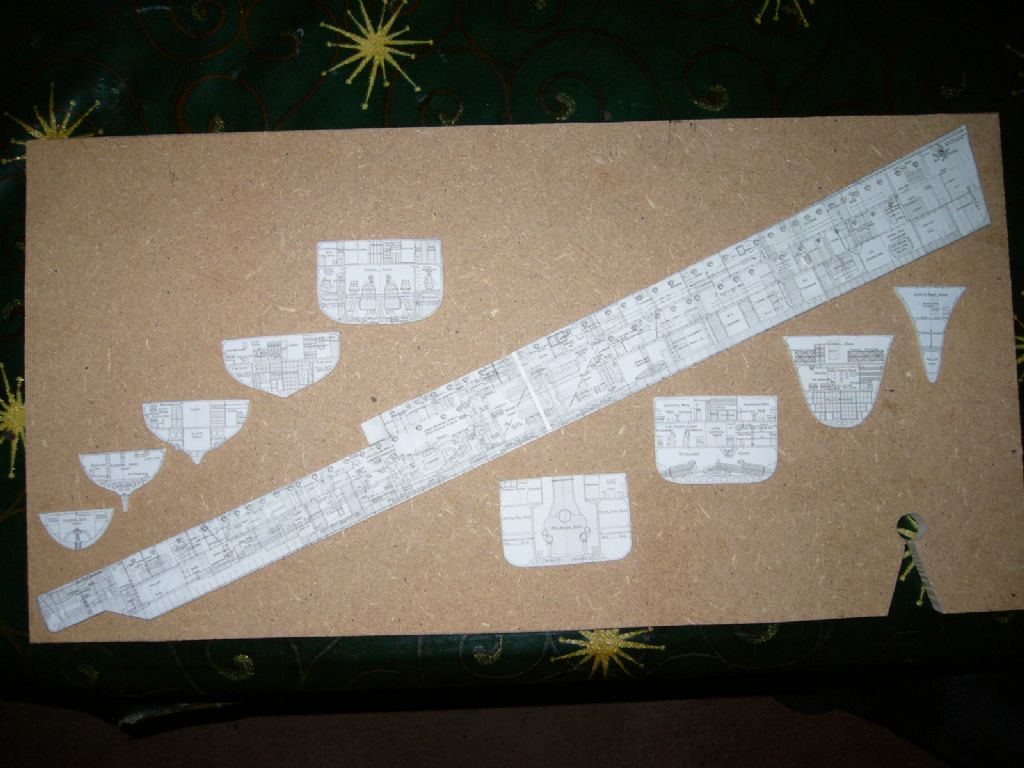
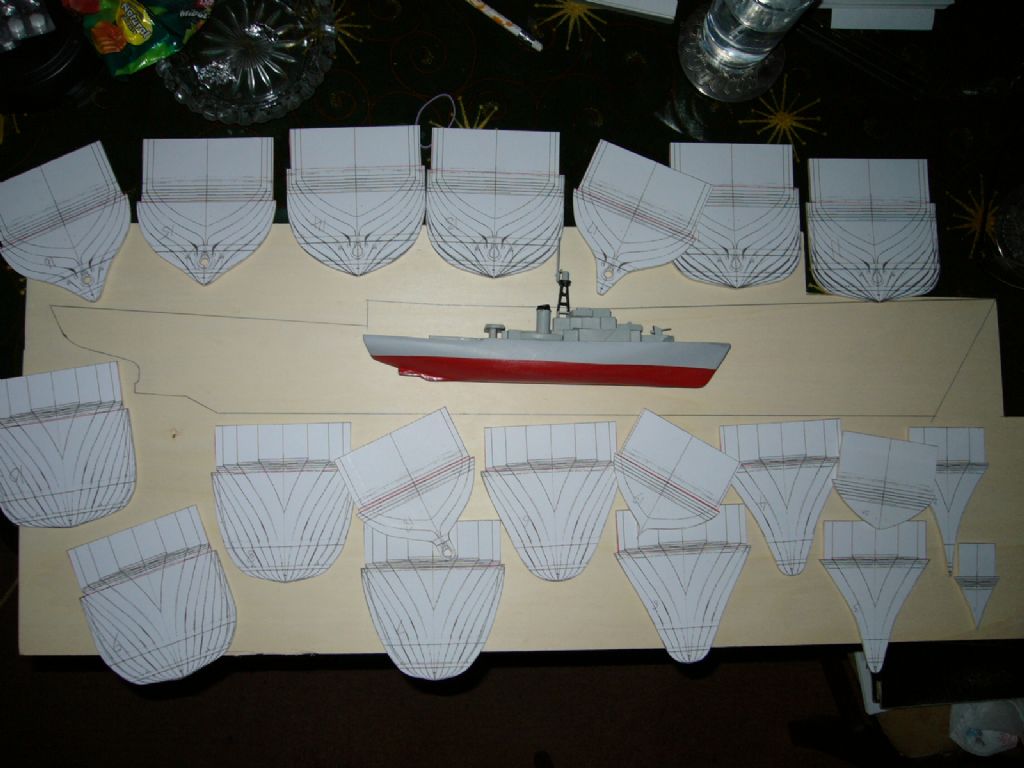
                                      I upsized the elevation and plan views to the size I required (about the size of my current model) by creating a banner in Publisher (I do not have and cannot use CAD). Printed these off and measured the beam at each of the sections and upsized the sections accordingly. I then stuck the hull profile and frames to some poplar ply left over from the Corvette build.

                                      p1040100.jpg

                                      p1040106.jpg


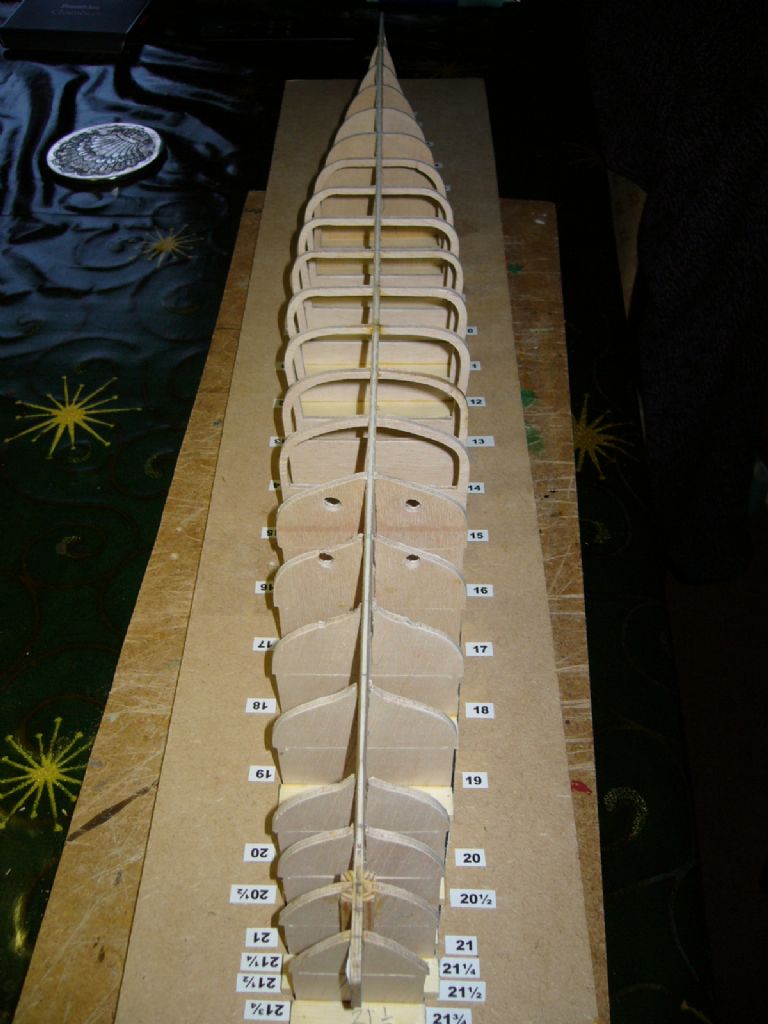
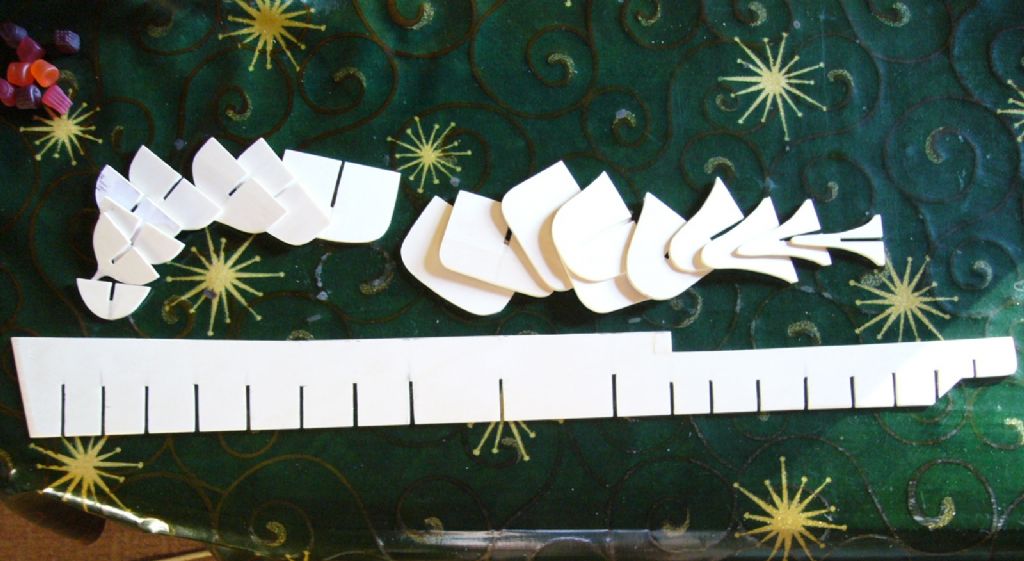
                                      I sharpened my pencil (metaphorically speaking since it is a mechanical one!) and set to with paper to draw the requisite frames, eventually ending up with this:

                                      p1040108.jpg

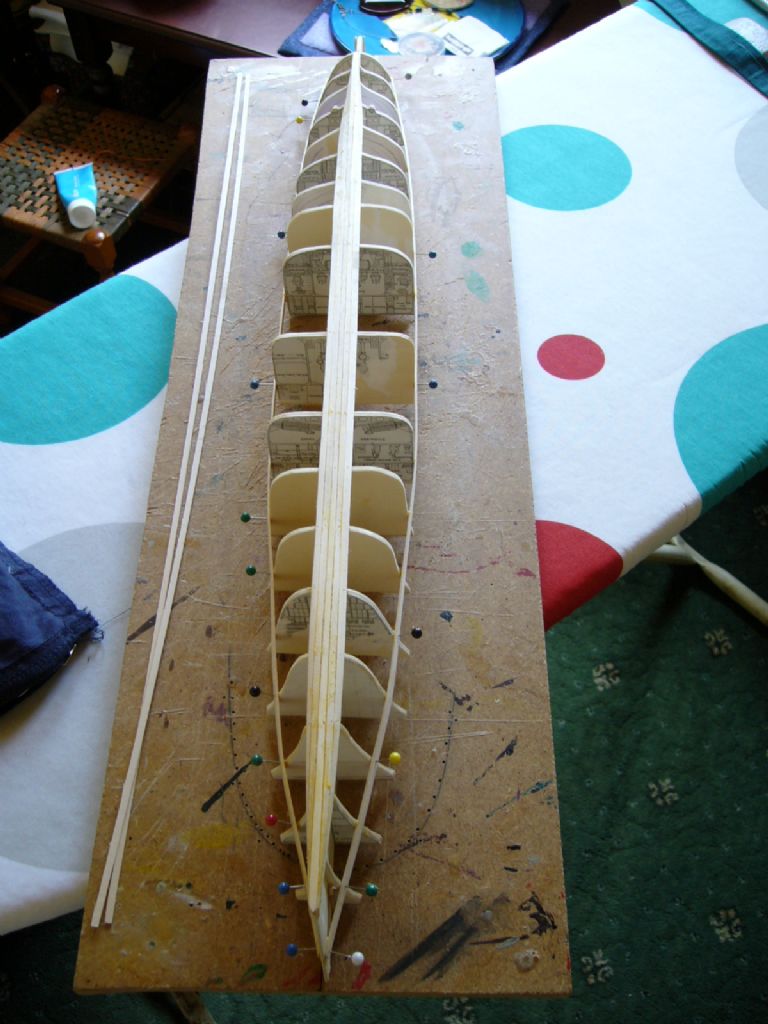
                                      I hasten to state that this build was never intended to be more than a doodle on a fag packet is to an engineering draughtsman; its purpose was purely to test my abilities as a naval architect. Construction commenced:


                                      p1040120.jpg

                                      (I thought that the ironing board cover would make a change from that dreadful tablecloth)


                                      Edited By Peter Crow on 15/03/2018 21:17:11

                                      #76268
                                      Peter Crow
                                      Participant
                                        @petercrow25030

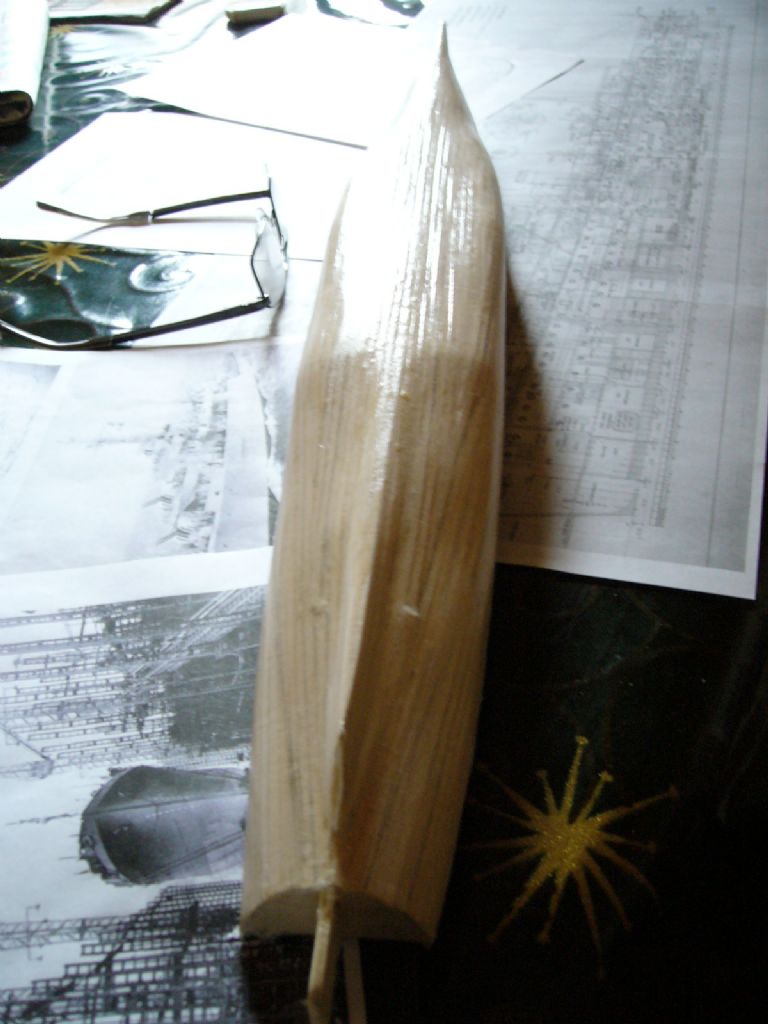
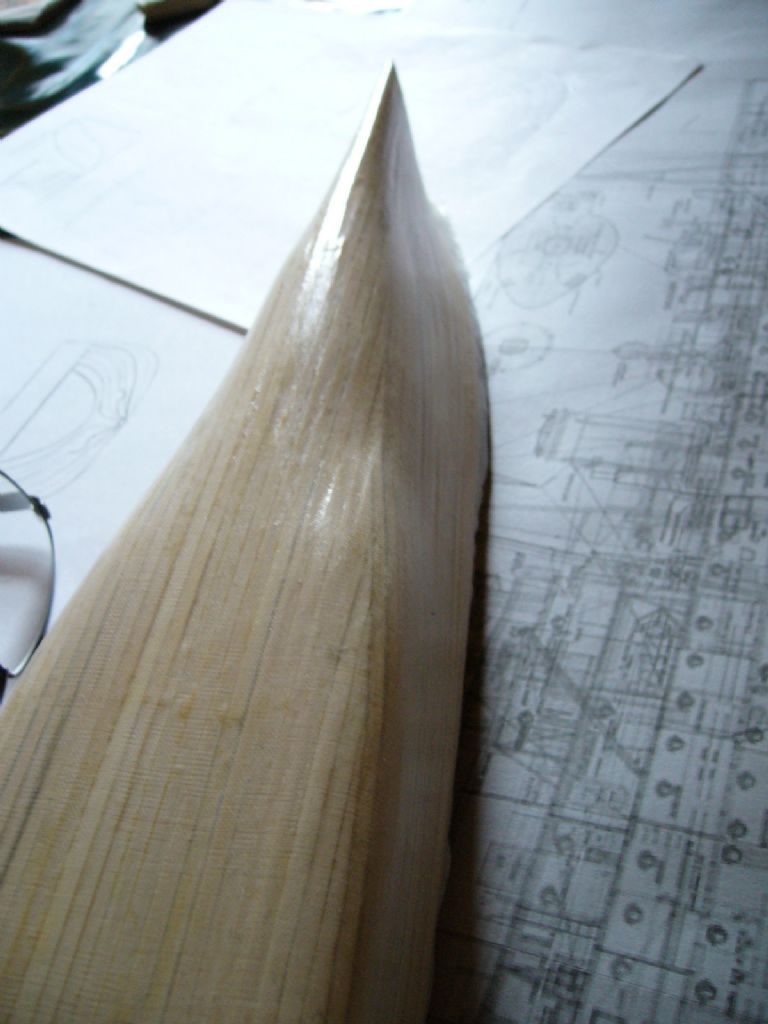
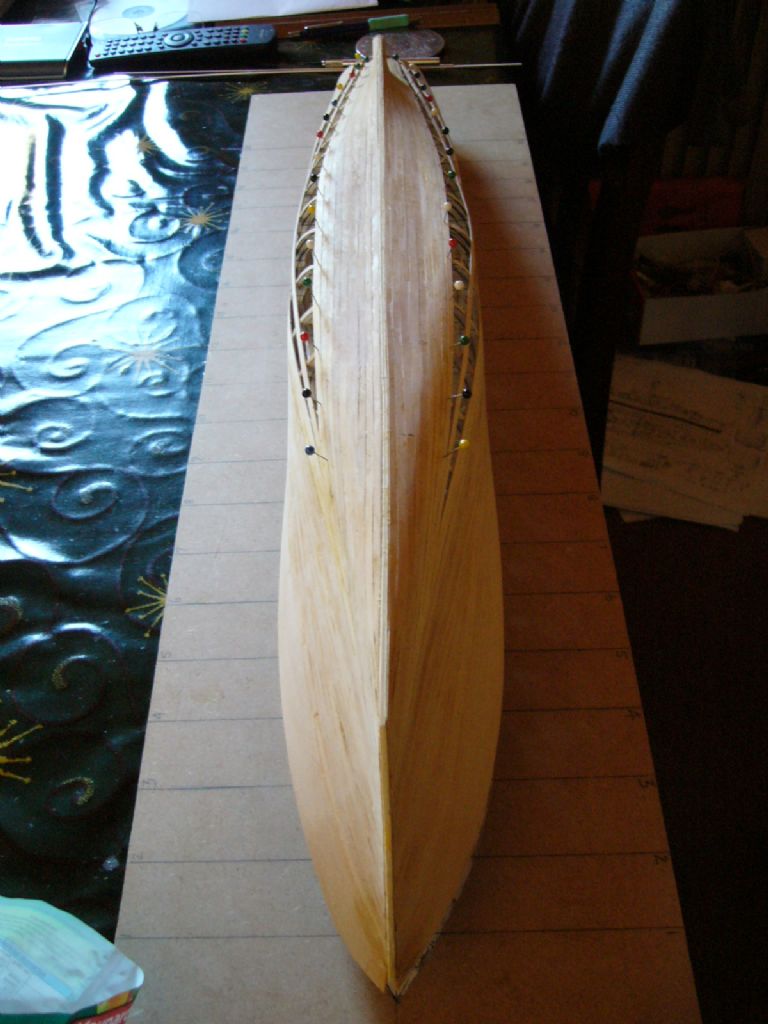
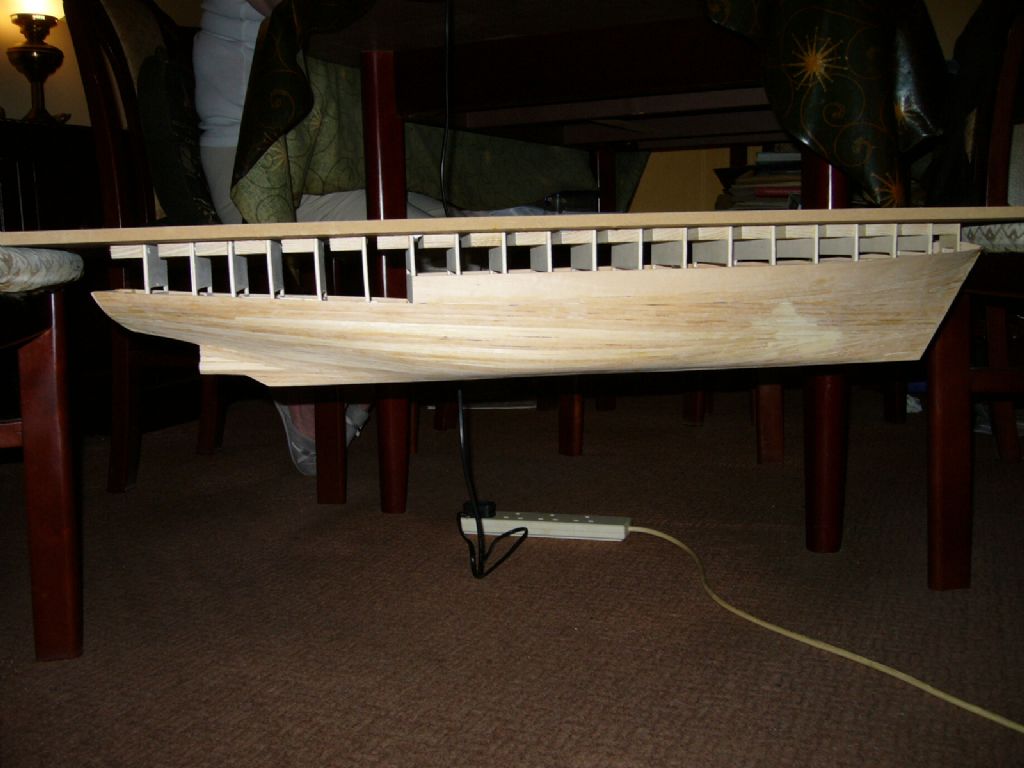
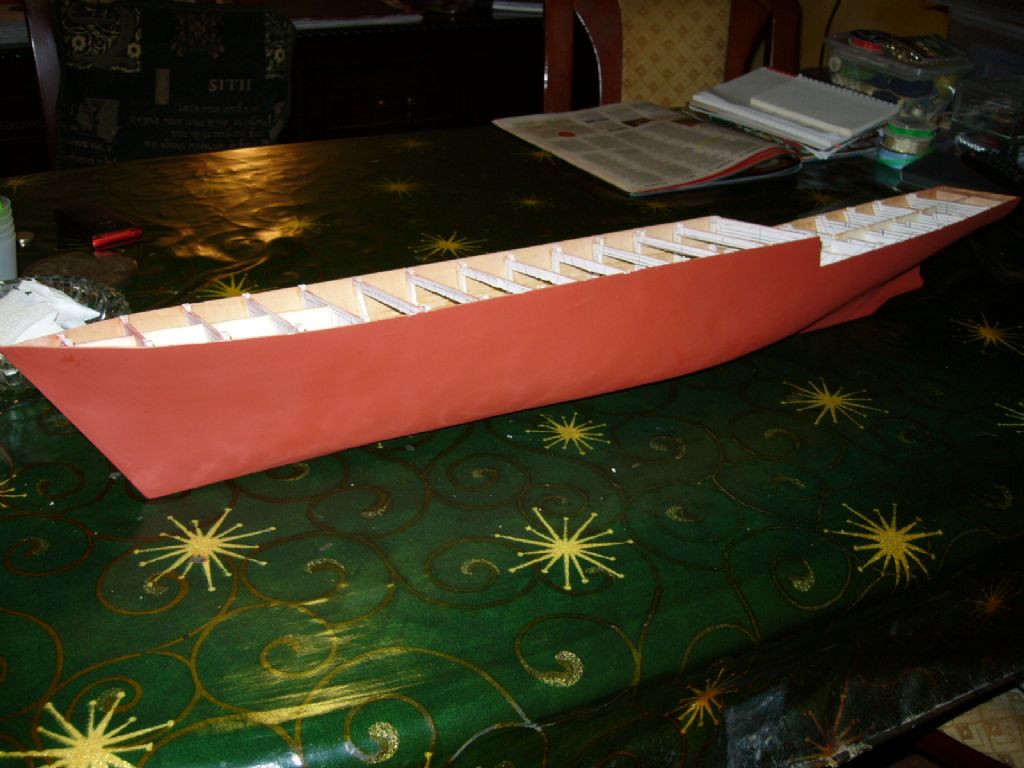
                                        As the build progressed, it was becoming abundantly clear that any aspiration to ability as a naval architect was laughable but I decided to carry on. It would be interesting, having got this far, to complete it for use in flotation tests. The materials being used were only leftovers after all (there goes the Scotsman in me again!). So I clad the planking with fibreglass cloth and Eze-Kote.


                                        p1040136.jpg

                                        p1040137.jpg

                                        p1040138.jpg


                                        No comments required from me; compared with the fruits of Mr Lambert’s labours, as pictured on page 1, you can spot the not so deliberate mistakes! No new Third Age career for me!


                                        For academic interest, I weighed all the hardware that I intended to install and cut pieces of lead flashing to fit into the cells of the hull and spread as nearly as possible to the locations of the installed items. I pencilled on a waterline and plonked it into the bath. It floated dead on its marks, leaving no margin for decks, superstructure or fittings! I no longer have the hull, but I still have a bag containing the lead I used. It weighs in at 497 grams. My proper hull is a bit longer and very much fuller in the bilge so should be capable of a greater displacement. Francis and I aren’t so very far out from each other. There, I’ve got to the point at last! What do you mean that you can’t remember what the point was?


                                        Guys, it occurs to me that the forum properly celebrates success and proudly shows off our achievements but it might also be instructive to hear of bloomers such as my Wonky Swan; any takers?


                                        ​Peter

                                        Edited By Peter Crow on 15/03/2018 21:18:04

                                        #76275
                                        Francis Macnaughton
                                        Participant
                                          @francismacnaughton39461

                                          Peter

                                          Thanks for your account of the route you took towards that first hull and the result looks pretty good to me for a first go – certainly a lot better than my first one which was a 4.5m long destroyer which required several tins of filler before I could even consider an exteral fibre glass coating! What thickness and material were your planks? I have recently built a 40cm planked hull with 0.8mm ply planking which has proved surprisingly strong but very light so perhaps a rebuild with thinner materials would give you enough margin of weight?

                                          I originated north of the border too so have a healthy appreciation of economy and am always open to free sources of information. Did you come across the website for the Historic Naval Ships Association in your searches as there is quite a treasure trove at **LINK**

                                          Also Dreadnought project which includes copies of the French naval archives too:

                                          hip_Plans”>http://www.dreadnoughtproject.org/tfs/index.php/Categoryhip_Plans

                                          #76276
                                          ashley needham
                                          Participant
                                            @ashleyneedham69188

                                            Peter. You have discovered that exact scale models have their limitations especially when on the smaller side and when intended to sail.

                                            ​I have seen several kits and so on where a massive improvement in on-the-water use could be had by making the hull just a bit deeper thus allowing more ballast and so on to be fitted.

                                            ​I saw a u-toob video clip of a KG5 battleship once, a big one, 5 foot or more, on a big lake in gusting conditions, and it was bobbing up and down like a bit of balsa, and looked awful (like a toy). When I made my HMS Nelson (at 44 inches long, and semi-scale) I added at least 30mm to the drawing hull depth and this results in it being very heavy and rock solid on the water.

                                            ​Wonky hulls, yes….I wonder how many boats have less than perfect hulls if you were to make precise measurements of them?? I find that photographing things at the right angle can minimise any distortion or unevenness…. (OBVIOUSLY not that any of mine have such flaws)…..

                                            Ashley

                                            #76295
                                            Peter Crow
                                            Participant
                                              @petercrow25030

                                              Francis

                                              HNSA site was the source of the plans that I used to build the Castle corvette (other than the hull sections which I sourced elsewhere). It is indeed well worth a browse. I haven’t looked at the Dreadnought Project yet; thanks for bringing it to my notice.

                                              When I was a lad, balsa was the material that I grew up with. I can’t think how many packs of assorted off-cuts of strip, sheet and block. I seem to remember that at 1/6d or a couple of bob they fell within pocket money range (if I saved up my tanner a week!). Even then, however, I can remember being quite exasperated at some of its limitations but I didn’t know of any alternatives.

                                              This time around I have latched on to basswood, or American lime as it is sometimes referred to. My first ever attempt at planking (in 2014) was on a small (A4 size plan) version of the hull that I used for RC boat number 1, (“The Boat”- so called because I never got around to naming it!). I used strips of balsa. Yuck! It fought me every step of the way.

                                              I read about basswood, and discovered that there was a stand of it in Hobbycraft next to the balsa. I have used 1/32inch (0.793mm) basswood strip for planking since, “The Boat” covered with tissue and Eze Dope and the Castle with 1oz per sq yd glassfibre fabric and Eze-Coat acrylic resin. I like the predictability of basswood, its strength and flexibility. I also find that it carves well in block form. I am intending to use the Castle formula on the Black Swan. The Castle hull (at 31 inches) worked out as very light. I did weigh it at the time, but my wife can’t remember the figure!

                                              The underlying structures of the 3 boats differ. “The Boat” keel and hull frames are 1/8inch (3.175mm) birch ply; the Castle keel and frames 1/8 poplar ply.

                                              Birch ply is great for strength but I can only work with it when I visit my Dad and have the use of his electric scroll saw. This is very inconvenient to one whose workbench is his dining table!

                                              Poplar and Lite ply are both workable with a Stanley knife at this thickness (albeit with a bit of effort and a plentiful supply of new blades). I did not like the poplar ply as I found it of indifferent quality- looked good on the face of it, but the knife often met fresh air at its core.

                                              I am trying the Lite ply for the Swan frames with Birch for the keel, and am happy with it thus far. I had started with a set of birch ply frames, but when it came to cutting out their internals, I gave up. I love my old man dearly but was fed up with working in his freezing garage every time I visited! An advantage of the change is that the Lite Ply frames are at least 40% lighter than the birch

                                              Ashley

                                              I have read of the stability and buoyancy difficulties with small models. When I was planning the Castle, I added 7mm beneath the waterline; 4mm above the stern tube and 3mm below. This served (1) to give me ample clearance between stern tube and hull bottom to run a 40mm prop, (2) to allow me to drop the motor in order to align it with the shaft, rather than angle the shaft up into the hull, (3) gain the displacement to carry 2 x 6volt 1.2ah SLAs and a little lead for trimming purposes.

                                              For better or for worse, I’m building the Swan to plan if for no other reason than the discovery learning lesson. If it all goes to rats at the maiden “sea” trials (before any superstructure goes on), I’ll strip it out and finish it as a static model!

                                              If anyone’s interested, this is how the Castle hull came together:-

                                              p1030687.jpg

                                              (I’d already roughed up an A4 plan sized version of the model to test the un-extended hull sections) You can see my literal cut and paste efforts on the sections to achieve the extra depth represented by the horizontal lines above and below the stern tube.

                                              p1030728.jpg

                                              p1030732.jpg

                                              p1030746.jpg

                                              #76297
                                              Peter Crow
                                              Participant
                                                @petercrow25030

                                                p1030751.jpg

                                                p1030773.jpg

                                                #76298
                                                Peter Crow
                                                Participant
                                                  @petercrow25030

                                                  p1030801.jpg

                                                  #76299
                                                  Peter Crow
                                                  Participant
                                                    @petercrow25030

                                                    Oh, Ashley- I reckon you must be right about your flawless models; nobody has contradicted you!

                                                    Peter

                                                  Viewing 24 posts - 1 through 24 (of 24 total)
                                                  • Please log in to reply to this topic. Registering is free and easy using the links on the menu at the top of this page.

                                                  Code of conduct | Forum Help/FAQs

                                                  Latest Replies

                                                  Home Forums All things floating Topics

                                                  Viewing 25 topics - 1 through 25 (of 25 total)
                                                  Viewing 25 topics - 1 through 25 (of 25 total)

                                                  View full reply list.