
Sailing Ship Rigs

Sailing Ship Rigs

Home Forums All things floating Sailing Ship Rigs

  • This topic is empty.
Viewing 11 posts - 1 through 11 (of 11 total)
  • Author
    Posts
  • #75043
    Bob Wilson
    Participant
      @bobwilson59101

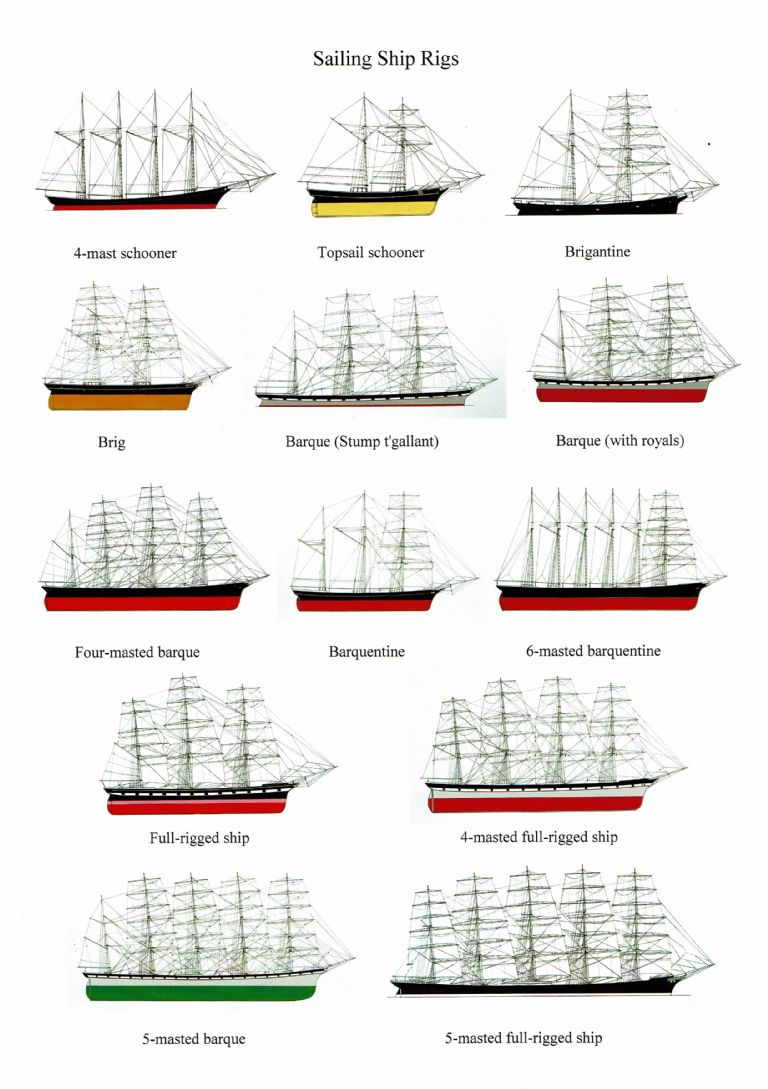
      Sailing ship rigs. All drawings by myself

      Bob

      sailing ship rigs jpeg.jpg

      #4457
      Bob Wilson
      Participant
        @bobwilson59101
        #75044
        Bob Abell 2
        Participant
          @bobabell2

          Very impressive, Bob

          I'm amazed at the extensive variation of sail and rig combinations that were available at one time!

          Can't imagine how you have gathered the necessary information?

          Are all these ships drawn to the same scale, I wonder?

          I could think of dozens of " Why " questions, as the combinations are so different from ship to ship

          But I'll control myself

          One question…….Why choose Yacht type sails rather than Galleon type sails?……..Could the choice be based on wind direction on certain sea routes?

          No need to knock yourself out, Bob

          Bob

          #75046
          Bob Wilson
          Participant
            @bobwilson59101

            Bob

            They are not to the same scale. When I put them on the page, each one was sized for convenience. The originals are all to specific scale. There aren't all that many and they are certainly not difficult to understand. i.e barquentine has at least three masts and only the foremast has square sails. Barque has at least three masts and the back one is fore-and-aft sails only. Full-rigged ship at least three masts, and square sails on all of them. I have no idea what you mean by galleon sails or yacht sails! There are square sails and fore-and-aft sails – that is all! Seamen were not all that educated in the 19th century, so if they could understand it, it was really no big deal. I went to sea in 1961 because I was not educated enough for anything else (failed 11+ and not even an O levelsurprise) but soon got the hang of all the sea terms and atypes of ship, although by that time they were all steamers and motor ships. These day, only motor ships.
            Bob

            #75051
            Bob Abell 2
            Participant
              @bobabell2

              Bob

              Referring to my Yacht and Galleon sails question

              I was referring to……..Why have a 4 mast schooner against a 4 mast full rigged ship?

              The prevailing wind direction must have been a deciding factor?

              Bob

              #75053
              Bob Wilson
              Participant
                @bobwilson59101

                Bob

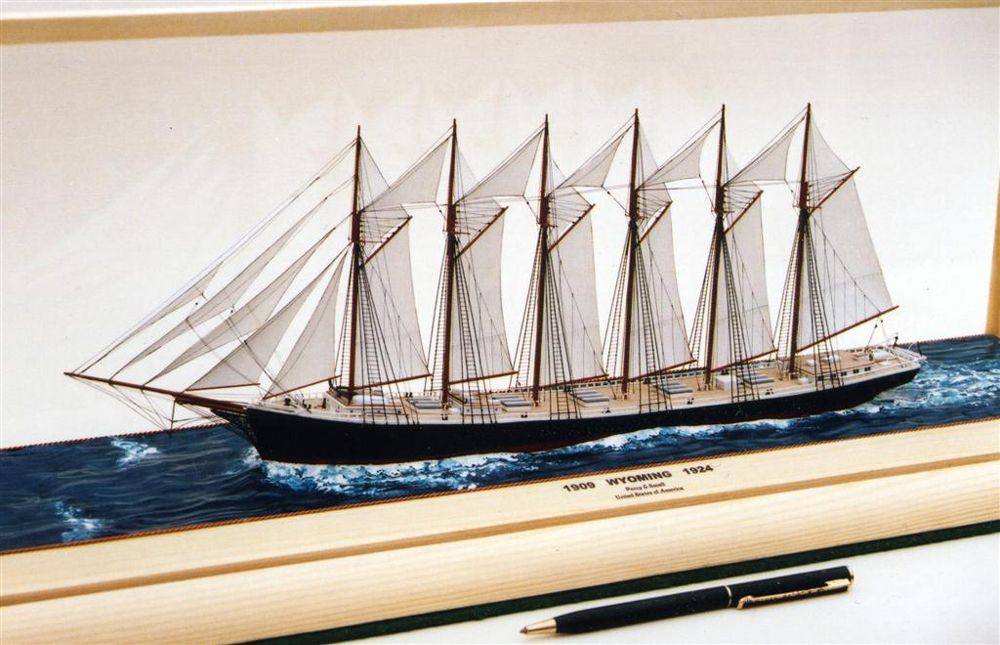
                The wind direction had very little to do with it. Schooners could sail closer into the wind than square-riggers, and there were some very large American schooners, like the six-masted Wyoming (See attached) or the seven-masted Thomas W. Lawson. Veritable giants, but they were less than satisfactory on bad weather runs such as Cape Horn or winter North Atlantic because the big fore-and aft sails were harder to control and it was almost all or nothing. Square-rigged ships had adequatley brtaced square sails and lots of them. In extreme weather condions, you could take a square rigger down to lower topsails and the odd staysail, and they were easier to control in very bad weather when compared with schooners. Small topsail schooners were usually coastal or UK – Mediterranean, but they did cross the Atalntic or even go to Australia or New Zealand if required, but being small, they were easier to handle than the big multi-masted ones.

                Bob

                wyoming.jpg

                #75054
                Colin Bishop
                Moderator
                  @colinbishop34627

                  Lovely drawings Bob.

                  Re sail types, as you say, it is horses for courses (literally!) depending on what conditions the ship is normally expected to be sailing in. Plus no doubt manning considerations were also taken into account.

                  Colin

                  #75055
                  Kev.W
                  Participant
                    @kev-w

                    The Americans built another version on the brig, they called it a 'Snow'

                    a snow.jpg

                    #75058
                    Bob Wilson
                    Participant
                      @bobwilson59101

                      Yes, the difference was minimal though, and I wonder why they even gave it a different name. A snow has an extra mast behind the mainmast on which the spanker is set. In the US, they didn't call four-masted barques, four-masted barques, but "shipentines!" Similarly they don't have port and starboard, but left and right, but it doesn't sound right to simple seamen such as myself!surprise Also, I can never come to terms with calling ships "boats."

                      "Battleboat" simply does not sound right, or "74-gun boat-of the line!" sad

                      Here is a larger plan of the four-masted barque "Forteveiot"

                      Bob

                      forteviot (large).jpg

                      Edited By Bob Wilson on 17/01/2018 07:26:34

                      #75059
                      Bob Abell 2
                      Participant
                        @bobabell2

                        I agree whole heartedly with you on those strange US ship names, Bob

                        But ships and boats is quite a stumbling block for many people in the UK

                        eg………Mailboat…………Mailship don't sound right?

                        Looking at those long slender six masted ships……..How many broke their backs in a storm?

                        Bob

                        #75062
                        Bob Wilson
                        Participant
                          @bobwilson59101

                          Bob,

                          The terms Mailboat, Boat Train, Banana Boat etc were coined by people who had nothing to do with the sea, and the general public just went along with it. I knew the difference between a ship and a boat before I was ten years old, simply by reading about them! My parents always called them boats! I was once made to stand in a corner at infants school for declaring that a derrick was a crane on a ship and that a barque (bark) was not so-called because it was made of wood!face 24

                          Sailing ships were not long and slender, although looking at the plan of Forteviot, you may think so. They were very wide, and very deep. Look how much is under water (the red part). When it came to breaking their backsin storms, not many of them did. In fact, I can only think of one, the 6-masted schooner Wyoming (See image above). That one broke up whilst lying at anchor in bad weather, but there was a reason. She was an enormous ship, well over 300-feet long, and to make matters worse, she was built of softwood! Far too big for a softwood ship. British shipbuilding changed over to iron and steel in the early 1870s for ocean going ships. They were immensely strong, often with plating over an inch thick for ships of only two thousand tons or so. I have sailed in a 32,000 ton tanker with hull plating only 5/8 inch thick!

                          Bob

                        Viewing 11 posts - 1 through 11 (of 11 total)
                        • Please log in to reply to this topic. Registering is free and easy using the links on the menu at the top of this page.

                        Code of conduct | Forum Help/FAQs

                        Latest Replies

                        Home Forums All things floating Topics

                        Viewing 25 topics - 1 through 25 (of 25 total)
                        Viewing 25 topics - 1 through 25 (of 25 total)

                        View full reply list.