
Silicon tube problem

Silicon tube problem

Home Forums Beginners Silicon tube problem

  • This topic is empty.
Viewing 18 posts - 1 through 18 (of 18 total)
  • Author
    Posts
  • #64313
    Southern Softie
    Participant
      @southernsoftie

      I have a problem with powering a boat I've built from kit.

      The motor is connected to the prop shaft by about an inch of 1.6mm diameter silicon tubing. It works OK out of water but when I start the motor in water (by RC), the propeller shaft slides backwards out of the tubing. I've tried: roughening the end of the propeller shaft with an emery board; de-greasing with spectacle cleaning fluid; and a small dab of glue inside the tubing at the propeller end (making sure the tube can still turn freely by hand) – but then the tube breaks in half, even when I go extra easy on the power!

      The boat is an Aero-Naut Diva, but all the parts involved in the problem seem to be fairly standard.

      #2580
      Southern Softie
      Participant
        @southernsoftie

        Using silicon tubing to transfer power to propeller

        #64314
        Dodgy Geezer 1
        Participant
          @dodgygeezer1

          What is the wall thickness of the silicone tube? What is the amount of power you are trying to transmit? What is the gap between the end of the motor shaft and the beginning of the prop shaft?  The ideal answers should be large, small and small respectively…

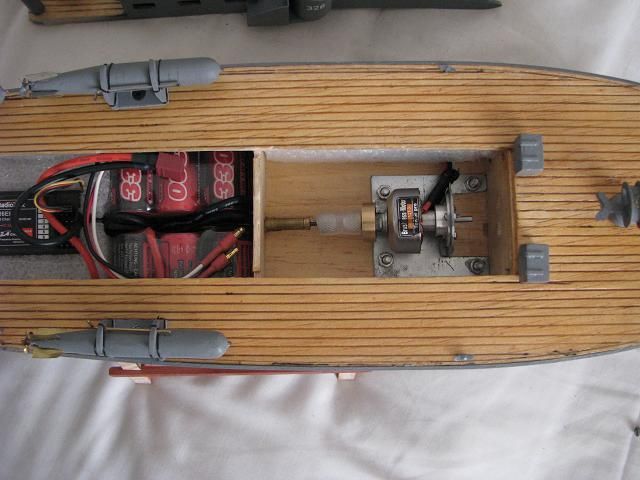
          I use silicone tube extensively to connect motors to prop-shafts. I would only use thin tubes directly onto the prop-shaft to connect weak-powered motors on small slow boats of around 1ft or less in size. For larger boats or higher powers, I make a wider end attachment in aluminium, knurl the outside, and use a thick-walled tube of about 1cm diameter to connect with. Example here:

          th-1553.jpg


          I suspect that you could really do with something like this: http://www.ebay.co.uk/itm/3-4-5-6mm-Shaft-Coupler-Motor-connector-Universal-Joint-Coupling-Model-Boat-Car-/151386901011?var=&hash=item233f5cca13:m:mg79N7lbqcZbDG8WQWt9fxg


          Edited By Dodgy Geezer on 05/04/2016 14:46:20

          Edited By Dodgy Geezer on 05/04/2016 14:53:04

          #64315
          Paul T
          Participant
            @pault84577

            The motor and shaft are not aligned correctly, this problem usually manifests itself when the motor/prop are under load (in the water)

            Re check the alignment of the shaft and motor.

            #64318
            Malcolm Frary
            Participant
              @malcolmfrary95515

              Do you mean that the prop shaft heads towards the stern? This is only likely in reverse, when running forward, the prop shaft is trying to get further into the boat.

              Most conventional motor-shaft coupling arrangements involve some kind of locknut/thrust washer arrangement to prevent the shaft from wandering off. A flexible tube that is relying on a push fit needs to have a really good clench on its shaft or, under load, it will become a slipping clutch. This strong clench usually involves an inside diameter much smaller than the outside diameter of the shaft, and usually a deal of muttering and mumbling when trying to connect it all up in what is usually a confined space.

              #64337
              Southern Softie
              Participant
                @southernsoftie

                Thanks people …

                DG: The wall of the tube is about 1mm thick and the motor is 6V. The gap between the shafts is indeed small – in fact pretty much zero. The boat is about 21" long (53 cm), nearly twice as long as your guideline. It sounds like I need a more meaty tube (at least), though the steel coupler in your link looks a bit fearsome. Thanks for the photo.

                Paul: The alignment isn't perfect (being a beginner!) though I'd have said not too bad at all. Sadly there's not much I can do to adjust it at this point – maybe try a spacer between the motor and the panel it's screwed into to alter the tilt. Or perhaps using a more robust tube will make it less critical?

                Malcolm: Yes, though it does seem counter-intuitive. But then I'd expect the propeller to operate in reverse as well without disengaging, so it's academic really. I'll research the lock-nut / thrust washer approach.

                Thanks again.

                #64338
                Dodgy Geezer 1
                Participant
                  @dodgygeezer1

                  A 6v motor doesn't tell us that much about the power – but it seems obvious to me that you are trying to put too much torque through a weak coupling. If it is 1.6mm internal with 1mm walls it's still only 3.6 mm total OD. As I said, I use 10mm or more, thick-walled tube.

                  Is the silicone tube very soft? To transmit power it needs to be firm. If your shafts are 1-2mm in size, find a bit of mains electric cable and strip a 1" length of insulation off – that should provide a stronger tube.

                  It is important to get the prop-shaft and motor shaft as nearly in-line as you can. Experiment with spacers. If the motor is out of line, you will lose power and gain vibration…

                  It's not at all unusual to have quite chunky couplers – the ones in the link are quite small! It sounds to me as if your tube can't take the extra torque when the prop is in the water, and the motor starts twisting the tube, which will squeeze the prop-shaft out of it. If the prop-shaft is glued in, the twisted tube will eventually break. A thicker, stronger tube is one answer…

                  #64343
                  Paul T
                  Participant
                    @pault84577

                    Surrey Tiger

                    It certainly sounds as though you have an alignment problem and given your description of the problem I would check this first however you could have a more fundamental problem that is manifesting itself in this way.

                    It is possible that either the motor or propshaft / tube are loose i.e. the motor is not screwed down tightly or the propshaft is wobbling within the tube or the entire propshaft / tube isn't fully glued into position / hasn't sufficient support over its entire length. Your photo doesn't provide sufficient detail to make a more accurate assessment

                    Check the motor and tube for movement and check the shaft for 'wobbling' as it rotates.

                    Any unintentional movement from either the motor of shaft / tube would be exaggerated by the silicone joint as it flexes to adsorb the uneven rotation resulting in the catastrophic failure that you have witnessed.

                    A larger or thicker silicon joint or commercial coupling might work but will be masking the underlying problem and will be put under tremendous stress as it attempts to cope with the uneven rotation.

                    I hope this helps you to solve the problem.

                    Paul

                    #64344
                    Dodgy Geezer 1
                    Participant
                      @dodgygeezer1
                      Posted by Paul T on 07/04/2016 14:35:04:

                      … Your photo doesn't provide sufficient detail to make a more accurate assessment…..

                      He has put up a photo? Where is it? That would certainly help to solve the problem…

                      #64345
                      Southern Softie
                      Participant
                        @southernsoftie

                        No, that was Dodgy Geezer's photo!

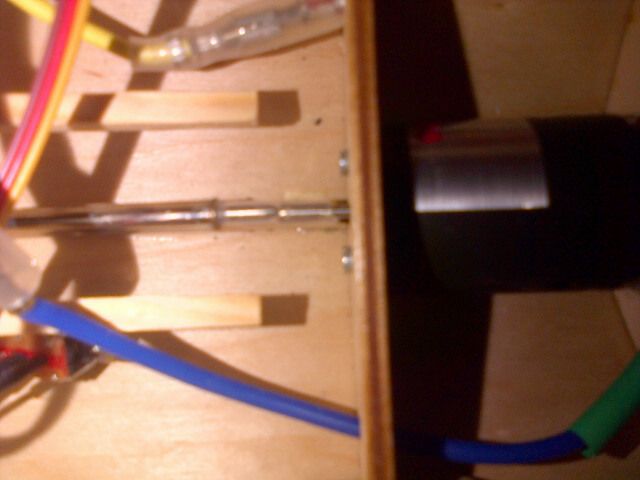
                        However, if it helps, here's mine (which is a bit different) …diva motor-prop connection sm.jpg

                        #64347
                        Paul T
                        Participant
                          @pault84577

                          Trust me to get the photo wrong.

                          But looking at the proper photo and even though it is slightly out of focus you can see that the motor and shaft are out of alignment

                          #64348
                          Dodgy Geezer 1
                          Participant
                            @dodgygeezer1
                            Posted by Paul T on 07/04/2016 17:04:03:

                            .. even though it is slightly out of focus you can see that the motor and shaft are out of alignment

                            It is hard to see, but the shaft might be displaced laterally. Are both those shafts the same size, such as 3mm? If so, a length of 3mm id brass will slip over both and provide a nice stiff reference position to hold the motor in.

                            My view is that the silicone connector must be inadequate to transmit the maximum torque, because if it were adequate it would not have broken. You do not want a coupler breaking in mid-pond, so you need a stronger one. A stiffer tube will be stronger, and will help to hold the motor in the correct position.

                            If your shafts are the right size, I would go for a more solid universal joint, like the one I linked to. That will lock firmly onto the shafts and force the motor shaft to be positioned along the axis of the prop-shaft.

                            With a firm connector of this kind, you can try running the motor on low power when it is loosely secured, and move it around to the position where vibration is least, and shaft speed is greatest. This will be the ideal motor position, and you can then arrange a mount to hold it at this angle.

                            #64359
                            Malcolm Frary
                            Participant
                              @malcolmfrary95515

                              The wobbling caused by the misalignment could very easily push the prop shaft away from the motor, giving the problem as described. The push from the tubing trying to make space for itself might be more than enough to overcome the propeller trying to push the shaft into the boat.

                              Any use of flexible tubing that relies on the tube clenching on the shafts rather than some kind of clamp does need the best alignment possible, as does any situation where the two shaft ends are very close together. A while back, when there was a model shop in town, I got some brass collars that were a close fit over the filled tube. Putting the grub screws at 180 deg from each other seemed to keep any eccentric vibration in check.

                              #64363
                              ashley needham
                              Participant
                                @ashleyneedham69188

                                I have a few boats with commercially made flexible silicone connectors. They have brass fittings for shaft/motor and the tube is quite thick walled. They seem to be adequate but they are on low powered 540`s and speed 400`s.

                                Usually when I install "the gear" I chock everything in place having made motor mounts to suit and motor the …motor…on a single aa battery to see if nothing much wobbles. If this is ok, a drop of superglue keeps it still followed by Araldite/whatever. This is using the plastic/brass u/j types of connector. I did find more difficulty when using the silicone ones as then always seem to lean one way or the other, and need a stiffener to centralise them.

                                Everyone should really have a shaft/motor alignment tool as this is the way to do it, but who has???

                                I have just, as I type , e-bayed a metre of silicone tubing (for a massive £1.20, free delivery!!) with an I/d of 6.3mm and an o/d of 12.5mm and will see if this makes a reasonable substitute for the u/j bit. Be interesting to see if it quietens down any of the boats (obviously not that they make much noise)

                                Ashley

                                #64366
                                Steve Walker 1
                                Participant
                                  @stevewalker1

                                  Apologies if I'm being a plonker here but when I was building my Tritons I just slipped a bit of brass tube over the motor shaft and the prop shaft to link them together and built up the motor mount to suit. I then just pulled the prop shaft out far enough to remove the sleeve. It has worked fine and two of them run very quietly. I thought I would be able to do this with bigger boats/motors too, using sleeves.

                                  Am I correct in assuming I won't be able to do this with bigger boats and that this is the issue here? To me it looked as if the shafts in the pictures had the same diameter.

                                  #64367
                                  Dodgy Geezer 1
                                  Participant
                                    @dodgygeezer1
                                    Posted by Steve Walker 1 on 08/04/2016 18:40:32:

                                    Apologies if I'm being a plonker here but when I was building my Tritons I just slipped a bit of brass tube over the motor shaft and the prop shaft to link them together and built up the motor mount to suit. I then just pulled the prop shaft out far enough to remove the sleeve. It has worked fine and two of them run very quietly. I thought I would be able to do this with bigger boats/motors too, using sleeves.

                                    Am I correct in assuming I won't be able to do this with bigger boats and that this is the issue here? To me it looked as if the shafts in the pictures had the same diameter.

                                    No, you can do that for any motor-shaft pair that's the same size – it's a standard way of achieving alignment. I said as much about 4 posts above…

                                    If you have different size shafts and access to a lathe, you can always drill a bit of nylon rod concentrically with the different sizes and use that. When I am using a 3mm brushless with a 3mm shaft, sometimes I remove the motor shaft and thread a 3mm brass rod straight through the prop-tube and motor. You can then bolt the motor in and epoxy the prop-tube to fit.

                                    For very small motors I used to bed the motor in epoxy putty, and move it around to find the lowest vibration/highest speed position, whereupon I left it to set….

                                    #65274
                                    Southern Softie
                                    Participant
                                      @southernsoftie

                                      Thanks for your help everyone. It's quite obvious that silicone or rubber tubing is nowhere near up to the job.

                                      In the end, this 2.3mm x 2mm fitting is what did the trick (the 2.3 mm end for the motor shaft, the 2mm end for the prop).

                                      #65310
                                      Armando Loni
                                      Participant
                                        @armandoloni78860

                                        When using silicone tubing as a means of coupling between motor and prop shafts, the joins can be strengthened by slipping a small section of the same diameter tubing over each end of the coupling piece (stretching it to fit)…. that reduces the internal diameter of the coupling piece by compression….. then slip it onto the shafts.

                                        My Paula III uses a rubber hose connector (factory fitting) pushed onto knurled brass connectors…. okay for the recommended motor/battery set-up, but the rubber easily shreds when using a much higher voltage battery!

                                      Viewing 18 posts - 1 through 18 (of 18 total)
                                      • Please log in to reply to this topic. Registering is free and easy using the links on the menu at the top of this page.

                                      Code of conduct | Forum Help/FAQs

                                      Latest Replies

                                      Home Forums Beginners Topics

                                      Viewing 25 topics - 1 through 25 (of 25 total)
                                      Viewing 25 topics - 1 through 25 (of 25 total)

                                      View full reply list.