
R/C Electronics Running Amok!

R/C Electronics Running Amok!

Home Forums R/C & Accessories R/C Electronics Running Amok!

  • This topic is empty.
Viewing 21 posts - 1 through 21 (of 21 total)
  • Author
    Posts
  • #16390
    Mike sLOAN
    Participant
      @mikesloan52046

      Here is the problem I have. On bench tests, my boat works fine. Once I put it into the water, the R/C does not work properly. It will only go into reverse. The rudder “twitches”. Other functions operate themselves.
      I assume this has to do with interference or poor antenna placement, but I am open to other suggestions. What I can’t figure is what effect being on the water has.
      Any comments or suggestions would be appreciated.

      #16402
      ashley needham
      Participant
        @ashleyneedham69188

        Mike. Does the rig work at a reasonable distance on the bench? if so perhaps you could try running your boat with the gear on deck and even a jury rigged ariel to see if the problem is too low a placement of the reciever gear. Make sure your motors are suppressed properly with capacitors, the interference will be greater when they are under load (ie in the water)than just spinning no load. Ashley

        ALSO… make sure the reciever wire  is not wound up, knotted or wrapped around any other wires when in situ in the boat.

        The reciever wire is supposed to be a certain length, and if you add an ariel to your boat you should in theory shorten the reciever wire by the same amount.

        the water absorbs radio energy, so any antennas very close to the water will recieve less transmitter energy that one higher up. So saying I believe submarines operate ok to about 2 or so feet below with just a trailing antenna..??

        #16403
        Len Ochiltree
        Participant
          @lenochiltree67043

          And, Make sure that your batteries are fully charged as if you are checking out your boat at home with the same batterery you will be already starting to drain it.

          Also some other person may have another RC model nearby and interfere if on the same frequency.

          Do you have different Crystals to change in your Tx and Rx ?

          Regards,

          Len.

          #16411
          Mike Davidson
          Participant
            @mikedavidson22772

            Mike, further to what Ashley was saying,when your boat is in the water, there is a modicum of resistance to the propellor due to the fact that it is trying to shove a whole bunch of water aft, so the motor will be struggling to say the least as each segment of the motor comes into its power cycle, it will be generating very strong lines of magnetic forceand as the commutator segment breaks contact with the brush , the lines of force will collapse big time inducing reverse polarity spikes all over the place, so, Ashley is quite correct, the motor does need to be suppressed, and personally, I recommend that you fit ashottky diode and capacitors to both your motors. The shottky diode can be bought from places like maplin or radiospares, maybe even model shops, and I thoroughly recommend that you solder a o.1 microfarad capacitor to each of your motor terminals, and the other end to the motor cases. another thing has occurred to me, and that is if your motors are struggling under a high load, the battery supply voltage will be dragged down quite alarmingly, so do you have a seperate autonomous battery for your radio and servo’s, a good point to note you guys with battery elimination outputs on your ESC’s, so, take note, if you don’t suppress your motors you could be interfering with folk’s televisions, good thing you might cry, but they won’t, and the home office man will come round with his broad band receiver and a big book of tickets. You know it makes sense          Mike    D     

            #16412
            Mike sLOAN
            Participant
              @mikesloan52046

              Thanks for the feedback. ThE antenna may be the problem. It is likely too close to either the motor or other wires. The receiver is powered from a battery eliminator circuit on the speed control. Batteries are fully charged. Capacitors are in place on the motor.

              #16413
              60watt
              Participant
                @60watt

                Without enough juice to the bec input,you get extra servo like pulses being fed to the servos.

                What voltage and what does the esc instructions say is the minimum?

                #16415
                Mike sLOAN
                Participant
                  @mikesloan52046

                  I think the minimum is 6v, max is 24, and I’m running 14

                  #16417
                  60watt
                  Participant
                    @60watt

                    Hi Mike,

                    How many servos and other things do you run off the receiver?

                    What make model is the esc, and radio set?

                    Are you able to use a receiver pack temporarily?

                    What is the motor?

                    As it’s a reversing speed control I’d be interested where a chottly diode could possibly be fitted!

                    #16420
                    Mike sLOAN
                    Participant
                      @mikesloan52046

                      This is my dad’s boat ( a 92 yr old veteran), so I am a bit vague on the details.
                      The speed controller is an electonize 43HVR .
                      The receiver is running a servo for the rudder, the speed control, and another servo that operates a switch for a sound board.
                      Both servos are twitching.
                      Receiver is an Airtronics (sanwa)
                      I Don’t know what motor. It came from Amati with the Riva kit…

                      #16421
                      Kiwimodeller
                      Participant
                        @kiwimodeller

                        I have had similar problems with my Aerokits Sea Hornet fitted with a 540 motor and an Electonize controller even though it had some suppressors fitted. I found a very good article at http://www.modelsolutions.ca/ in an article on RF Interfence. I followed their reccomendations and found that what made the difference was fitting the Ferrite Beads to the motor leads. Obviously the capacitors on their own were not enough. The only time I get any problem now is when the battery is getting really low, the BEC still works but it is like there is a time delay and it does not like steering and motoring at the same time. When that happens I know it is time to get it to the bank pronto. Hope this helps. Cheers, Ian.

                        #16423
                        60watt
                        Participant
                          @60watt

                          Mike

                          You have the boat and RC to hand?

                          Is the motor suppressed and are the wires in twisted pairs like domestic equipment?

                          As a diagnostic you can safely fit a receiver pack to a live 5volt line from that ESC

                          I’m away for two days so your left in the capable hands of the other Mike.

                          Tom

                          #16424
                          60watt
                          Participant
                            @60watt

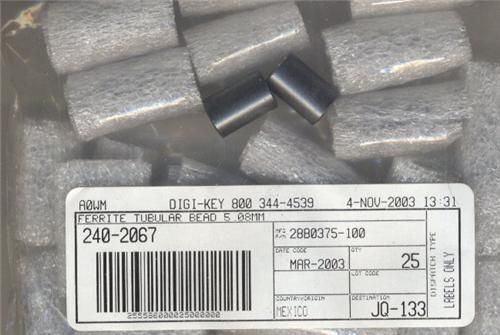
                            /wp-content/uploads/sites/5/images/member_albums/3475/ferrite.jpg

                            Ferrite beads. You can’t even give them away to fellow model boaters until you’ve demonstrated what difference they make.These ones are Nickel Manganese and take 50 amp turns.

                            #16425
                            Mike sLOAN
                            Participant
                              @mikesloan52046

                              Hmm. I’ll look at the reference listed. The motor IS supressed. I also will be away for two days

                              #16482
                              ashley needham
                              Participant
                                @ashleyneedham69188

                                 Ferrite beads, Maplins sell them, they are dead cheap, I am going to get some. Seems silly not to try them really. I have a lack-of-range issue on a couple of models, and this seems like an easy thing to try. In any event, it wouldnt do any harm, eh?   Ashley

                                #16486
                                60watt
                                Participant
                                  @60watt
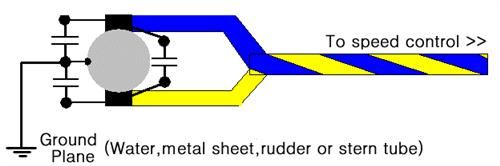
                                  /wp-content/uploads/sites/5/images/member_albums/3475/common_mode_suppression.gif

                                  Ashley. Before you shill out to Maplin my ESC says :-

                                  PREVENTING RADIO INTERFERENCE

                                  If you are driving a high stall current motor (e.g. a modified competition race or vehicle fan motor) you should use additional choke suppression on motor cables as well as using the essential suppresser capacitor.

                                  A lot of the locally generated noise in the radio frequency spectrum can be eliminated by a pair of 2 pence ceramic capacitors in the range 1 to 100nF. They will make a difference if you either ground the motor case(best) or use a fourth ceramic capacitor 47 – 220nF to connect the case to a ground plane.The ground plane can be water via a metal rudder or stern tube.

                                  That measure and twisting wires is usually sufficient. If that does not work I’d try conncting the drive battery cathode to that plane too.Try to avoid connecting two drive batteries together by doing this

                                  Mike. You have a radio that is notorious for spewing out spurious interference noise .The 43HVR speed control can not cope with that so the two do not form a good match.The speed control manufacturer has addressed this problem with their new microprocessor based control.( or rather it has copied an ESC from Little Models that did the job a lot better 10 years ago). I quote…..

                                  ” Firstly, the microprocessor digitally measures the input signal and totally rejects any out of limits signal produced by interference. Next the ‘good’ signals are used to calculate a rolling average for the transmitter signal. Slight interference causes the jitter that makes most controllers seem harsh. Using this digital technique, interference effects are reduced by a factor of 8 whilst maintaining a fast response time of only 160 milli-seconds.”

                                  The Little Models ESC says:-

                                  • PULSE COUNTING :- for a good response with a poor radio signal yet abruptly halts the motor 1/2 second after loss of radio contact.

                                  That esc rejected all manner of radio jitter averages 8 good pulses and a submarine version allowed you to stretch the time it waited for a proper signal to 2 seconds.
                                  I wonder where electronize got the idea from

                                  #16508
                                  ashley needham
                                  Participant
                                    @ashleyneedham69188

                                    60. I have not heard of grounding the case before. seems like a plan to me, easily done. i will give it a go. I dont think many of my models have twisted motor wires either. I am boating today (sunday, am) so will have a twist before floating. You see, if you dont talk to the right poeple you dont get the right tips!

                                    so saying , its easy to speak to the wrong poeple and get duff tips!

                                    Ashley

                                    #16527
                                    Kiwimodeller
                                    Participant
                                      @kiwimodeller

                                      Don’t forget (both Mike and Ashley) to let us know what finally sorts the problems. We are all still learning here. Thanks, Ian.

                                      #16536
                                      ashley needham
                                      Participant
                                        @ashleyneedham69188

                                        Most of my model control woes seem to centre around ariel placement.  What works for one doesnt always work for another. My Titanic and Argus carrier both have the ariel (I have trimmed a bit off the ariel wire on the reciever and use an appropriate length of steel wire fixed on the end to retain the length) laying along the inside of the hull and work fine., My latest 48" battlecruiser just will not have it, I get about 20 feet out and start to experience cutting out. I think this is because the thing is very low to the water, and so the signal strength is lower, but equally the twin 380 motors (both capacitor suppressed) may start to influence this once the signal strength drops a bit. Next week I am going to try it with an upright placement to see if this cures it, but I have grounded the motor casings by soldering a wire to the prop tube, fixing this to the motor carriers and scratching a bit of paint off the outboard end of the tube. I will try this first with the ariel horizonmtal to see if there is any change.

                                        I had terrible trouble with the Sunderland, and this was only cured by putting in an upright  ariel, as seen on the pictures, but even then if the ariel wire is not untangled and stretched out  towards the front as much as it will go I get a bit short on distance control. This is at odds with my small landing craft, which although has an upright ariel, the wire inside the compartment at the back is all screwed up as there is nowhere to put it! but there agin the motor setup is different to each one.

                                        All my other boats have upright ariels of one sort or another and work ok.  Ashley

                                        #16547
                                        Penny Lee
                                        Participant
                                          @pennylee76979

                                          /wp-content/uploads/sites/5/images/member_albums/3951/motor_filter_0.gif
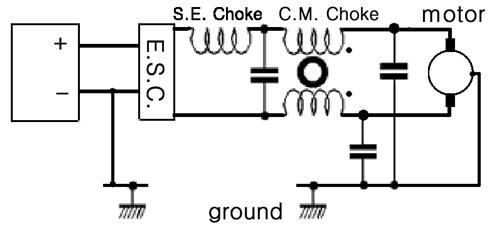
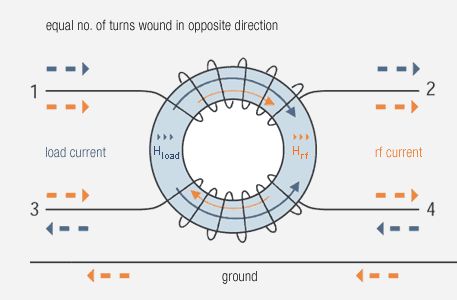
                                          /wp-content/uploads/sites/5/images/member_albums/3951/common_mode_choke.gif

                                          ashley needham wrote (see)

                                          I believe submarines operate ok to about 2 or so feet below with just a trailing antenna..??

                                          Not that one again?

                                          If a pond is right next to the sea shore then your out of luck.

                                          After adding a vertical whip antenna.The subtracted length should be wound to avoid creating an air cored inductor which truncates the electrical length of antenna as inductance is a block to r.f..It also picks up interference from anything close.

                                          Place the out and return length together then wind onto a flat card or thin ply.

                                          This article starts at the basics so if it makes no sense you see the difficulty I have below.

                                          OK The two capacitors to the left of 6Owatt’s motor forms a filter for common mode noise.They handle RF and therefore should be low inductance,low leakage(cog or X7R) disc ceramic type 1 to 10nF and not 220 to 470 nF in YFV material.They don’t work unless there is a ground connction of some sort so all those instruction diagrams with three caps are tosh.

                                          That is usually sufficient but to beef common mode filtering you can use a common-mode transformer made of high permeability ferrite. The 1:1 ratio an direction you wind is important as the net magnetic flux created by the load (solid black arrow) should be zero .The toroidal transformer acts as an inductance and therefore a high frequecy block (choke) only to common mode current (red dashed arrow)

                                          If you break open some old mains powered electrical equipment you wiill find a ready made 6 amp filter with both a differential and common mode choke filter.The circuit symbols will be printed on the metal shroud.

                                          Differential mode filtering is done separately and, again, a low inductance 10-220nF disc ceramic capacitor of X7R-dialectric should be used. Because it is handles lower frequency differential noise, it does not need to be so close to the motor as the common-mode transformer (common mode choke).To inprove differential mode filtering a single ended (S.E.) choke wound on a ferrite cylinder or a sleeve type like the ones in the plastic bag are slipped onto individual cables.The cable can be looped around in several turns but not so many as the load current magnetically saturates the sleeve.The material used is usually lower permeability (Ur=80) Nickel-Zinc.

                                          Be careful with all these ground comnnections so first try grounding batteries with 220nf of capacitance to form a D.C.block. The reason is they form a path for fault currents and can themselves be a source of noise in a poorly designed installation. Another diagram will show how cable inductance and two grounded drive batteries for twin throttle can mutually affect each other.

                                          Regards

                                          Lee Penny

                                          #16579
                                          Mike Davidson
                                          Participant
                                            @mikedavidson22772

                                            Well said,I try to give my radios a groundplane byconnecting the common negative wire to a propshaft and therefore the waterLifeboats are all equiped with a 5/8 wave vertical whip antenna mounted on the superstructure sides, and I model this routing the connector wire as far away from motor power wires as I possibly can, I wish I could show you my current Tamar class lifeboat model to illustrate this point. I did the same with the Arun boat and the tyne classThe receiver antenna of the Arun was easy to locate that way, and I never had any trouble at all with hermabuchi 540 motors and home made ESC, For that, I made a stabilised power supply circuit with the output voltage controlled by a servo driven potentiometer, and 4 2N3055’H’s in parallel for the output  I built the whole thing from 1/8 thick black anodised aluminium, which also acted as the gearbox casing and motor mountsfor the propulsion I was also hoping for the prize for electrically propelled vehicles in the 83 Model Engineer, but not only did I not get that, I got no prizes at allbut my poor old boat was up against some pretty classy opposition including an enormous HMS Vanguard 15 inch battleship. Talking of endurance, I powered her from 7.2 volt 4000 m/A/H Ni-Cads, and that would keep my wife amused driving it around Poole park pond for a good half hour

                                            #5001
                                            Mike sLOAN
                                            Participant
                                              @mikesloan52046
                                            Viewing 21 posts - 1 through 21 (of 21 total)
                                            • Please log in to reply to this topic. Registering is free and easy using the links on the menu at the top of this page.

                                            Code of conduct | Forum Help/FAQs

                                            Latest Replies

                                            Home Forums R/C & Accessories Topics

                                            Viewing 25 topics - 1 through 25 (of 25 total)
                                            Viewing 25 topics - 1 through 25 (of 25 total)

                                            View full reply list.