
Reverse circuit

Reverse circuit

Home Forums All things floating Reverse circuit

  • This topic is empty.
Viewing 25 posts - 1 through 25 (of 27 total)
  • Author
    Posts
  • #50619
    CookieOld
    Participant
      @cookieold

      Hi All , Can anyone please give me a simple circuit that can change a motor direction using a limit switch at each end of a stroke , I want to use a motor to rotate a screwed shaft fixed to a platform that will move along and hit a limit swich sending the motor into reverse to send the platform back to hit another limit swich to repeat the process..

      Thanks Cookie question

      #4128
      CookieOld
      Participant
        @cookieold
        #50622
        Dave Milbourn
        Participant
          @davemilbourn48782

          I'm taking advice, Dave. Don't hold your breath, but……

          Dave M

          #50630
          CookieOld
          Participant
            @cookieold

            Thanks Dave , I was hoping you would see this post.

            Best Regards Dave

            #50646
            Kimosubby Shipyards
            Participant
              @kimosubbyshipyards

              Cookie,

              I set one of these up on the Celestine ro-ro model.

              My sincere apologises to Dave M for the use of a chocolate block, I have assumed the submissive posture and expect your reprimand, I have since changed my ways.

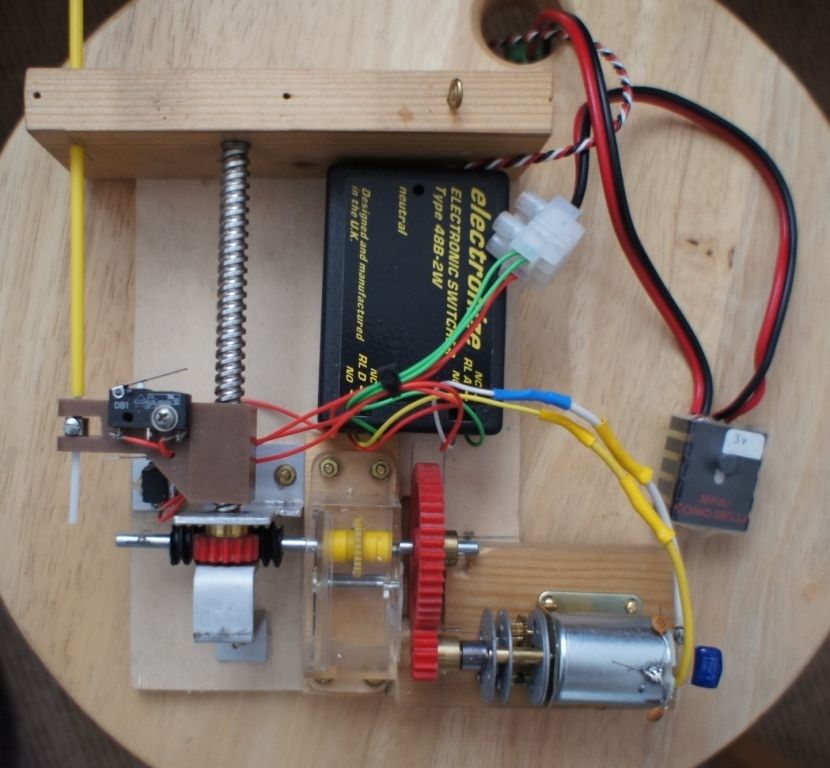
              I used micro switches and a two way switcher from Electronize to cut the motor power when the travel had reached the required distance. This was a wormed shaft and the end point was not critical to the nearest millimetre.

              Sea crusader ramp mechanism 1

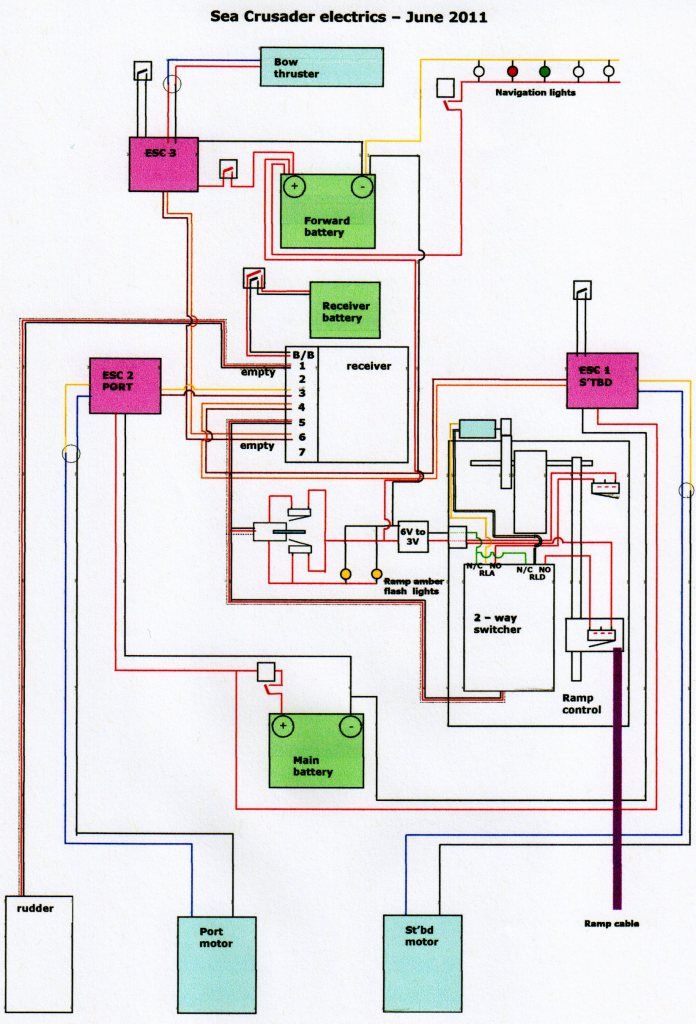
              This is the unit in position, and here's the wiring diagram (which I writ so it's not using correct symbols) but you should be able to follow the circuit through. Note there are no diodes, which I'm told ought to be installed to stop sparking and to ensure that the current flows only in the desired direction. My unit used a 3V motor, so voltage is stepped down from 6V, and after 4 years it still works.

              Sea Crusader electrics

              The unit wiring is on the right of the diagram, labelled at its lower right corner as "ramp control". The switcher enables the motor direction to be reversed, by swapping the polarity.

              Hope it gives you some ideas.

              Kim.

              Edited By Kimosubby Shipyards on 25/07/2014 09:40:48

              Edited By Kimosubby Shipyards on 25/07/2014 09:42:55

              Edited By Kimosubby Shipyards on 25/07/2014 09:43:35

              #50648
              Dave Milbourn
              Participant
                @davemilbourn48782

                Dave
                Just to clarify matters; my understanding from your description is that you want this motor, once switched on, to continue running from one end to the other and then back again ad infinitum (or until it is switched off manually). There will be no radio-controlled starting and stopping at any point as in Kim's suggestion. I don't know what application you have in mind; it might help if you could explain that and also provide the value of the current drawn by the motor. I have in mind one of these gizmos with two microswitches **LINK** and a toggle switch to isolate the whole circuit from the battery.

                Kim
                Glad to hear you've said your Hail Mary's. We have certain standards to maintain, you know.
                DM

                #50658
                Telstar
                Participant
                  @telstar

                  Hi Cookie I have, or can draw, a circuit that no matter where the screw platform is, when switching on of the isolator/battery switch, the motor will drive the platform to one end (always the same end). When the platform reaches that end and touches the microsw. the motor will reverse and run in the opposite direction until it touches the other microsw. when the cycle starts again ad. infinitum. It will use a 4 pole change over relay and 2off microsw. The motor volts need not be the same as control circuit voltage. No electronics involved.

                  Is this the kind of thing you need?

                  Cheers Tom

                  Dave Not trying to steal your Trade wink 2  Tom

                  Edited By Telstar on 25/07/2014 14:05:34

                  #50660
                  Dave Milbourn
                  Participant
                    @davemilbourn48782

                    Tom

                    I could have written it myself………….. almost! I'd be interested in seeing your solution.

                    Dave

                    #50664
                    shipwright
                    Participant
                      @shipwright

                      Use a latching relay (eg Omron G2RK-2 DPDT) and 2 microswitches. The relay state is retained even though power is removed from the coil. There are variants but the G2RK has 2 coils – one for "set" and one for "reset". A momentary application of voltage to a coil (approx. 20 msec minimum) will set or reset the changeover contacts. I expect these relays are available from several suppliers but I know that they are available from Farnell at £6-60 each but note that they will impose a minimum order value (not sure but I think it is £25) and there will be a charge for postage and packing.

                      **LINK**/omron-electronic-components/g2rk25dc/relay-dpdt-3a-latching-5v/dp/2213735

                      Ian

                      #50677
                      Dave Milbourn
                      Participant
                        @davemilbourn48782

                        Here's the circuit from me and Malcolm Frary, using the relay in my earlier link:

                        cookie ver02.jpg

                        #50682
                        shipwright
                        Participant
                          @shipwright

                          I should have waited for Dave's response ! I just carried out an experiment with a latching relay, small MFA motor and a couple of "push to make" switches (these because I don't have spare microswitches amongst my components). It works as expected. I actually used a very small latching relay (2 Amp rating) from Maplin :

                          **LINK**

                          **LINK**

                          If your motor exceeds 2 amps you will have to use a latching relay with a higher current rating.

                          Ian

                          #50687
                          Telstar
                          Participant
                            @telstar

                            Hi Dave A rough sketch of circuit

                            image2.jpg

                            M/s1 is n/c

                            M/s2 is n/o

                            Control voltage to suit coil on relay Diode is not essential

                            Relay pole’s all operate together

                            On switch on, relay is not energized. Motor will run towards M/s2 (if not reverse motor connections)

                            On reaching M/s2, the switch will operate energizing relay coil

                            Motor will now run the other way, relay pole1 will latch the coil energized .

                            On reaching M/s2, the switch will open deenergizing the relay reversing the motor once more

                            Possable relay **LINK**

                            Tom

                            #50691
                            Dave Milbourn
                            Participant
                              @davemilbourn48782

                              Farnell's handling charge for orders less than £20 (excl VAT) is £3.95. Over that it's free delivery.
                              DM

                              #50694
                              Malcolm Frary
                              Participant
                                @malcolmfrary95515

                                If anybody's wondering what the "extra" components are for, they are intended to act as spark quenchers to max out the life of the relay contacts, which will be switching a running motor. Even a small one (and we have no idea yet what motor is intended, or what it is actually going to do) can generate a fearsome amount of back-emf and do horrible things to relay contacts.

                                #50696
                                Telstar
                                Participant
                                  @telstar

                                  Malcolm The resistor, capacitor circuit is as you say a switching transient damper (spark quencher)teeth 2 while the resistor in series with the motor is to try to reduce the 'starting surge' as the motor reverses

                                  I agree that instantly reversing the motor will give problems especially if the motor current is near the max.relay contact current, but to build in 'time' for the motor to stop before reversing could get complicated.

                                  Tom

                                  #50698
                                  Malcolm Frary
                                  Participant
                                    @malcolmfrary95515

                                    The problem with not knowing what the actual power requirements are gives a problem with shopping for parts. If power use is to be minimized, the polarized two coil relay is a clear winner since it only needs a brief pulse to change state, but only up to the limits of what its contacts can switch. The conventional relay with the self latching circuit probably uses a cheaper relay, but at the cost of spending half its duty cycle switched on and drawing current. Yer makes yer choice and yer pays yer money.

                                    #50700
                                    Dave Milbourn
                                    Participant
                                      @davemilbourn48782

                                      Cookie

                                      I think we've gone as far as we can without knowing what motor you're going to use; what voltage, and what sort of current the motor draws. Until we have this information then anything else posted here will be just whimsy.

                                      Dave M

                                      #50710
                                      CookieOld
                                      Participant
                                        @cookieold

                                        hi All, thanks for all the feed back sorry i should have been more precise about the application i intend to use this on . I want to use this as a means to lower the transom flap on my big Perkasa . I have designed all the mechanics and it works fine , I intended to use a MFA motor & gearbox with male & female threads to push the flap down and the fact it is a gearbox it will work as a brake to hold it when it is in the lowered position as the water will try and push it back up . When lowered i wanted the mechanism to hit a limit switch and kill the power to the motor so i could then move my remote stick the other way to reverse the flap back to level . I would love to put my CAD drawing on for you to see but i have not figured out to do it yet.

                                        Cheers Lads Dave yes

                                        #50713
                                        Dave Milbourn
                                        Participant
                                          @davemilbourn48782

                                          See drawing "Limit Switches" – top diagram (P44). Your original description was quite a lot different from this one.

                                          **LINK**

                                          DM

                                          #50743
                                          Kimosubby Shipyards
                                          Participant
                                            @kimosubbyshipyards

                                            Ah,

                                            can I now say my system does what the client requested – or should I go away? And its an MFA 3V geared motor! Glad you accepted my apology DM, I knew the sight of one would offend.

                                            Not sure your link goes to correct page, "top diagram (P44)" limit switches.

                                            Kimmo

                                            #50745
                                            CookieOld
                                            Participant
                                              @cookieold

                                              Hi Dave & Kimosubby , Thanks lads i know how to sort this now ,

                                              PS . Sorry Dave if i have P***** you off with my lack of info in my first post.

                                              yes

                                              #50748
                                              Dave Milbourn
                                              Participant
                                                @davemilbourn48782

                                                Kim
                                                The link will take you to a list of wiring diagrams. Scroll down to the one entitled "Limit Switches" and click on it. I have to admit that your solution was closer than mine (and Tom's and Malcolm's and Shipwright's), but that was because we were trying to do what was originally requested. I'll give you 4/10 for a good stab in the dark!
                                                Dave M

                                                #50754
                                                CookieOld
                                                Participant
                                                  @cookieold

                                                  Hi Dave , Will the P44 be OK on 12V ,If so i will get one on order.

                                                  Thanks Daveyes

                                                  #50760
                                                  Telstar
                                                  Participant
                                                    @telstar

                                                    Of course there is a non-electronics solution to this requirement. Using a standard servo to operate 2 micro switches to give Off neither switch pressed, Forwards micro switch ( 1) pressed and Reverse micro switch (2) pressed.

                                                    2 other mrcroswitches used as limit switches are used to stop the over travel ( by moving the servo to center at any time the carriage will stop where it is) The Diodes will allow the motor to be "backed off" the limit switchmbrevers sw025.jpg

                                                    All switches are shown in their normal ie not pressed position, and the diodes must be capable of carrying the motor current 

                                                    Also the circuit is not voltage  critical

                                                    Tom

                                                    Edited By Telstar on 28/07/2014 15:58:57

                                                    #50761
                                                    Kimosubby Shipyards
                                                    Participant
                                                      @kimosubbyshipyards

                                                      Found it Dave,

                                                      I didn't look very hard did I… 4/10 thats about my average mark, just scraping a pass. More of a flash in the pan!

                                                      Kim (must get round to adding those diodes to the circuit, just looked and I have about 30 in the drawer, so must have been told before and got some.)

                                                    Viewing 25 posts - 1 through 25 (of 27 total)
                                                    • Please log in to reply to this topic. Registering is free and easy using the links on the menu at the top of this page.

                                                    Code of conduct | Forum Help/FAQs

                                                    Latest Replies

                                                    Home Forums All things floating Topics

                                                    Viewing 25 topics - 1 through 25 (of 25 total)
                                                    Viewing 25 topics - 1 through 25 (of 25 total)

                                                    View full reply list.